


What Citigroup Holders Saw Early, And Where That Argument Is Live Now
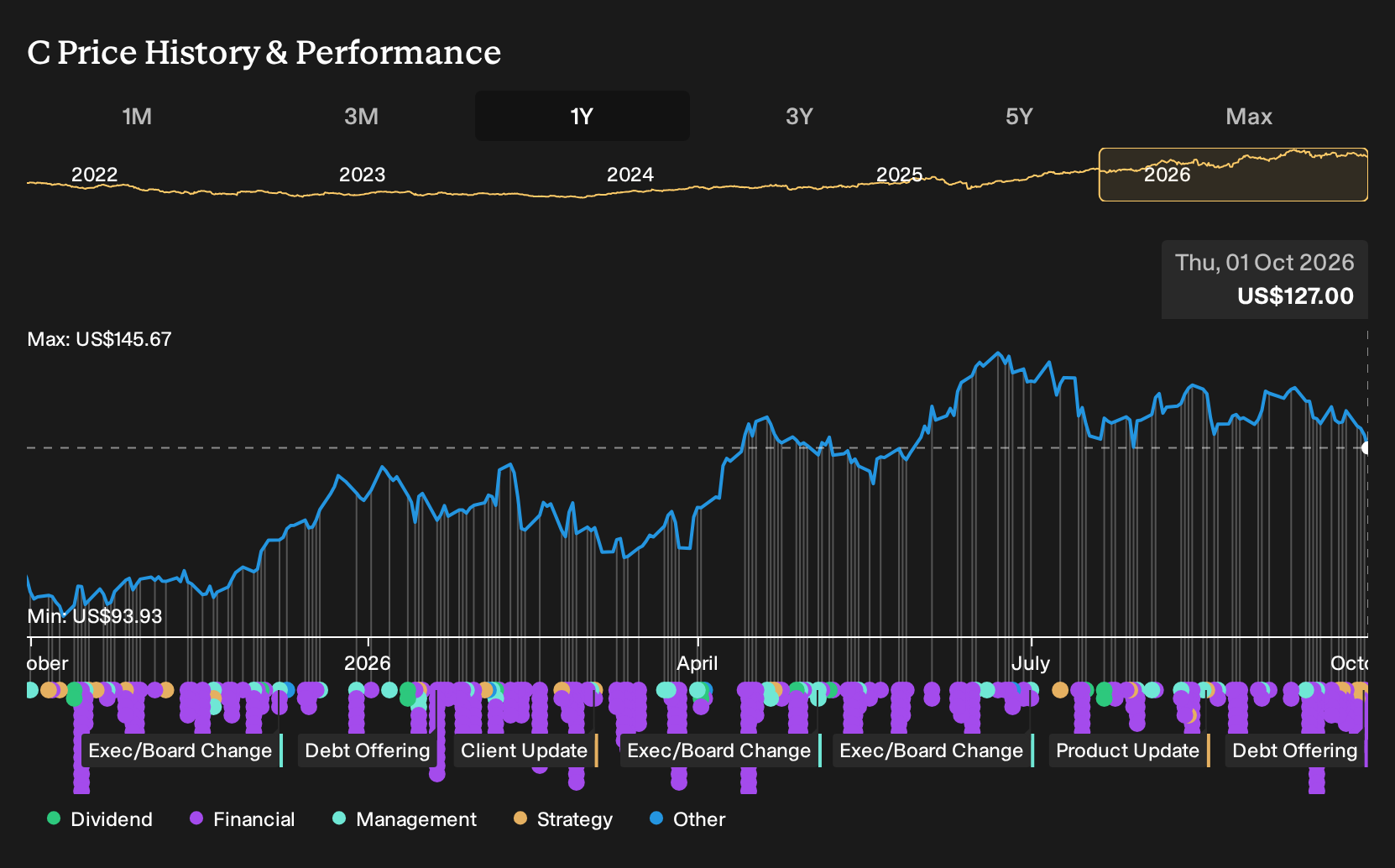
If you only skimmed Citigroup headlines this year, the eye catcher might have been the record Q2 2026 revenue and the decision to ramp a multi year US$30b buyback. Holding Citigroup over the past year would have returned 33.2%, including dividends. If you were weighing a purchase back on 1 October 2025, what did you need to believe about digital assets, cost cuts and capital returns before those blowout quarters hit the tape?
If the move has made Citigroup harder to judge, start where the gap is still open and scan 27 high quality undervalued stocks.
The Two Citigroup Stories Investors Had To Choose Between
The shares cost US$98.71 at the start of the period, and Citigroup investors were effectively choosing between a digital assets springboard story and a slower, grind-it-out restructuring story.
On the bullish side, the GENIUS Act pitch said a Fair Value of US$233, a price implied by its own assumptions, if Citi converted stablecoin regulation and Citi Token Services into 6.0% revenue growth and a 34.0% profit margin over a 10 year stretch.
The bearish script pointed to a Fair Value of US$77, assuming heavy macro sensitivity, transformation costs and regulatory or credit risk could limit any upside from the US$20b buyback and expense cuts.
What The Citigroup Evidence Actually Tested
Citigroup’s Q2 2026 report showed revenue of US$22,162m and net income of US$5,446m, both above Q2 2025, with net margin rising from 19.2% to 24.6%. Record Q1 and Q2 2026 performance, heavier AI use and a larger buyback leaned toward the bullish digital and efficiency story, although ongoing regulatory risk kept the cautious script alive. Overall, the evidence cut both ways.
The useful takeaway is simple. When a bank story hinges on digitisation and cost cuts like Citigroup’s did, it may be helpful to test the claim against reported net margin and the actual size and pace of buybacks rather than the share price alone.
What Citigroup’s Run Up 33% Now Prices In
Citigroup now trades at US$127, with this Narrative’s Fair Value sitting above the current price based on its own framework rather than an objective truth. The argument leans on global services, digital payments work and broad AI use as the key engines that could justify paying today’s level.
The focus then shifts to whether Citigroup can keep turning those services gains, technology driven efficiency moves and capital returns into sustained double digit returns on tangible common equity. A buyer at today’s price has to judge if that RoTCE outcome can actually hold.
"The current valuation implies that the market is not fully crediting Citigroup for its recent 13.1% RoTCE, services and wealth performance, and capital return program, which this narrative views as inconsistent with the underlying franchise position and therefore supportive for the share price."
Not everyone reads the same price the same way. → See the higher figure this Narrative lands on, and how it gets there
Citigroup And A Different Kind Of Digital Bank
Citigroup’s story leans on software, data and efficiency. Your next question is where that same playbook already runs hard.
One Latin American platform built itself around a purely digital account. Customers open, fund and manage money from a phone, avoiding physical branches.
That setup channels nearly every interaction into an app. It cuts friction, holds service costs down and lets new products appear quickly.
As more behaviour flows through that channel, its data engine strengthens. Credit models refine, cross selling improves and new markets sit as unresolved potential.
One Narrative has already put a figure on it. → Uncover the company trading 42% below one Narrative's Fair Value
This article by Simply Wall St is general in nature. We provide commentary based on historical data and analyst forecasts only using an unbiased methodology and our articles are not intended to be financial advice. It does not constitute a recommendation to buy or sell any stock, and does not take account of your objectives, or your financial situation. We aim to bring you long-term focused analysis driven by fundamental data. Note that our analysis may not factor in the latest price-sensitive company announcements or qualitative material. Simply Wall St has no position in any stocks mentioned.
Have feedback on this article? Concerned about the content? Get in touch with us directly. Alternatively, email editorial-team@simplywallst.com