


IonQ Just Scored a New ‘Buy’ Rating. What Comes Next for IONQ Stock.
Quantum computing is feeling less like science fiction and more like the next big technology race. From governments to major corporations, the push is on to develop useful quantum systems before competitors get too far ahead. Naturally, investors are beginning to hunt for potential winners, and IonQ (IONQ) keeps finding its way into that conversation.
IonQ has been making plenty of moves of its own. Through a string of acquisitions, the company has been building a broader quantum platform spanning computing, networking, security, sensing, space, and semiconductor manufacturing.
That strategy is now getting fresh Wall Street validation. Bank of America just initiated coverage with a “Buy” rating and a $60 price target. Analyst Vivek Arya pointed to IonQ’s expanding product lineup, customer relationships, and in-house manufacturing capabilities as key reasons for the bullish view.
IONQ stock has also been picking up momentum lately. So, with Wall Street turning more optimistic, can the rally keep going? Let's take a closer look.
About IonQ Stock
Founded in 2015, IonQ has grown into one of the better-known pure-play quantum computing companies, built around its proprietary trapped-ion technology. Headquartered in College Park, Maryland and valued at roughly $16.7 billion, IonQ provides cloud-based access to its quantum systems through platforms including Amazon's (AMZN) AWS, Microsoft (MSFT) Azure, and Alphabet's (GOOGL) Google Cloud.
IonQ’s technology has roots in decades of academic research at the University of Maryland and Duke University. Since then, IonQ has broadened its capabilities through acquisitions, adding expertise in qubit control, quantum sensing, and navigation.
Today, IonQ’s ambitions extend beyond quantum computing. The company is developing technologies spanning quantum networking, cybersecurity, sensing, and space-based infrastructure. With solutions reportedly reaching more than 50 countries across six continents, IonQ is building a broader presence in the emerging quantum technology ecosystem.
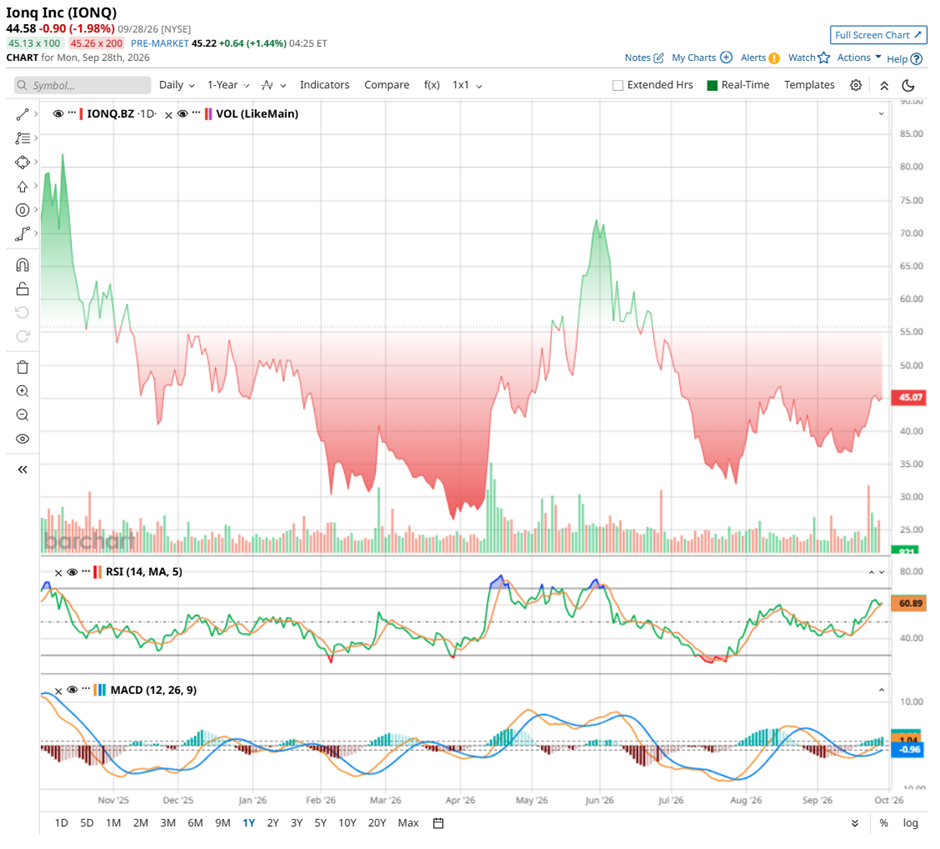
If there is one thing IONQ stock has not been in 2026, it is boring. Shares have bounced between sharp selloffs and bursts of optimism, reflecting just how quickly investor sentiment can change around quantum computing.
The year got off to a rough start. Investors were generally pulling back from higher-risk tech names, while IonQ faced some company-specific concerns. Growing losses, potential future share dilution, and intensifying competition all weighed on sentiment. By the end of March 2026, IONQ fell to a 52-week low of $25.89.
The selling pressure returned in July, when concerns over lofty valuations across the quantum-computing space hit the sector. IonQ was among the stocks caught in that pullback, with some market commentary highlighting the industry’s extremely high price-to-sales (P/S) multiples and speculative nature. The arrival of IQM Quantum Computers (IQMX) on the Nasdaq added a wrinkle, giving investors another publicly traded option for quantum exposure.
Then the mood started to change. IonQ’s strong second-quarter results and higher full-year revenue guidance in August helped the stock regain its footing. More recently, the company has given investors even more reason to take notice. On Sept. 23, IONQ stock edged higher after the company announced a partnership with Nvidia (NVDA) to deploy its quantum computer at Nvidia’s Accelerated Quantum Research Center. The collaboration combines IonQ’s trapped-ion technology with Nvidia’s CUDA-Q platform. IONQ stock also received a boost after IonQ unveiled an end-to-end, real-time quantum error-correction decoder capable of running on a single standard CPU. The technology is designed to remove decoding delays.
All of that has sparked a powerful rebound. IONQ stock is now up 71% from its March low and up 60% over the past six months. Shares have also gained 18% in the past month. Still, the comeback has not erased earlier damage. IonQ remains 48% below its 52-week high of $84.64 and is down 29% over the past year.
Technically, momentum has improved. The 14-day RSI is around 60, pointing to positive momentum without yet signaling overbought conditions. Meanwhile, the MACD line has crossed above the signal line, while the histogram has turned positive, suggesting that buying momentum is strengthening.
IONQ stock is not exactly cheap. The stock is priced at 128 times sales, which is well above the sector average. With profitability still deeply negative, investors are essentially paying a hefty premium for future growth while IonQ continues pouring money into expanding its quantum-computing business.
IonQ’s Q2 Revenue Jumps, But Losses Deepen
IonQ reported its Q2 fiscal 2026 results on Aug 5, delivering its fifth consecutive quarter of record results. Revenue reached $80.1 million in Q2, a stunning 287% year-over-year (YOY) increase. The figure came in above both the guidance and analysts’ expectations, helped by IonQ Tempo deployments, strong cloud utilization, and broader demand across the company's quantum platform. About 50% of Q2 revenue was international, 60% came from commercial customers, and 25% came from multi-product customers, suggesting the revenue base is becoming more diversified.
Meanwhile, remaining performance obligations (RPO) reached $485 million in Q2, up from $470 million in Q1 and $122 million a year earlier. That means new contracts more than replaced the revenue recognized during the quarter. Notably, potential business connected to IonQ’s agreements with Anduril and Sandia National Laboratories was not yet included in RPO, as those relationships remain in early stages.
Of course, rapid growth is coming with heavy spending. IonQ posted an adjusted EBITDA loss of $120.3 million, up from a $36.5 million loss a year earlier. That included $24.7 million in R&D costs tied to its commercial relationship with SkyWater. Excluding that expense, the adjusted EBITDA loss would have been $95.6 million. Adjusted loss per share also widened to $0.33 from $0.08 a year ago.
The good news is that IonQ has plenty of financial firepower to fund its ambitions. The company ended June with $3 billion in cash, cash equivalents, and investments. On a pro forma basis after the SkyWater acquisition, that figure was $2 billion. IonQ also has no debt. Management says the balance sheet gives IonQ room to develop its 256-qubit and 10,000-qubit systems while expanding manufacturing and global deployments.
Looking ahead, IonQ raised its 2026 revenue outlook to $280 million to $290 million, while maintaining expectations for 100% organic YOY growth. Importantly, that forecast does not include any contribution from SkyWater, leaving potential room for additional revenue once the acquisition begins contributing.
Analysts tracking IonQ anticipate revenue to be around $455 million in fiscal 2026, but the path to profitability remains challenging. Loss per share is projected to widen 16% YOY to $2.11 in fiscal 2026, then widen another 7% to a loss of $2.26 in fiscal 2027.
What Do Analysts Expect for IonQ Stock?
Wall Street’s view of IonQ is getting more interesting. Bank of America recently joined the conversation, initiating coverage with a “Buy” rating and a $60 price target. Analyst Vivek Arya sees IonQ’s recent acquisitions as more than just a way to expand its technology portfolio. In Arya's view, the deals have accelerated the company’s quantum-computing roadmap while opening up more opportunities.
The SkyWater acquisition is particularly important to that thesis. Completed in July, the deal has brought semiconductor fabrication and advanced packaging capabilities in-house, giving IonQ greater control over the manufacturing process and its future quantum chips.
Arya also highlighted the company's Superion 256 system, which combines Oxford Ionics’ electronic qubit control technology with SkyWater’s fabrication and packaging capabilities. IonQ says the system is designed to replace much of the optical complexity traditionally associated with quantum computing and is now available to order, with “first customer deliveries expected in 2027.” That progress is giving analysts more to work with as they assess whether IonQ can turn its technological advances into meaningful commercial growth.
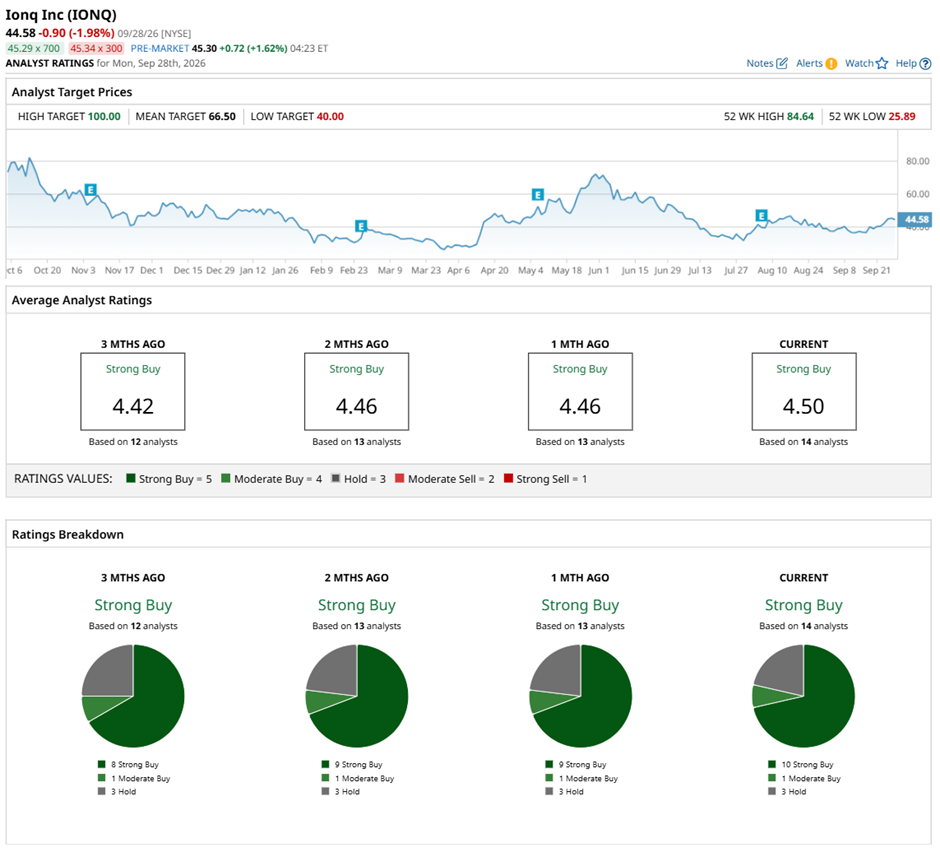
IONQ stock has a consensus “Strong Buy” rating overall. Out of the 14 analysts covering the stock, 10 advise a “Strong Buy,” one recommends a “Moderate Buy” rating, and three analysts have a “Hold” rating.
Analyst expectations for IONQ stock are anything but uniform, with price targets ranging from $40 to $100. That spread shows just how much uncertainty still surrounds quantum computing. Still, the average price target of $66.50 points to roughly 50% potential upside from current levels. At the bullish end, the $100 price target suggests IonQ could rally as much as 126% from here.
On the date of publication, Sristi Suman Jayaswal did not have (either directly or indirectly) positions in any of the securities mentioned in this article. All information and data in this article is solely for informational purposes. For more information please view the Barchart Disclosure Policy here.