


Awa Bank (TSE:8388), Why Is It Getting Attention Today?
Awa Bank (TSE:8388) has released higher earnings guidance for the year to March 2027, along with a planned dividend increase, a 5-for-1 share split, and a new regional alliance.
Awa Bank's raised guidance and regional alliance news have arrived alongside strong recent momentum, with a 30 day share price return of 14.38% and a 90 day gain of 48.21%, while the 1 year total shareholder return of 215% and very large 5 year total shareholder return suggest the market has already been reassessing both its earnings potential and its perceived risk profile.
Compare Awa Bank's momentum and guidance upgrade with a hand picked group of 17 high quality undervalued stocks that also pair earnings power with balance sheet strength.
Awa Bank has moved fast on guidance, dividends and capital actions. The real question now is whether you commit after this surge or wait for the valuation to cool off first.
Preferred P/E of 24.7x for Awa Bank: Is it justified?
The rally in Awa Bank now lines up with a P/E of 24.7x, which is higher than both its peer group at 18.5x and the broader JP Banks industry at 16.2x. At a last close of ¥2,235, the question for anyone looking at the stock is whether that premium reflects earnings quality and momentum or simply exuberance after a very strong share price run.
The P/E ratio compares the share price to earnings per share. For a lender like Awa Bank, it effectively shows how much investors are willing to pay today for each unit of profit that the franchise is currently generating. A higher multiple often signals that the market is baking in either stronger profit growth, lower perceived risk, or a mix of both.
Earnings have grown 10.3% per year over the past 5 years, with the most recent year at 28%, which exceeds that longer term pace. That acceleration, together with high quality earnings and outperformance of both the JP Banks industry and the wider JP market over the last year, helps explain why the P/E has stretched above the sector. The premium multiple means the market is placing a richer price on each yen of profit compared with peers.
The gap is wide. Awa Bank trades on 24.7x earnings while peers average 18.5x and the overall JP Banks group sits at 16.2x. That is a clear valuation premium to both direct comparables and the domestic banking sector, which signals that expectations around future profitability and risk are meaningfully higher than for the typical Japanese bank.
See what the numbers say about this price — find out in our valuation breakdown.
Result: Price-to-earnings of 24.7x (OVERVALUED).
Still, Awa Bank faces risks if earnings momentum stalls, or if the new regional alliance fails to deliver the operational benefits that investors appear to be pricing in.
Find out about the key risks to this Awa Bank narrative.
Another View on Awa Bank’s Valuation
The earlier P/E discussion presents Awa Bank as expensive. The SWS DCF model goes further and values the shares at ¥998.08 based on forecast cash flows, compared with the current ¥2,235 level. That suggests the stock may be overvalued. Which lens do you trust more when the signals conflict?
Look into how the SWS DCF model arrives at its fair value.
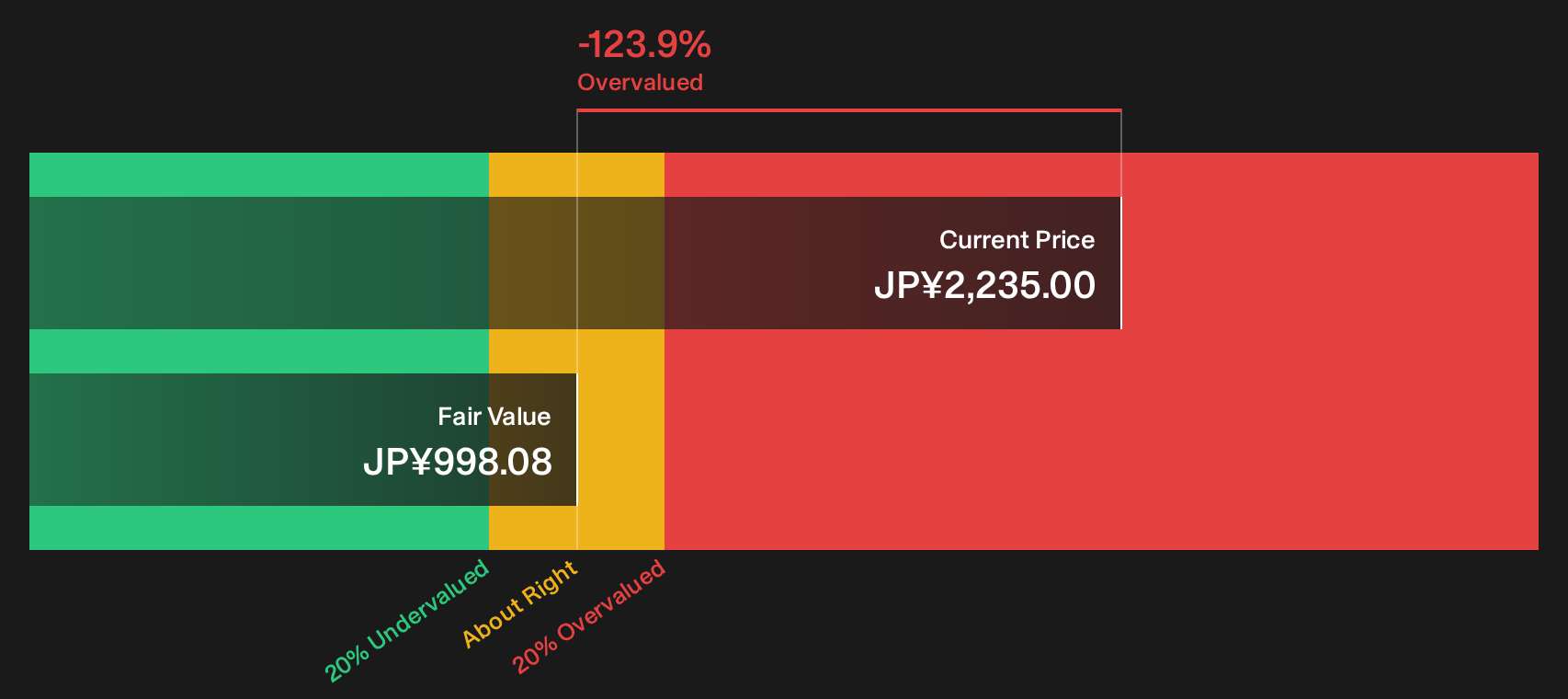
Simply Wall St performs a discounted cash flow (DCF) on every stock in the world every day (check out Awa Bank for example). We show the entire calculation in full. You can track the result in your watchlist or portfolio and be alerted when this changes, or use our stock screener to discover 17 high quality undervalued stocks. If you save a screener we even alert you when new companies match - so you never miss a potential opportunity.
Next Steps
This mix of optimism and caution around Awa Bank only matters if you use it as a starting point. Move quickly, review the full set of data, weigh the potential upside against the potential downside, and ground your view in the 1 key reward and 2 important warning signs.
Looking for more ideas beyond Awa Bank?
If Awa Bank feels fully priced to you today, broaden your watchlist with other opportunities that pair clear financial stories with focused fundamentals.
- Target potential turnaround stories with strong balance sheets by running through the 1 elite penny stocks with strong financials and see which smaller players match your risk tolerance.
- Zero in on resilient businesses that combine earnings power with measured risk using the 21 resilient stocks with low risk scores before capital chases them higher.
- Spot under-the-radar opportunities that the crowd may have overlooked by scanning the 76 high quality undiscovered gems while they still sit off most investors' radar.
This article by Simply Wall St is general in nature. We provide commentary based on historical data and analyst forecasts only using an unbiased methodology and our articles are not intended to be financial advice. It does not constitute a recommendation to buy or sell any stock, and does not take account of your objectives, or your financial situation. We aim to bring you long-term focused analysis driven by fundamental data. Note that our analysis may not factor in the latest price-sensitive company announcements or qualitative material. Simply Wall St has no position in any stocks mentioned.
Have feedback on this article? Concerned about the content? Get in touch with us directly. Alternatively, email editorial-team@simplywallst.com