


AMD Is Buying World Labs for $8.2 Billion. What This Could Mean for AMD Stock.
Advanced Micro Devices (AMD), better known as AMD, will not be left behind Nvidia (NVDA) in the AI race. By debuting Helios, its first rack-scale system, it positioned itself in direct competition with Vera Rubin. Further, Nvidia's $12.9 billion acquisition of model platform Hugging Face has been matched by AMD, which announced it will buy spatial intelligence-focused frontier model developer World Labs for $8.2 billion in an all-stock deal. Interestingly, AMD was an early investor in World Labs when it was founded in 2024.
Founded by the legendary Fei-Fei Li, often referred to as the “Godmother of AI”, AMD reckons that bringing World Labs into its fold “will bring a world-class team of researchers and model experts to AMD, strengthening its ability to develop AI hardware, software and systems around the needs of emerging models and applications.”
Notably, Li will join AMD as its Chief Scientist and Executive Vice President and will report to AMD CEO Lisa Su.
How Does World Labs Fit Into the World of AMD?
Demand for memory and energy may be the most immediate and crucial bottlenecks confronting the AI industry right now. However, access to quality data is essential for compute, and that's what a company like World Labs brings to the table for AMD. That's why Nvidia with Hugging Face, and Meta with Scale AI, paid multibillion-dollar sums for these acquisitions.
Along with data, though, what a company like World Labs brings to AMD is vast amounts of expertise and industry know-how from a veteran like Li and her team's experienced cohort of AI researchers. Specifically, the addition of Li can be a transformative one for AMD, considering her standing in the world of AI. Li is one of the most influential researchers in modern artificial intelligence, primarily because of her pioneering work on ImageNet, which helped catalyze the deep learning revolution, and her contributions to computer vision and human-centered AI.
At ImageNet, Li provided researchers with a large, standardized resource to train and evaluate visual recognition systems. Its associated ImageNet Large Scale Visual Recognition Challenge (ILSVRC) became a major benchmark for computer vision research. Her research with ImageNet and beyond has contributed to object recognition, visual understanding, cognitive neuroscience-inspired AI, and robotic learning. She was also chief scientist of AI/ML at Google Cloud, where she gained direct experience with the development and deployment of AI technologies at an industrial scale.
Thus, World Labs was an evolution of her earlier vision, where her aim was to enable AI to understand and interact with the 3D physical world. With spatial intelligence, World Labs is developing the ability of AI to perceive, generate, reason about, and interact with virtual and physical environments. Its first product, Marble, enables users to generate persistent, explorable 3D worlds from inputs such as text, images, and video. To Marble, a powerful complement in the form of Atlas was added on Sept. 1. Atlas is World Labs' next-generation multimodal world model, pretrained from scratch to work natively with text, images, video, and 3D data. Notably, by integrating Atlas into future versions of Marble, World Labs aims to extend its platform beyond 3D content creation toward more sophisticated applications in cinematic production, robotics training, and real-world simulation.
But how is AMD expected to use all this expertise and capability? Well, AMD explicitly identifies reasoning, robotics, simulation, and physical AI as areas where computing requirements are becoming more diverse. Physical AI is therefore a major part of the rationale for acquiring World Labs. Competing with Nvidia's Cosmos is also a relevant strategic consideration.
Cosmos is an established world-foundation-model platform designed to generate synthetic data, simulate physical environments, and support the development of robotics and autonomous-vehicle systems. It is integrated with Nvidia's wider software and computing ecosystem, including its simulation and model-development tools. World Labs' expertise in spatial intelligence, including its Atlas model and Marble platform, allows AMD to develop a comparable offering around world models, simulation, and physical AI, potentially integrated with AMD's own compute infrastructure and open software ecosystem.
Thus, World Labs' buyout is done with a broader goal for AMD, one that envisions the chip giant not remaining restricted to chips, but also developing broader expertise in offering full-stack AI solutions involving models, rack-scale systems, software, and networking.
Q2 Reiterates Momentum
AMD posted solid second quarter 2026 results that largely aligned with elevated expectations. Even though the share price declined following the announcement, the company once more achieved a double beat on both the top line and the bottom line.
Revenue increased 50% year over year to $11.5 billion. The data center segment generated $6.7 billion, representing growth of 107% from the previous year. Gross margins improved substantially to 54% from 40% in the prior-year period. Looking ahead, management projected third-quarter net revenue in the range of $12.7 billion to $13.3 billion, comfortably above the consensus estimate of $12.5 billion.
Earnings per share rose sharply by 246% year over year to $1.66, beating the consensus forecast of $1.62. This extended AMD’s streak of consecutive earnings beats to seven quarters.
Cash flow remained healthy, as net cash from operating activities increased to $2.4 billion from $1.5 billion in the year-ago period. Free cash flow grew 32% to $1.6 billion. The company closed the quarter with $13.1 billion in cash, well above its short-term debt of $875 million.
AMD also launched its next-generation Instinct MI400 Series graphics processing units, sixth-generation EPYC server central processing units, and Helios rack-scale systems during the quarter.
The strong rally in the shares has pushed AMD’s valuation to elevated levels. The forward P/E, P/S, and P/CF of 80.24, 19.50, and 126.27, respectively, are all substantially above the sector medians of 23.26, 3.36, and 19.44, respectively.
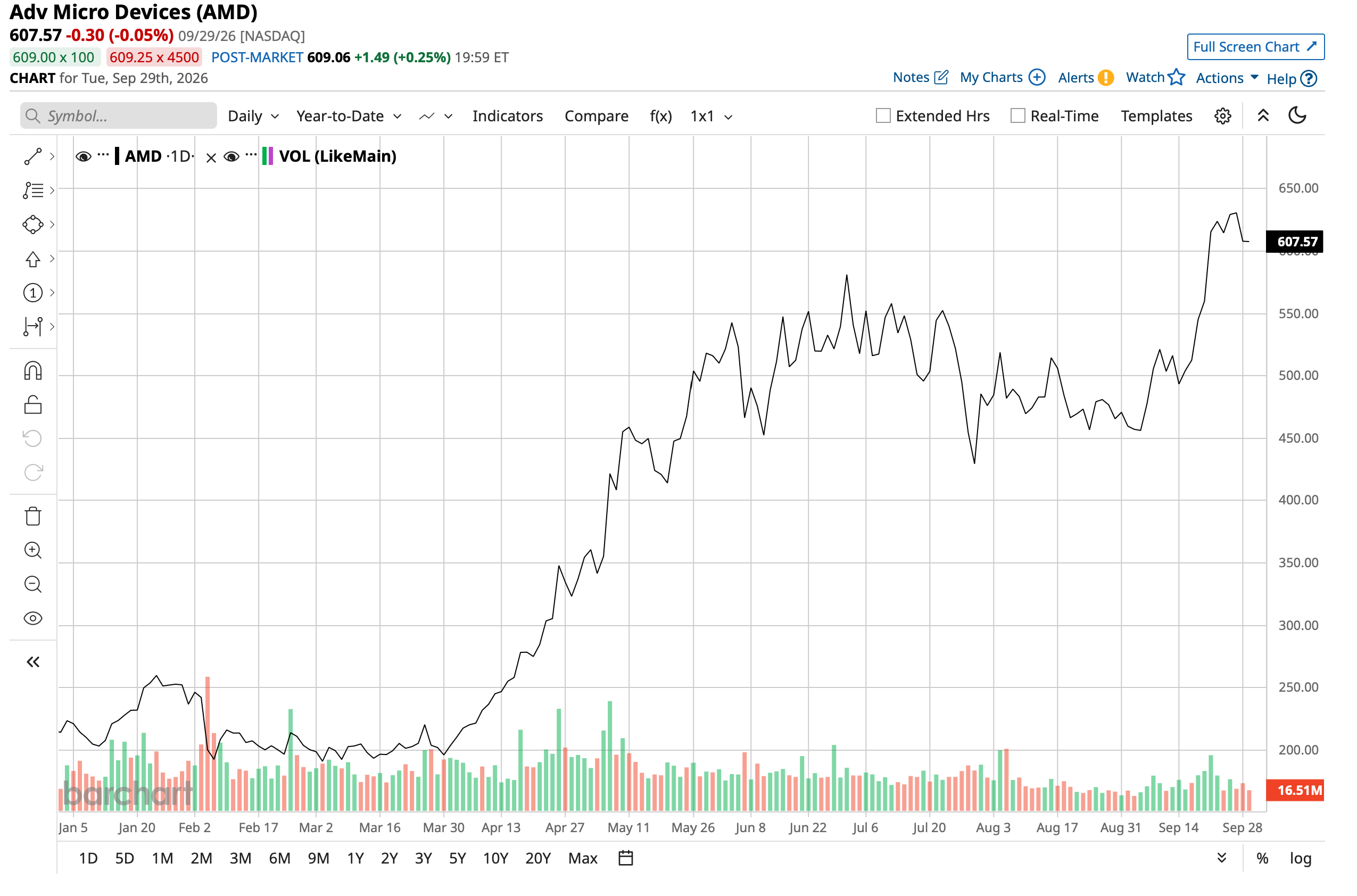
Valued at a market cap of $992.3 billion, AMD stock is up a robust 183.7% on a YTD basis.
What Do Analysts Think of AMD Stock
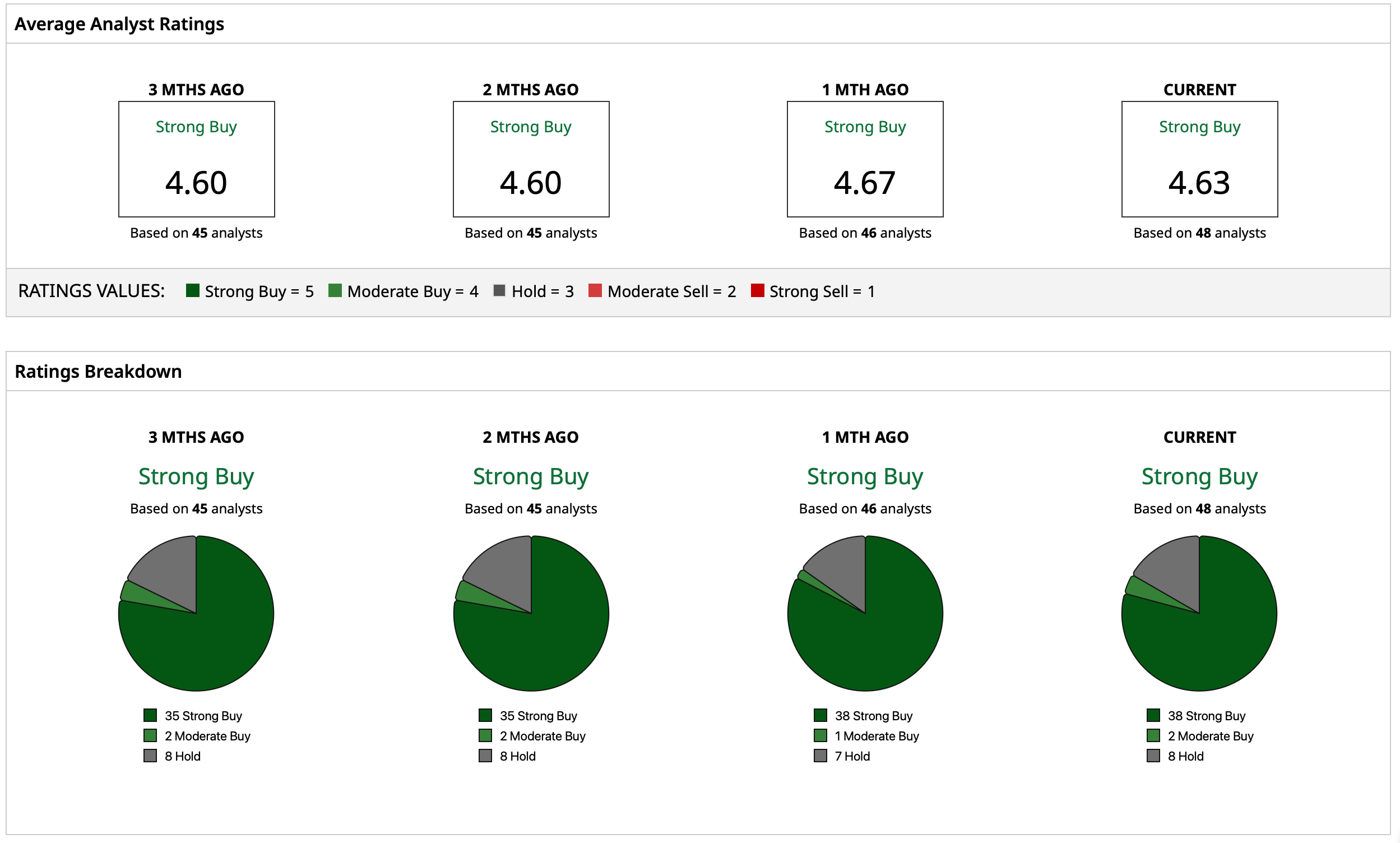
Analysts are bullish on AMD stock, and they have an overall consensus rating of “Strong Buy.” However, the mean target price of $627.79 is just 3.3% above current levels, suggesting an upward revision soon. Out of 48 analysts covering the stock, 38 have a “Strong Buy” rating, two have a “Moderate Buy” rating, and eight have a “Hold” rating.
On the date of publication, Pathikrit Bose did not have (either directly or indirectly) positions in any of the securities mentioned in this article. All information and data in this article is solely for informational purposes. For more information please view the Barchart Disclosure Policy here.