


What Is Drawing Fresh Attention To Sumitomo Electric Industries (TSE:5802)?
Sumitomo Electric Industries (TSE:5802) is back in focus after joining AFL, Corning, and TeraHop to finalize and publish the SDM4 Multicore Fiber MSA specifications for AI data centers and dense optical networks.
Recent trading backs up that story. The share price is at ¥2,352 with a 7-day share price return of 6.88% and a 30-day gain of 6.47%, even though the 90-day share price return declined 11.71%. Meanwhile, the 1-year total shareholder return of 128.62% and a very large 5-year total shareholder return suggest longer-term holders have already seen substantial compounding.
See how Sumitomo Electric Industries fits into the broader AI infrastructure story by comparing it with a handpicked 90 AI infrastructure stocks that is shaping tomorrow's data center backbone.
After a sharp 1-year run and fresh AI tailwind headlines, Sumitomo Electric Industries still trades at a sizeable discount to both analyst targets and intrinsic estimates. Is the market’s caution on this move sensible or stretched?
Price-to-Earnings of 18.3x: Is it justified?
Sumitomo Electric Industries closed at ¥2,352 while trading on a P/E of 18.3x, and that sits well above both its auto components peers and the wider industry even as our DCF estimate suggests the shares trade below intrinsic value.
The P/E ratio compares what investors are paying today for each unit of current earnings. For a diversified manufacturer like Sumitomo Electric Industries, with exposure to automotive, infocommunications and energy infrastructure, that metric often acts as a shorthand for how confident the market is in the durability of profits rather than just the next quarter.
On one hand, the stock is described as good value relative to an estimated fair P/E of 26.1x, which implies the market is pricing earnings at a discount to where regression-based models suggest they could trade if sentiment moved closer to peers with similar fundamentals. On the other hand, the current 18.3x multiple is described as expensive versus the JP Auto Components industry average of 9.8x and a peer group on 12.1x, which points to a market that is already assigning Sumitomo Electric Industries a premium versus its closest comparables.
Explore the SWS fair ratio for Sumitomo Electric Industries.
Result: Price-to-Earnings of 18.3x (OVERVALUED).
Still, the recent 1-year surge and premium P/E leave Sumitomo Electric Industries exposed if AI data center demand cools or if capital spending cycles turn abruptly.
Find out about the key risks to this Sumitomo Electric Industries narrative.
Another View on Sumitomo Electric Industries’ Value
While the current 18.3x P/E suggests Sumitomo Electric Industries trades rich compared to the JP Auto Components sector, the SWS DCF model points the other way. On that framework, the shares at ¥2,352 sit below an estimated future cash flow value of ¥2,914.04, which frames the recent premium multiple in a different light.
The model flags the stock as trading about 19.3% under that fair value estimate. This raises the question for investors: which signal deserves more weight, the earnings multiple or the cash flow math.
Look into how the SWS DCF model arrives at its fair value.
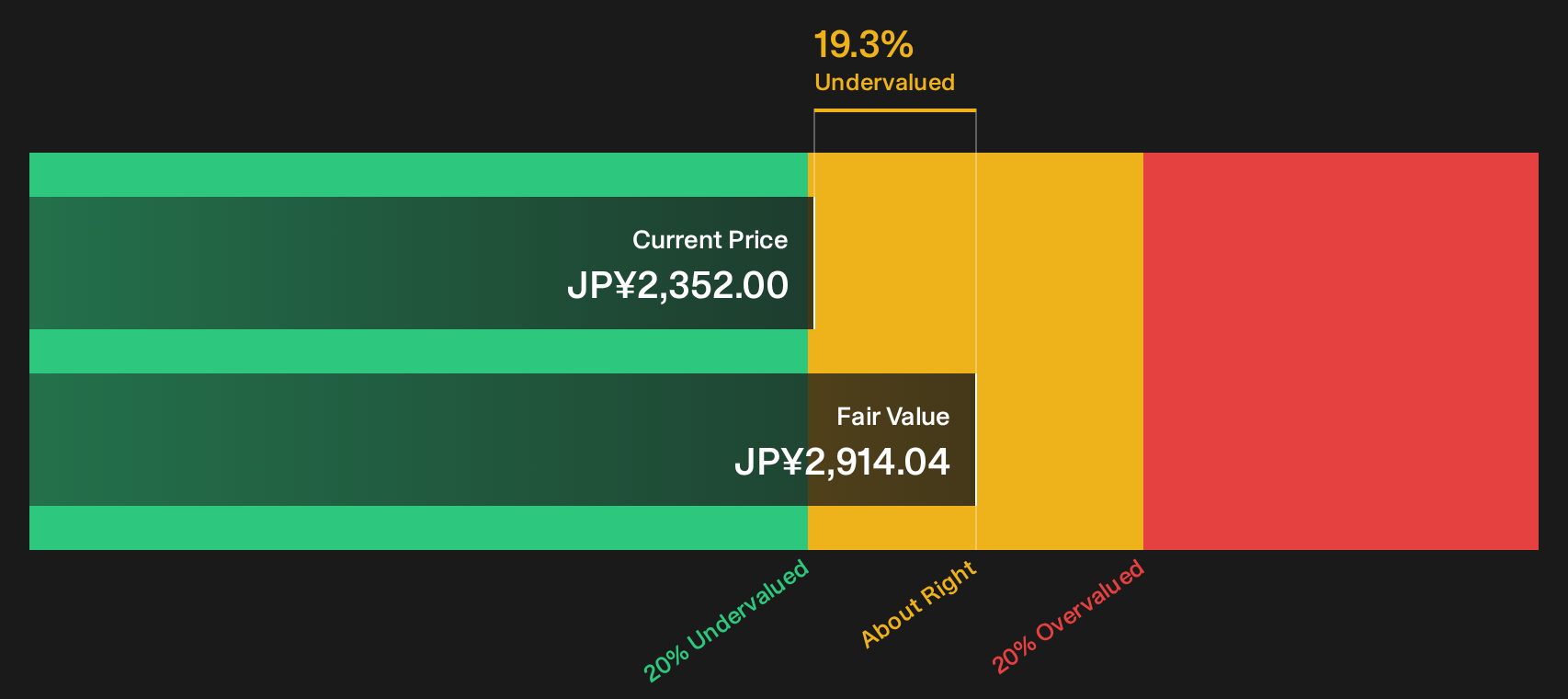
Simply Wall St performs a discounted cash flow (DCF) on every stock in the world every day (check out Sumitomo Electric Industries for example). We show the entire calculation in full. You can track the result in your watchlist or portfolio and be alerted when this changes, or use our stock screener to discover 17 high quality undervalued stocks. If you save a screener we even alert you when new companies match - so you never miss a potential opportunity.
Next Steps
Reading this, are you leaning cautious or optimistic on Sumitomo Electric Industries after such a sharp move and mixed valuation signals? Act quickly, review the underlying data, then weigh the 3 key rewards and 1 important warning sign
Looking for more investment ideas beyond Sumitomo Electric Industries?
If this Sumitomo Electric Industries move has you thinking bigger, do not stop at one stock. Broaden your watchlist with curated ideas built from hard numbers, not hype.
- Target potential mispricings early by scanning a focused set of 17 high quality undervalued stocks that pair quality fundamentals with attractive entry points.
- Strengthen your income stream by reviewing 20 dividend fortresses that aim to combine higher yields with more resilient payout histories.
- Prioritize resilience over excitement by filtering for 21 resilient stocks with low risk scores that score well on balance sheet strength and business stability.
This article by Simply Wall St is general in nature. We provide commentary based on historical data and analyst forecasts only using an unbiased methodology and our articles are not intended to be financial advice. It does not constitute a recommendation to buy or sell any stock, and does not take account of your objectives, or your financial situation. We aim to bring you long-term focused analysis driven by fundamental data. Note that our analysis may not factor in the latest price-sensitive company announcements or qualitative material. Simply Wall St has no position in any stocks mentioned.
Have feedback on this article? Concerned about the content? Get in touch with us directly. Alternatively, email editorial-team@simplywallst.com