


Whoever lays out first in the face of inflation will benefit! The global debt base racked up Australian and German treasury bonds, and the Federal Reserve and Bank of England were listed as “catchers”
The Zhitong Finance App learned that countries that have responded quickly to this year's surge in inflation are winning the favor of bond investors; those slow to act may end up paying the price with higher interest rates. Fund management institutions such as Jupiter Asset Management and Candriam are buying Australian Treasury bonds, betting that the four rate hikes since February mean that the current cycle is nearing its end. UBS Asset Management and France's Carmignac Gestion SA are absorbing German treasury bonds. It is expected that German bond yields will decline as the ECB becomes more proactive and is more capable of suppressing inflationary pressure than the Federal Reserve and the Bank of England.
The logic is that central banks that act earlier will see results sooner, thereby limiting the extent to which they need to do more. Unlike the last round of inflationary shocks in 2021 and 2022 — when they first stood still and then stepped in unison to drastically tighten policies — this year's actions were staggered. This creates opportunities for investors to bet on different paths.
“Everything this year revolves around inflation and central bank credibility,” said Jupiter Asset Management fixed-income fund manager Mark Nash. “Those who bet right will benefit.”
The transmission of monetary policy is lagging behind, so ECB austerity has not fully penetrated the real economy, which explains why inflation in Europe remains high. RBA Chairman Michelle Bullock raised this point on Tuesday, pointing out that the rate hike may take 12 to 18 months to fully take effect.
The ECB's position is the key reason Carmignac bought German 5-year treasury bonds — it favors German bonds over other developed countries' bonds. The German bond yield curve has leveled off compared to other countries in recent months. It has stabilized more than that of other members of the Group of Ten (G-10), sending a signal that future inflation expectations are cooling down.
“I separate the central banks. The ECB is on one side, and the Federal Reserve and the Bank of Japan are on the other side,” said Guillaume Ligeyard, co-head of fixed income at the French asset management company. “The ECB made it very clear around March and April. They said, 'OK, this is an inflationary shock. '”
ECB President Christine Lagarde said this week that rising bond yields will slow growth and limit the inflationary impact of high energy costs more drastically than the original forecast last month — last month the bank implemented the second rate hike since June. Policymakers need to anticipate such secondary effects as early as possible, “because by the time they appear, it will be a little too late.”
Kevin Zhao of UBS Asset Management has been buying 30-year German treasury bonds and Australian treasury bonds. His opinion is that the central bank, which began raising interest rates earlier, will need to tighten less in the future. Meanwhile, he is shorting US debt and anticipates that the AI-driven boost to the US economy will require the Federal Reserve to implement more rate hikes.
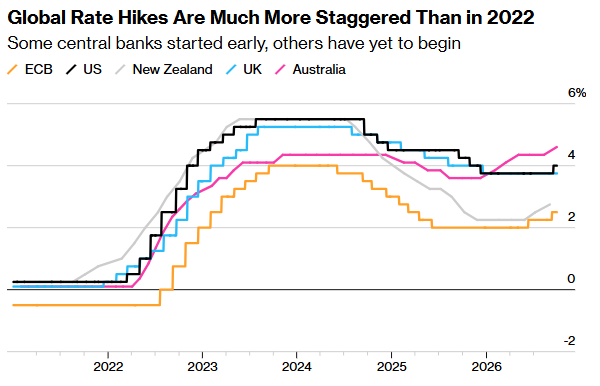
“During supply shocks, an active central bank is beneficial to invest in bonds because it reduces the risk of inflation getting out of control,” Kevin Zhao said.
With interest rate hikes this week, the Reserve Bank of Australia became the first major central bank to raise interest rates above their peak during the pandemic. Australian Treasury bonds rose after Bullock said he hoped four rate hikes this year would be enough to calm inflation.
Jupiter Asset Management's Nash has overallocated Australian Treasury bonds in all of its fixed income funds, and this week reduced his holdings to flatten the curve in favor of holding two-year products — previously the RBA hinted that it may be nearing the end of the austerity cycle. He has always been cautious about buying US bonds, believing that the Federal Reserve “will be slow” to follow the actions of countries such as Australia and Europe. Despite this, this month's bond sell-off pushed the two-year US Treasury yield to the highest level in more than two years, prompting him to buy because the market is overpricing the interest rate hikes in the next few months.
Candriam's senior fixed income portfolio manager Jamie Niven is more optimistic about Australian Treasury bonds than New Zealand and US bonds. He also cut his exposure to British treasury bonds on the grounds that the Bank of England, which has not yet raised interest rates, will have to catch up.