


Buy Upgrades Could Change The Case For Royal Caribbean Stock
- Royal Caribbean Cruises has committed about US$3b for a 50% stake in Sandals Resorts, tying its cruise network to a large all inclusive resort platform that targets similar leisure travelers.
- The Sandals joint venture links ships, resorts, and private destinations into a broader vacation ecosystem, which could influence how Royal Caribbean balances guest demand, costs, and capacity planning across both sea and land.
- This article reviews how Royal Caribbean's investment narrative is affected by the Sandals joint venture and analyst sentiment regarding execution.
Royal Caribbean Cruises Investment Narrative Recap
To own Royal Caribbean Cruises, you need to be comfortable with a travel business that still leans on resilient leisure demand, higher onboard spend, and steady booking trends to support its US$18.7b revenue base. The most important near term catalyst is whether demand and pricing on new capacity and private destinations hold up as more ships enter service.
The biggest immediate risk is a pullback in discretionary spending that hits close in bookings and on board revenue, especially with fuel, currency and debt costs already in the mix. Recent analyst upgrades do not materially change that core risk reward tension in the operating story.
The Sandals Resorts joint venture sits right in the middle of these catalysts. Royal Caribbean Cruises is tying its ships and private islands to a land based resort platform that targets similar guests, which could help support yields, onboard spend, and utilization if cross selling between cruises and all inclusive stays gains traction.
Execution risk is real. Integrating a US$3b resort investment while managing high leverage, fuel exposure and potential consumer softness asks a lot of the balance sheet and management. The recent upgrades from Bank of America and Deutsche Bank reflect confidence in that execution, but the operational proof will come from EBITDA delivery and booking trends across both sea and land.
Royal Caribbean Cruises Analyst Assumptions Behind the Sandals Deal
Royal Caribbean Cruises' Sandals venture is being weighed against a set of fairly specific analyst assumptions. Revenue is modeled to rise by 9.1% a year over the next 3 years, while profit margins move from 23.5% today to 26.2% over the same period. That profit bridge matters for Sandals, because management is now committing capital to a resort platform while analysts already expect the cruise business to carry higher margins in a few years.
Earnings are a key anchor in that story. Consensus points to profit climbing from US$4.4b today to US$6.4b by 2029, which is about a 45% increase in absolute dollar terms. Some forecasters are more optimistic, with the high end of estimates at US$7.0b, but the Sandals integration will still be judged against the US$6.4b baseline that sits underneath most models.
Share count assumptions add another layer. Analysts are baking in a 1.93% annual decline in shares outstanding over the next 3 years, so a chunk of the earnings per share trajectory comes from buybacks, not only from operating performance. That puts extra pressure on Royal Caribbean Cruises to make sure the US$3b Sandals stake earns its keep, because the balance sheet now has to support both resort expansion and capital returns.
Valuation work then links those operating estimates to the stock. The Street is using a discount rate of about 9.2% and a future P/E of 17.9x on 2029 earnings, compared with 17.6x today and an industry multiple cited at 23.6x. For investors trying to frame the Sandals joint venture, the question is less whether that resort exposure looks attractive in isolation and more whether it helps Royal Caribbean Cruises support those earnings and margin profiles without stretching the P/E any further.
Royal Caribbean Cruises' narrative projects US$24.3b revenue and US$6.4b earnings by 2029. This rests on 9.1% yearly revenue growth and an earnings increase of about US$2.0b from US$4.4b today.
Uncover why Royal Caribbean Cruises' fair value indicates a 33% potential upside to its current price, which could narrow quickly.
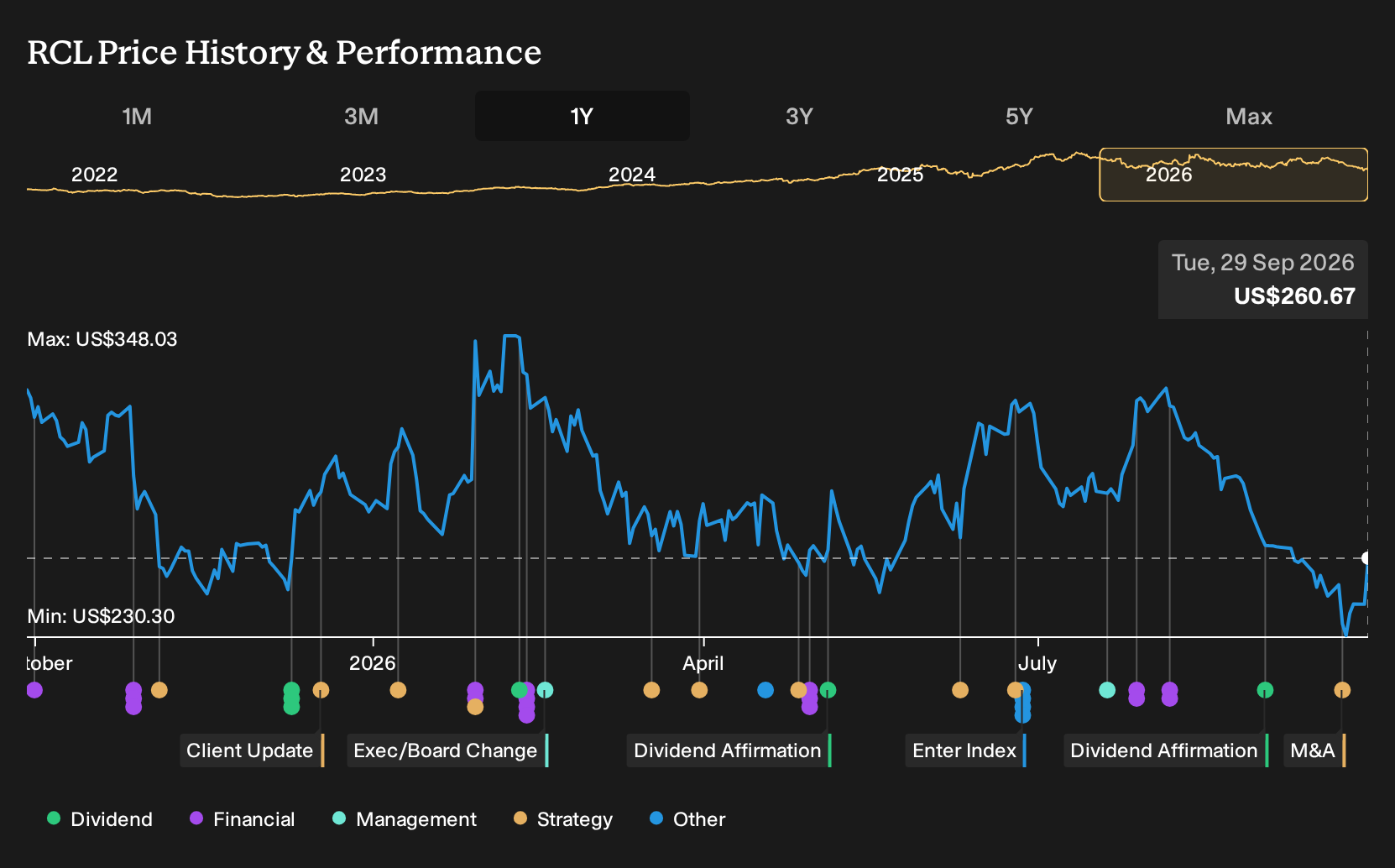
Exploring Other Perspectives
You are seeing one big swing factor that consensus plays down. The most cautious analysts lean into regulatory and climate costs, assuming revenue of about US$23.3b and earnings of roughly US$6.1b by 2029, and a lower 15.2x P/E. Those views were set before the Sandals news, so expect opinions to shift and stay curious about both stories.
Explore 5 other Royal Caribbean Cruises fair value estimates, including one that suggests it could be worth just $278.55.
Reach Your Own Conclusion
Disagree with existing narratives? Extraordinary investment returns rarely come from following the herd, so consider forming your own view.
- A great starting point for your Royal Caribbean Cruises research is our analysis highlighting 5 key rewards and 3 important warning signs that could impact your investment decision.
- See our latest analysis for Royal Caribbean Cruises. The report includes a comprehensive fundamental analysis summarized in a single visual, the Snowflake, making it easy to evaluate Royal Caribbean Cruises' overall financial health at a glance.
Looking For More Investment Ideas Beyond Royal Caribbean Cruises?
If the Sandals deal has you thinking more broadly about travel and leisure exposure, it can help to line Royal Caribbean Cruises up against other opportunities with different risk and return profiles. The Simply Wall St Screener lets you scan for businesses that match the balance sheet strength, income potential, or valuation profile you prefer before committing fresh capital.
- If capital preservation and a smoother ride matter most to you, start with 32 resilient stocks with low risk scores that aim to keep downside in check while still giving you equity exposure.
- For investors who want dependable income streams, filter for companies with sturdy payouts using a focused group of 6 dividend fortresses that already clear a 5% yield hurdle.
- When you are hunting for quality at a sensible entry point, broaden your watchlist with a curated 17 high quality undiscovered gems that pair strong fundamentals with limited market attention.
This article by Simply Wall St is general in nature. We provide commentary based on historical data and analyst forecasts only using an unbiased methodology and our articles are not intended to be financial advice. It does not constitute a recommendation to buy or sell any stock, and does not take account of your objectives, or your financial situation. We aim to bring you long-term focused analysis driven by fundamental data. Note that our analysis may not factor in the latest price-sensitive company announcements or qualitative material. Simply Wall St has no position in any stocks mentioned.
Have feedback on this article? Concerned about the content? Get in touch with us directly. Alternatively, email editorial-team@simplywallst.com