


What Fidelity National Financial Stock's FTSE Index Removal Means For Shareholders
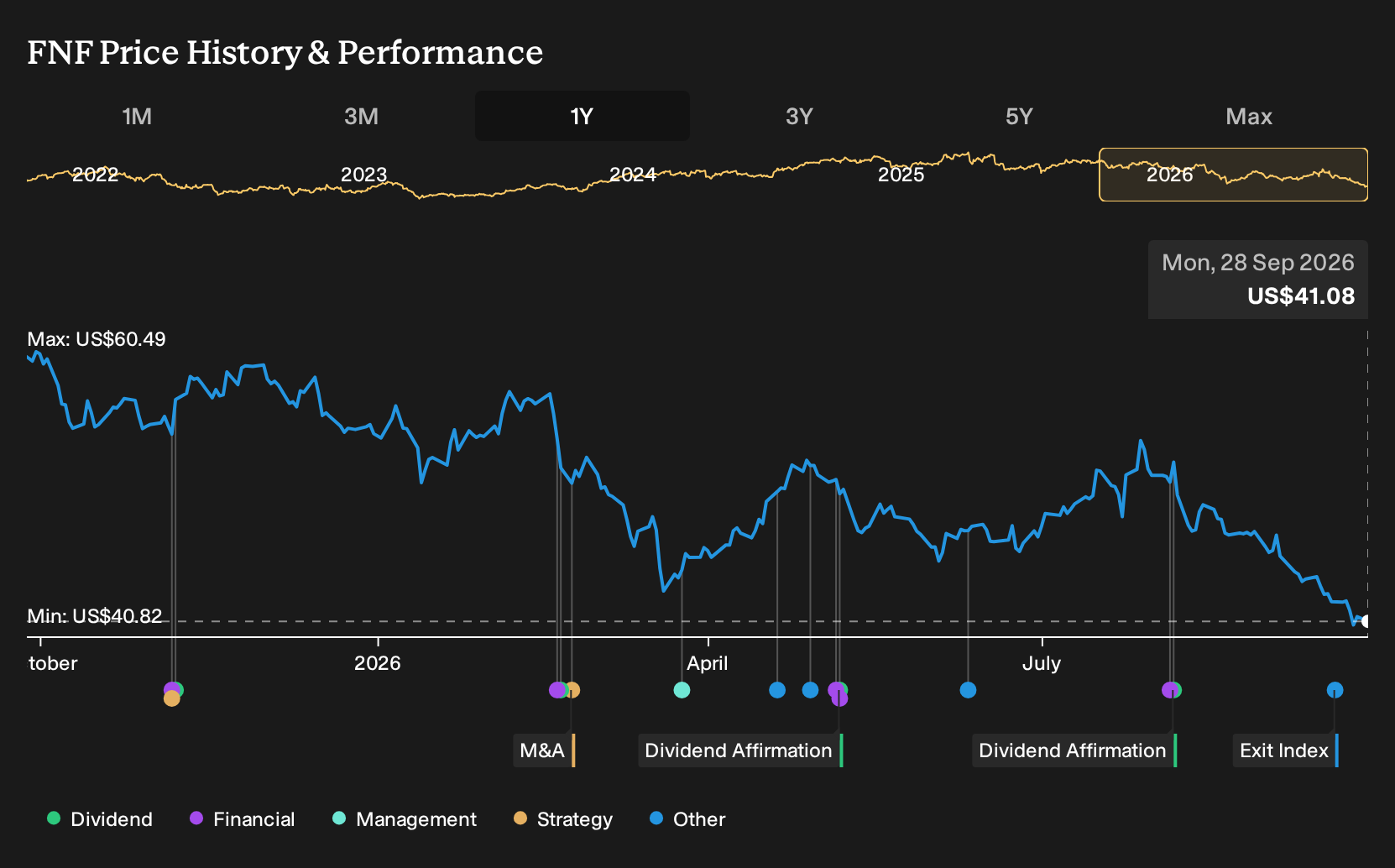
- Fidelity National Financial was removed from the FTSE All-World Index after the latest review of constituents, which can reshape how some global portfolios gain exposure to the business.
- This index exit may affect trading flows and liquidity for Fidelity National Financial, which matters for a group that relies on capital to fund technology, distribution and insurance growth initiatives.
- We will examine how Fidelity National Financial's investment narrative relates to its recent removal from the FTSE All-World Index.
Scan handpicked alternatives to Fidelity National Financial that also sit at the crossroads of capital access and quality fundamentals with the list of solid balance sheet and fundamentals (25 results).
Fidelity National Financial Investment Narrative Recap
To own Fidelity National Financial, you need to be comfortable with a title and annuity group that leans heavily on technology, AI tools and commercial activity to support earnings while residential real estate stays subdued. The short term swing factor is still how quickly residential volumes stabilize and how efficiently those digital platforms keep productivity high at today’s activity levels.
The FTSE All World removal mainly influences how some index funds trade the stock rather than what happens inside the business. The bigger near term risk remains execution. Recent revenue coming in 10.7% below expectations and profit margins sitting at 5% versus 7.9% last year keep pressure on management to translate recruiting and acquisitions into better earnings.
With no fresh corporate announcements tied directly to the index exit, the most relevant context is the existing earnings and margin commentary. Management has flagged adjusted pretax title margin compression in the second half of 2026 because recruiting and acquisition spending is front loaded. That detail matters more to operations than the benchmark change itself.
For you as a shareholder, the key link is between those investments and the catalysts already in motion. Digital tools like the inHere platform and broad AI use are intended to support mid to high teen title margins over time and offset softer residential activity. If those projects deliver the efficiency gains analysts expect, they can help counterbalance both index related selling pressure and the risk that near term margins undershoot.
Analyst Expectations Behind the Fidelity National Financial Story
Fidelity National Financial's narrative projects US$16.2b revenue and US$2.1b earnings by 2029. This implies 1.9% yearly revenue growth and an earnings increase of roughly US$1.3b from US$772.0m today.
Uncover how Fidelity National Financial's fair value indicates a 49% potential upside to its current price that could narrow quickly.
Exploring Other Perspectives
One alternative storyline around Fidelity National Financial focuses on AI integration risk rather than index flows. The most cautious analysts suggest that slower tech adoption could keep margins close to current levels, even if revenue reaches about US$16.5b and earnings approach US$2.0b by 2029. Your view might shift as index removal reactions begin to filter into those assumptions.
Explore 2 other Fidelity National Financial fair value estimates, including one that suggests it could be worth just $51.31!
Form Your Own Verdict
Don't just follow the ticker. Dig into the data and build a conviction that's truly your own.
- A great starting point for your Fidelity National Financial research is our analysis highlighting 4 key rewards and 1 important warning sign that could impact your investment decision.
- See our latest analysis for Fidelity National Financial. The report includes a comprehensive fundamental analysis summarized in a single visual, the Snowflake, making it easy to evaluate Fidelity National Financial's overall financial health at a glance.
Looking For More Investment Ideas Beyond Fidelity National Financial?
Once you have a view on Fidelity National Financial, it can help to widen the lens and compare it with other businesses that share similar qualities or offer a very different risk and reward profile. The Simply Wall St Screener is built for exactly that kind of side by side work.
- If you care most about robust finances and staying power, start with a list of solid balance sheet and fundamentals (25 results) that can handle shocks without stretching the balance sheet.
- For investors hunting for quality at a price that still looks reasonable, scan through 32 high quality undervalued stocks that combine fundamentals with room for sentiment to catch up.
- If your priority is income, focus on steady payers by reviewing 6 dividend fortresses that target yields above 5% while aiming to keep payouts supported by cash flow.
This article by Simply Wall St is general in nature. We provide commentary based on historical data and analyst forecasts only using an unbiased methodology and our articles are not intended to be financial advice. It does not constitute a recommendation to buy or sell any stock, and does not take account of your objectives, or your financial situation. We aim to bring you long-term focused analysis driven by fundamental data. Note that our analysis may not factor in the latest price-sensitive company announcements or qualitative material. Simply Wall St has no position in any stocks mentioned.
Have feedback on this article? Concerned about the content? Get in touch with us directly. Alternatively, email editorial-team@simplywallst.com