


The SpaceX (SPCX.US) starship entered orbit for the first time and completed a revenue-generating mission. Engine failure caused the mission to end prematurely
The Zhitong Finance App learned that the new-generation heavy launch vehicle “Starship” under SpaceX (SPCX.US) first entered orbit on Monday and deployed a new Starlink satellite. Despite the early termination of the mission due to engine failure, its 14th test flight still achieved landmark results.
This unmanned mission was originally scheduled to last 10 hours, but after the Starship was separated from the lower-level overweight booster, one of the three main engines shut down early, and the mission was shortened to 3 hours.
Monday's engine failure is the latest failure the Starship has experienced since the 2023 test flight. It's unclear how much impact this will have on Elon Musk's newly listed company's goal of putting Starship into regular service later this year.
Unlike previous Starship flights, Monday's mission was both a high-risk test of a next-generation rocket and an operational mission to launch a multi-million dollar Starlink satellite into orbit. This marked the Starship's first revenue-generating mission, even though its final design is still under development.
SpaceX shares fell 2% on Monday. As of last Friday's close, the company had a market capitalization of $2 trillion, and much of its market value and continued investor confidence depended on Starship's success. The Starship was designed to be the world's first fully reusable spacecraft.
After entering space, one of the Starship's three main engines shut down prematurely, causing SpaceX spokesman Dan Hoot to announce during a live broadcast that the spacecraft would not be able to enter orbit. But after a few minutes, Huth changed his mind because engineers confirmed that the spacecraft could still try to ignite other onboard engines to push it into orbit. Starship successfully completed this operation a few minutes later.
Starship in orbit for the first time: 26 Starlink V3 satellites successfully deployed
After entering orbit, the Starship deployed 26 next-generation Starlink satellites one by one at an altitude of about 269 kilometers. This is the first time the spacecraft has been deployed in orbit. “All 26 Starlink V3 operating satellites have been deployed and are operating normally,” Musk wrote on X.
“The deployment of all 26 Starlink V3 satellites into target orbit is a huge victory, particularly since it marks the first profitable commercial flight of a Starship,” said Dean Sladen, quality manager and aerospace engineer at Accu Components. “But from an engineering perspective, the real highlight was how the team handled engine failures during the ascent.”
Starship has had engine problems in some of its previous suborbital missions. This has always been a major challenge facing the project, because the engine's ability to control is critical to the rocket's mobility in space. Although engine control capability is not critical for low-orbit Starlink deployment missions, it is essential for future Starship missions to transport NASA astronauts to the Moon. On X, NASA Director Jared Isaacman congratulated SpaceX for “getting the spacecraft into orbit and managing every step of the way in a safe, responsible, and particularly inspiring way.”
The starship descended under control into the Pacific Ocean, and eventually flipped the aircraft vertically through propeller maneuvering and entered the sea with the nose facing up. When the arrow touched the surface of the sea, the flame engulfed the bottom, then overturned, and then a large fireball appeared. The company had no previous plans to recover the spacecraft from the sea and reuse it after the mission ended.
From testing to revenue generation: How Starship's entry into orbit can support a $2 trillion market capitalization
The purpose of the Starship is to launch SpaceX's Starlink satellites more frequently and carry out NASA's future lunar missions. Entering orbit is a critical milestone for any new rocket designed to launch a payload into space, yet Starship's goal has been slow to be achieved. Musk has predicted that the Starship will be put into orbit in 2022 and that satellites will be deployed in 2023.
Since 2023, Starship's previous 13 test flights have all been limited to suborbital space. This research and development program, which took nearly ten years, has so far cost SpaceX more than $15 billion. Musk has stated that he plans to eventually launch hundreds or even thousands of starship missions every year. This launch speed is unprecedented in the space field.
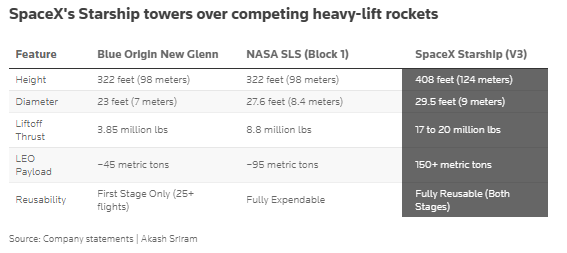
Comparison of the SpaceX Starship with other heavy launch vehicles
“The Starship is still 2 to 3 years away from flying every hour,” Musk wrote on X on Sunday.
Analysts estimate that based on the new customer capacity of the network, SpaceX's new v3 Starlink satellite launched on Monday is expected to bring the Starlink division hundreds of millions of dollars in expected revenue, highlighting Starship's supporting role in the company's core profit business. According to SpaceX, the data processing capacity of the V3 Starlink satellite deployed on Monday is 10 times that of the previous V2 mini satellite. The latter company used its main Falcon 9 rocket to launch 20 or 30 satellites at once. In order to build a broadband satellite constellation faster, Musk hopes to launch 60 V3s each time once the Starship enters regular operation.
Starship's orbital debut this time is only three months since SpaceX launched in June. SpaceX's IPO set a record, making it the sixth-largest company by market capitalization in the US and making Musk, who founded the company in 2002, the first trillionaire in the world.