


Maplebear (CART) Is Drawing Fresh Attention, What Is Behind It?
Maplebear (CART) has been busy. Within three days in late September 2026, the Instacart parent announced new partnerships with Dollar General and Gopuff that expand delivery coverage and increase its retail media presence.
Despite the flurry of announcements, Maplebear’s recent trading has been choppy, with a 30-day share price return down 14.25% and a 7-day share price return down 4.87%. At the same time, its 1-year total shareholder return of 14.29% and 3-year total shareholder return of 60.76% point to longer term momentum that has so far been more constructive than its short term price swings suggest.
Spot 33 high quality undervalued stocks that, like Maplebear, pair real operating scale with revenue, net income, and retail media momentum that the wider market may not be fully pricing in yet.Maplebear just signed two big distribution and ad partnerships while the share price slipped over the past month. That mix of new reach and recent weakness raises a simple question: Does the risk reward still tilt toward buyers here?
Most Popular Narrative: 24% Undervalued
Maplebear last closed at $43.34, while the most followed narrative anchors fair value at $57.00. The story centres on whether that gap is justified by its growth, margins, and partner reach.
Deepening enterprise partnerships and a growing suite of omnichannel retailer integrations (such as Storefront, Carrot Ads, Caper Carts, Carrot Tags) are increasing stickiness with major retail chains, creating new recurring revenue streams and driving higher margin, non transaction based revenues (e.g., advertising, in store tech). This is making the business model less volatile and supporting sustainable margin expansion and earnings resilience.
See why 20 investors see Maplebear as 24% undervalued.
Result: Fair Value of $57.00 (UNDERVALUED)
Still, the Maplebear story can break if labor rules tighten around gig work, or if retailer led delivery options pull order volumes and ad budgets away faster than expected.
Find out about the key risks to this Maplebear narrative.
Another View on Maplebear’s Valuation
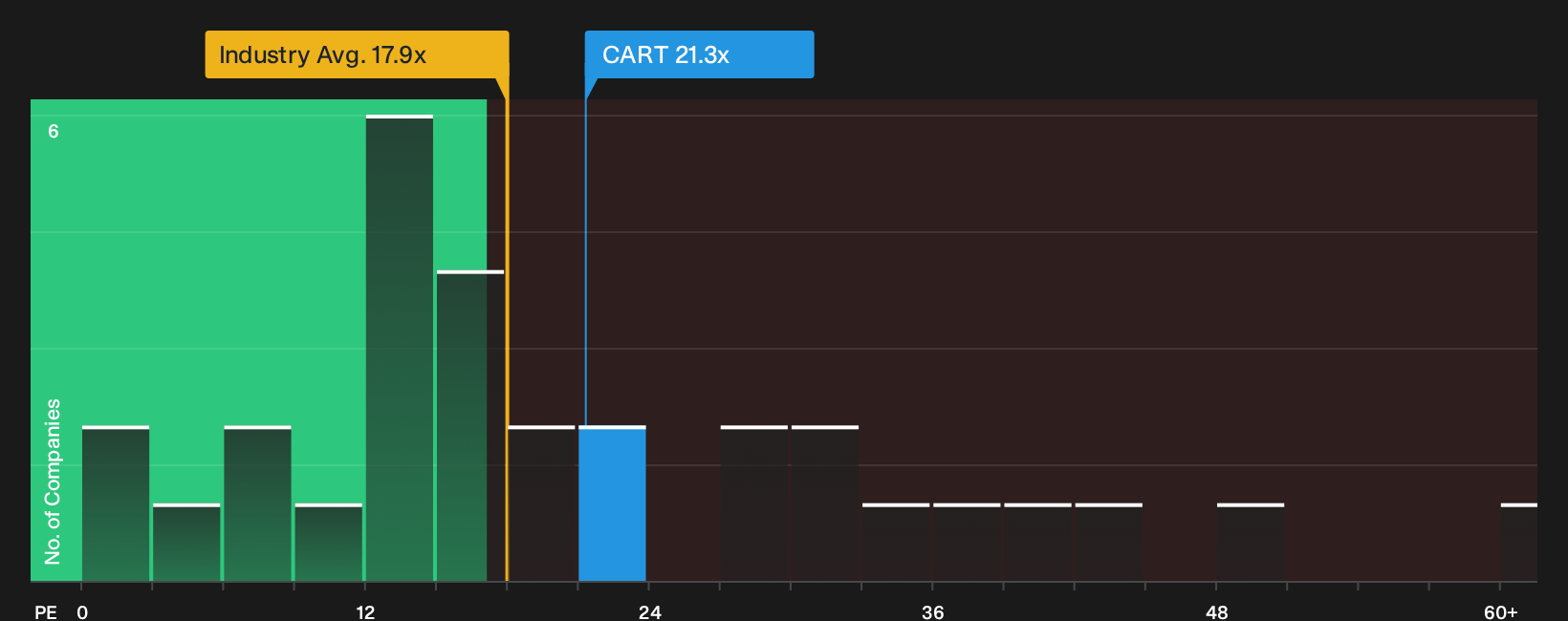
On simple earnings multiples, Maplebear looks less straightforward. The stock trades on a P/E of 21.3x, richer than the US Consumer Retailing group at 17.9x, but below a peer average of 39.9x and under the 27.2x fair ratio that SWS estimates the market could lean toward. That mix hints at upside if sentiment shifts, but also leaves less room for error if growth assumptions are too optimistic.
For a closer look at how that earnings multiple compares with fundamentals, investors can review the valuation breakdown in more detail through See what the numbers say about this price — find out in our valuation breakdown..
Next Steps
Mixed sentiment around Maplebear’s valuation and partnerships only matters if you translate it into your own decision quickly, using the full picture of risks and rewards. To weigh both sides in one place, start with 3 key rewards and 1 important warning sign.
Looking for more Maplebear sized opportunities?
If Maplebear has your attention, do not stop there. Broaden your watchlist now and give yourself more quality options before the next move arrives.
- Target potential mispricings by scanning a curated 33 high quality undervalued stocks that blend solid fundamentals with prices that may not fully reflect their financial profile.
- Focus on stability and capital strength by reviewing a list of solid balance sheet and fundamentals (25 results) that can help anchor your portfolio when sentiment swings.
- Lean into asymmetric upside by checking a 16 high quality undiscovered gems that the wider market may not be paying close attention to yet.
This article by Simply Wall St is general in nature. We provide commentary based on historical data and analyst forecasts only using an unbiased methodology and our articles are not intended to be financial advice. It does not constitute a recommendation to buy or sell any stock, and does not take account of your objectives, or your financial situation. We aim to bring you long-term focused analysis driven by fundamental data. Note that our analysis may not factor in the latest price-sensitive company announcements or qualitative material. Simply Wall St has no position in any stocks mentioned.
Have feedback on this article? Concerned about the content? Get in touch with us directly. Alternatively, email editorial-team@simplywallst.com