


How Investors May Respond To Pfizer (PFE) ESMO Cancer Data Showcase
- Pfizer will showcase data from 45 oncology research abstracts at the October 2026 ESMO Congress in Madrid, including 11 oral presentations on established medicines such as PADCEV and TALZENNA, as well as late stage candidates like atirmociclib and tivunatamig.
- The scale of Pfizer’s ESMO presence signals a strong R&D emphasis on cancer therapies at a time when the business is repositioning away from COVID products and facing pricing and competition pressure in other areas.
- We will now look at how Pfizer’s investment narrative could shift as investors weigh the ESMO oncology pipeline data against existing expectations.
Compare Pfizer's oncology pivot with other potential opportunities by scanning our hand picked list of 37 healthcare AI stocks that could benefit from similar research depth and data driven drug development.
Pfizer Investment Narrative Recap
To stay invested in Pfizer, you need to believe the pivot from COVID products to oncology, obesity and acquired franchises can offset falling COVID sales and pricing pressure. The ESMO oncology data fits that story by reinforcing where R&D spend is going, but the main near term swing factor still looks like execution on the US$9.7b cost saving plan.
The biggest operational risk remains pressure on net margins from drug pricing rules and reference models at a time when Pfizer carries high debt and a dividend that is not well covered by earnings. If oncology data disappoints or key oncology launches underperform, that pressure could intensify rather than ease.
The Most Favored Nation pricing agreement with the U.S. Department of Health and Human Services is particularly relevant here. It directly links overseas price gains to revenue sharing and runs through January 2029, overlapping with the heavy oncology investment cycle and the push to expand Seagen and Biohaven assets.
For you as a shareholder, that deal adds some policy visibility but also caps how much higher international pricing can offset U.S. pressure. The trade off is clear. Pfizer needs oncology and obesity progress, plus cost cuts, to do more of the heavy lifting, because simple price mix improvement looks more constrained under this framework.
What The Current Forecasts Assume For Pfizer
Pfizer's current analyst consensus sketches a world where oncology, obesity and acquired products carry more of the load, but the numbers behind that story matter just as much as the clinical headlines.
Analysts are working with a scenario where Pfizer's revenue is expected to decline by 5.2% a year over the next three years, while profit margins are modeled to rise from 6.8% today to 16.8% over the same period. Earnings today are put at about US$4.3b, with consensus estimates pointing to US$9.1b by 2029, and the most optimistic and pessimistic forecasts spread between US$12.5b and US$6.7b.
That shift implies roughly a doubling of earnings on the base case over the period, even as the top line is modeled to shrink in the near term. This puts a lot of weight on margin improvement and the US$9.7b cost saving plan rather than pure sales growth. It also assumes a modest 0.25% yearly increase in the share count, so per share results still depend heavily on how cleanly those savings flow through to the bottom line while Pfizer leans into oncology and obesity R&D.
On valuation, the analyst framework assumes Pfizer is trading on a P/E of about 36.3x today and would need to settle around 22.5x on 2029 earnings for the current price targets to make sense. That future multiple sits above the cited 16.2x P/E for the broader US pharmaceuticals peer group, so the stock is being treated as needing a premium based on its oncology and obesity potential plus the cost reset actually landing as planned.
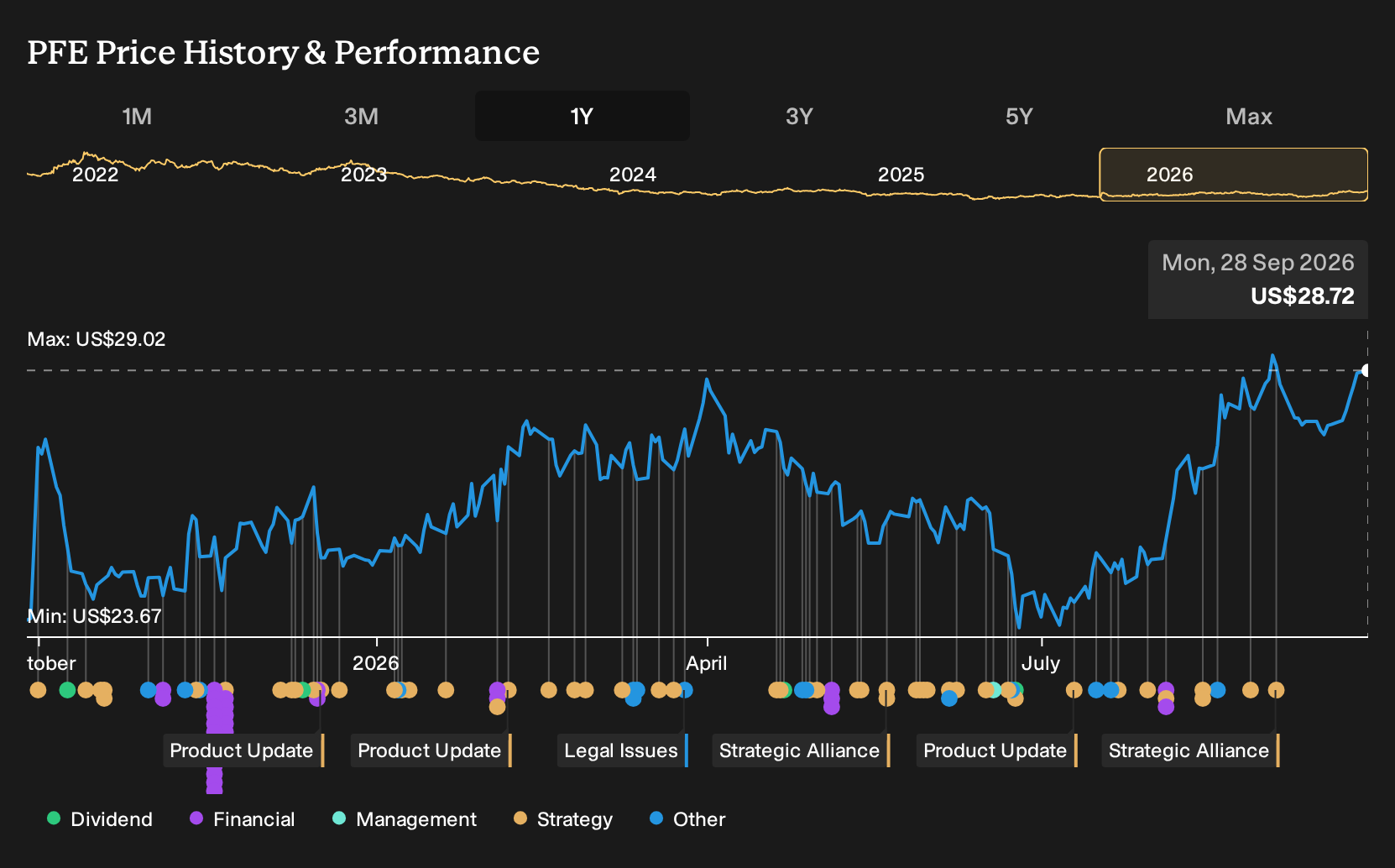
Consensus targets cluster around a US$28.88 share price, versus a current level of US$27.64, with a bullish end of US$35.75 and a bearish view of US$25. The relatively tight 4.3% gap between today’s price and the midpoint target suggests that, on these assumptions, a lot of the expected earnings progress from oncology, obesity and the Seagen and Biohaven portfolios is already baked into the market view.
Pfizer's narrative projects US$54.3b revenue and US$9.1b earnings by 2029. This builds on an assumed 5.2% yearly revenue decline in the near term and roughly a doubling in earnings from about US$4.3b today.
Uncover why Pfizer's fair value indicates a valuation gap that is approximately aligned with its current price.
Exploring Other Perspectives
You could also focus on one contrasting risk from the bearish Pfizer story. Those analysts worry that patent expiries and tighter pricing leave less room for oncology wins to help. They were modeling revenue at about US$50.6b and earnings around US$6.2b by 2029, so the fresh ESMO data could eventually push those views to shift.
Explore 10 other Pfizer fair value estimates, including one that suggests as much as 11% downside from the current price.
Decide For Yourself
Disagree with existing narratives? Extraordinary investment returns rarely come from following the herd, so go with your instincts.
- A great starting point for your Pfizer research is our analysis highlighting 2 key rewards and 4 important warning signs that could impact your investment decision.
- See our latest analysis for Pfizer. The report includes a comprehensive fundamental analysis summarized in a single visual, the Snowflake, making it easy to evaluate Pfizer's overall financial health at a glance.
Looking For More Investment Ideas Beyond Pfizer?
If Pfizer's oncology focus has you thinking about how to balance risk, income and quality across your portfolio, it can help to scan a wider universe of companies with similar or stronger fundamentals.
- For investors who want potential upside without ignoring financial strength, consider starting with a curated set of underpriced opportunities by reviewing 33 high quality undervalued stocks.
- If capital preservation and steadier profiles appeal more than aggressive growth stories, filter for steadier operators using the 30 resilient stocks with low risk scores.
- For those who care about resilient balance sheets and robust fundamentals backing their ideas, broaden the watchlist using a list of solid balance sheet and fundamentals (25 results).
This article by Simply Wall St is general in nature. We provide commentary based on historical data and analyst forecasts only using an unbiased methodology and our articles are not intended to be financial advice. It does not constitute a recommendation to buy or sell any stock, and does not take account of your objectives, or your financial situation. We aim to bring you long-term focused analysis driven by fundamental data. Note that our analysis may not factor in the latest price-sensitive company announcements or qualitative material. Simply Wall St has no position in any stocks mentioned.
Have feedback on this article? Concerned about the content? Get in touch with us directly. Alternatively, email editorial-team@simplywallst.com