


How Higher Fed Oversight Limits Could Change The Case For PNC Stock
- PNC Financial Services Group is affected by the Federal Reserve’s move to raise asset thresholds for heightened bank oversight, which could change how regional lenders are supervised.
- The shift in regulatory thresholds, together with PNC’s plan to add four new branches in Houston, highlights how the bank is reshaping its cost base and growth footprint at the same time.
- This article now examines how PNC Financial Services Group’s investment narrative could change as lighter oversight interacts with its Houston expansion plans.
Scan how PNC Financial Services Group compares with peers that are reshaping branch networks and cost bases by running the curated list of solid balance sheet and fundamentals (24 results).
PNC Financial Services Group Investment Narrative Recap
To own PNC Financial Services Group, you need to be comfortable with a story built around technology spend, branch expansion and fee based income. The near term swing factor is whether heavy AI and automation investment, plus the broader national buildout, translate into the operating leverage management is targeting.
The largest immediate risk sits in credit quality and fee sensitive businesses such as capital markets and asset management. Recent Fed plans to lift oversight thresholds may ease some compliance friction, but do not fundamentally change those core earnings drivers or the exposure to weaker client activity.
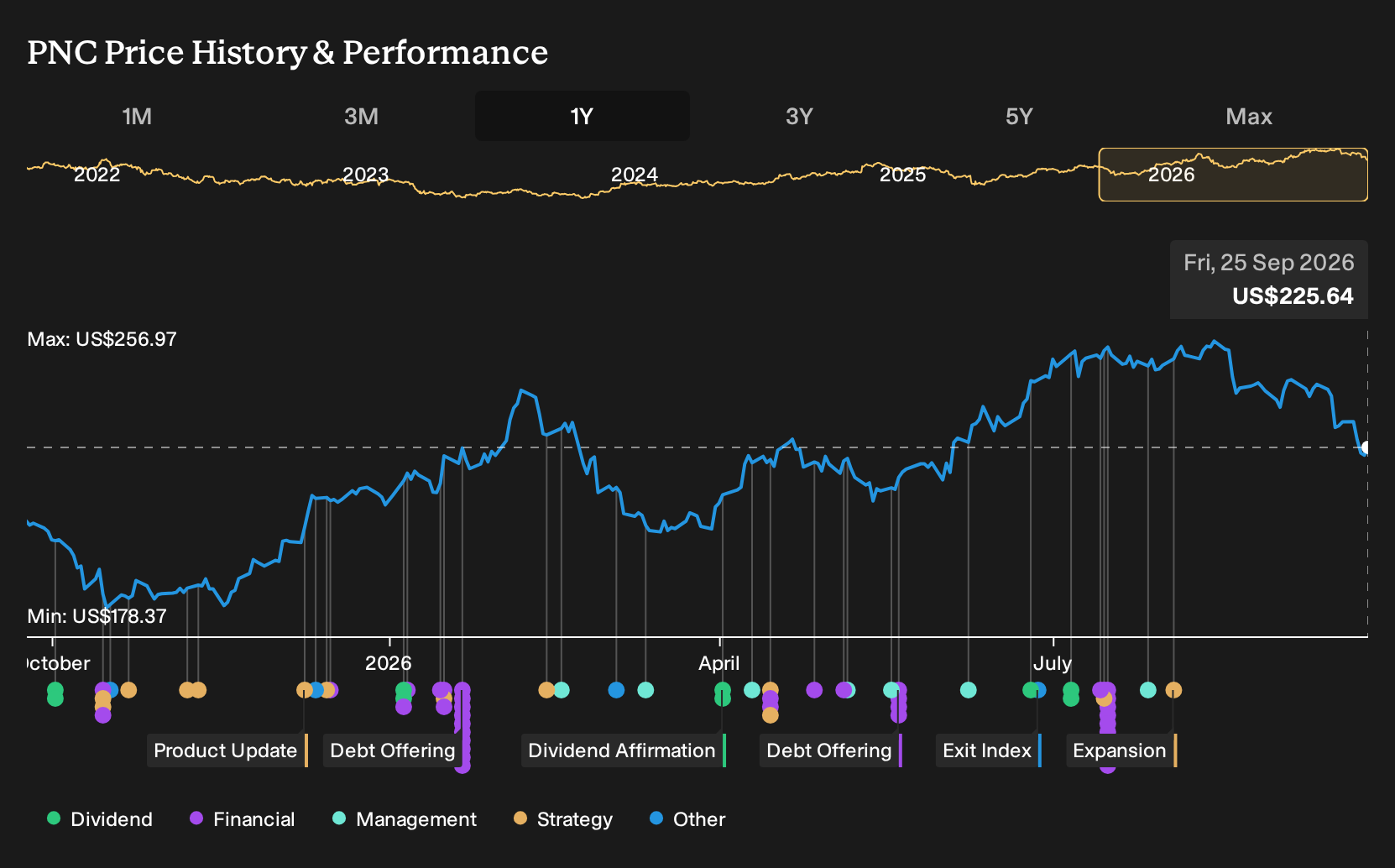
The Houston branch expansion is the clearest recent announcement that ties directly into this regulatory shift. Four new locations fit within PNC Financial Services Group’s plan to add 300 branches nationally and to push toward higher local share where management sees better branch productivity.
For you as a shareholder, the question is whether that on the ground buildout, layered on top of US$3.5b a year of tech spending and AI projects, can support both revenue and cost efficiency without stretching risk. Execution on credit discipline and fee income resilience remains critical whatever the Fed does on thresholds.
PNC Financial Services Group’s current analyst story lines up around revenue of US$29.1b and earnings of US$8.7b by 2029, built on forecast revenue growth of 6.2% a year and an earnings increase of about US$1.4b from US$7.3b today.
Uncover why PNC Financial Services Group's fair value indicates a 23% potential upside to its current price before the market closes the gap.
Exploring Other Perspectives
Two fair value estimates from the Simply Wall St Community span roughly US$278 to US$393 per share, which signals a wide gap in how PNC Financial Services Group is being priced by different retail investors. Set that against the possibility of shifting credit costs or changing fee income momentum and you can see why opinions vary so much. Explore those alternative views before deciding how this story fits in your own portfolio.
Explore another PNC Financial Services Group fair value estimate, including one that suggests it could be worth just $277.72!
The Verdict Is Yours
Don't just follow the ticker; dig into the data and build a conviction that's truly your own.
- A great starting point for your PNC Financial Services Group research is our analysis highlighting 5 key rewards and 1 important warning sign that could impact your investment decision.
- See our latest analysis for PNC Financial Services Group. The report includes a comprehensive fundamental analysis summarized in a single visual, the Snowflake, making it easy to evaluate PNC Financial Services Group's overall financial health at a glance.
Looking For More Ideas Beyond PNC Financial Services Group?
If the PNC Financial Services Group story has sharpened your thinking about risk, return and balance sheet strength, you can use that same lens to scan a wider opportunity set with the Simply Wall St Screener.
- For investors who want quality at a discount, start with a curated group of 32 high quality undervalued stocks that pair solid fundamentals with appealing valuations.
- If capital preservation comes first for you, focus on stability by checking out 30 resilient stocks with low risk scores that screen well on financial strength and volatility.
- When income is the priority, look for payout resilience by reviewing a hand picked set of 8 dividend fortresses that combine higher yields with robust balance sheets.
This article by Simply Wall St is general in nature. We provide commentary based on historical data and analyst forecasts only using an unbiased methodology and our articles are not intended to be financial advice. It does not constitute a recommendation to buy or sell any stock, and does not take account of your objectives, or your financial situation. We aim to bring you long-term focused analysis driven by fundamental data. Note that our analysis may not factor in the latest price-sensitive company announcements or qualitative material. Simply Wall St has no position in any stocks mentioned.
Have feedback on this article? Concerned about the content? Get in touch with us directly. Alternatively, email editorial-team@simplywallst.com