


Is Leadership Succession Altering The Investment Case For Kadant (KAI)?
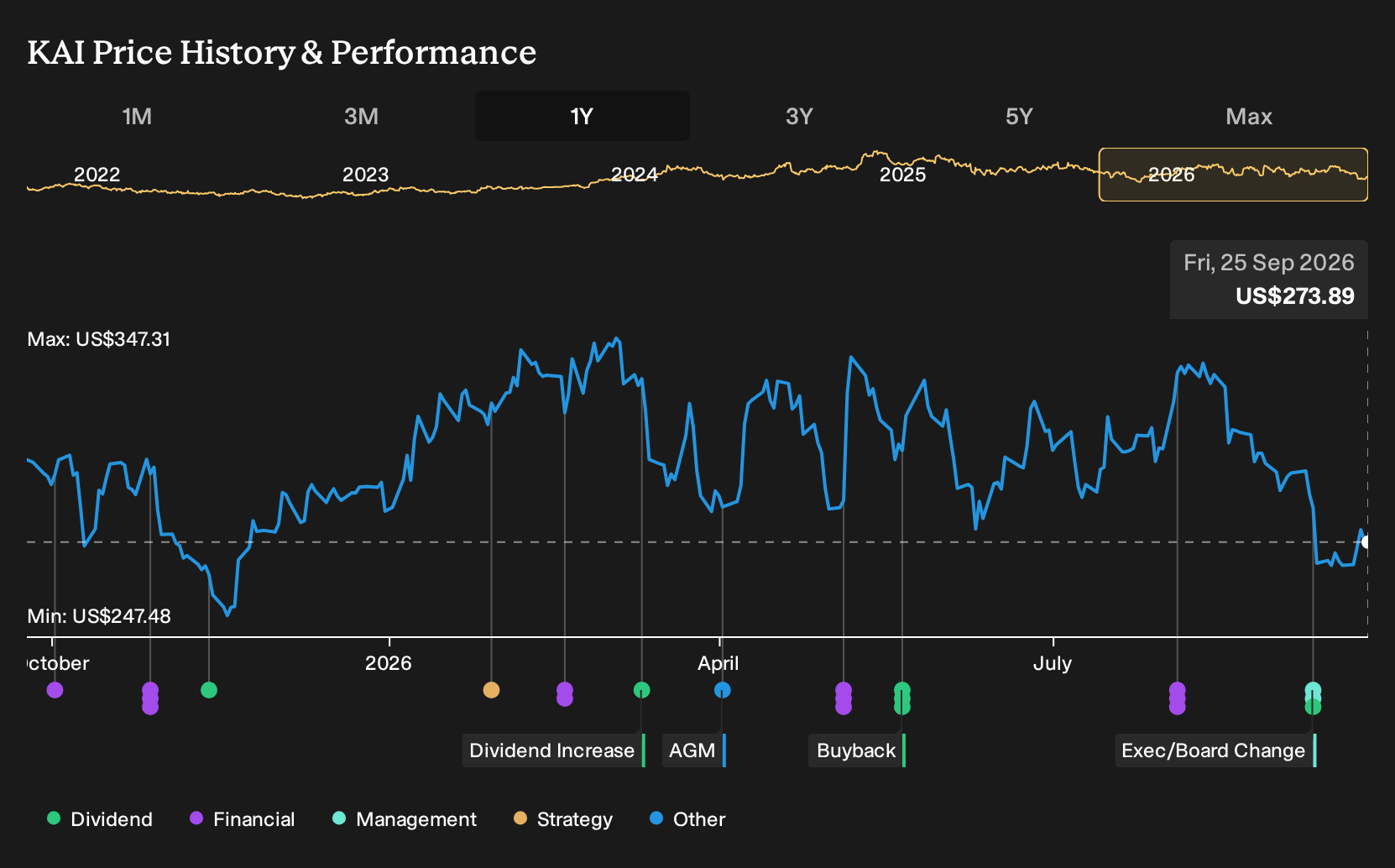
- Kadant announced that long-time executive Michael C. Colwell will become President and COO in October 2026, and then succeed Jeffrey L. Powell as CEO in January 2027, while also confirming a US$0.36 cash dividend with an ex-date of October 15, 2026.
- The planned CEO transition and continued use of cash dividends indicate that Kadant is focusing on leadership continuity while still returning capital to shareholders.
- We will now look at how Kadant's planned CEO succession could influence the existing investment narrative investors use to frame the business.
Scan how Kadant’s dividend and leadership plans compare with other companies steadily returning cash to investors by zeroing in on 8 dividend fortresses in today's market.
What Is Kadant's Investment Narrative?
The basic Kadant story is about running a niche industrial platform cleanly. Three segments, Flow Control, Industrial Processing, and Material Handling, give the group a spread of end markets rather than a single demand swing. Earnings have grown 3.2% per year over the past 5 years, with forecasts pointing to profit growth of about 17% a year and revenue growth of 6.3% a year. That kind of steady, capital equipment heavy model usually rewards consistent execution more than headline grabbing product launches.
The new CEO timeline and the latest US$0.36 dividend fit that narrative. Management is signaling continuity on both operations and capital returns rather than a reset. In the short term, the bigger swing factors are still order intake, pricing power and capital spending cycles in machinery customers. The stock has fallen about 9% over the past year and trades on a P/E of 29.5x, above both the firm’s estimated fair P/E of 23.5x and the US Machinery peer average of 24.3x. Investors are therefore paying a premium for that stability even while analysts see upside to their US$361.67 target.
Even so, there is a less comfortable angle to Kadant that only really shows up when you look at ...
There's only one way to know the right time to buy, sell or hold Kadant. Head to Simply Wall St's company report for the latest analysis of Kadant's Fair Value.
Exploring Other Perspectives
For a very different angle on Kadant, focus on the risk that pulp and paper demand structurally fades. The most cautious analysts were already building in only 5.6% annual revenue growth and earnings of about US$183.6 million by 2029. Those views predate the dividend and CEO plans, so opinions may evolve.
The Verdict Is Yours
Disagree with this assessment? Extraordinary investment returns rarely come from following the herd, so go with your instincts.
- A great starting point for your Kadant research is our analysis highlighting 4 key rewards that could impact your investment decision.
- See our latest analysis for Kadant. The report includes a comprehensive fundamental analysis summarized in a single visual, the Snowflake, making it easy to evaluate Kadant's overall financial health at a glance.
Looking For More Investment Ideas Beyond Kadant?
If this Kadant story has you rethinking how you build a watchlist, it can help to line it up against other companies with different strengths and risk profiles using the Simply Wall St Screener.
- For investors who care most about quality at a sensible entry point, review companies flagged as 32 high quality undervalued stocks that still pair fundamentals with a margin of safety.
- If balance sheet resilience is your first filter, focus on the list of solid balance sheet and fundamentals (24 results) to see which businesses combine low financial strain with solid operating profiles.
- To widen the search beyond well known tickers, scan the 16 high quality undiscovered gems that match strong fundamentals with less crowded investor attention.
This article by Simply Wall St is general in nature. We provide commentary based on historical data and analyst forecasts only using an unbiased methodology and our articles are not intended to be financial advice. It does not constitute a recommendation to buy or sell any stock, and does not take account of your objectives, or your financial situation. We aim to bring you long-term focused analysis driven by fundamental data. Note that our analysis may not factor in the latest price-sensitive company announcements or qualitative material. Simply Wall St has no position in any stocks mentioned.
Have feedback on this article? Concerned about the content? Get in touch with us directly. Alternatively, email editorial-team@simplywallst.com