


What United Parks And Resorts Stock's CEO President Split Means For Shareholders
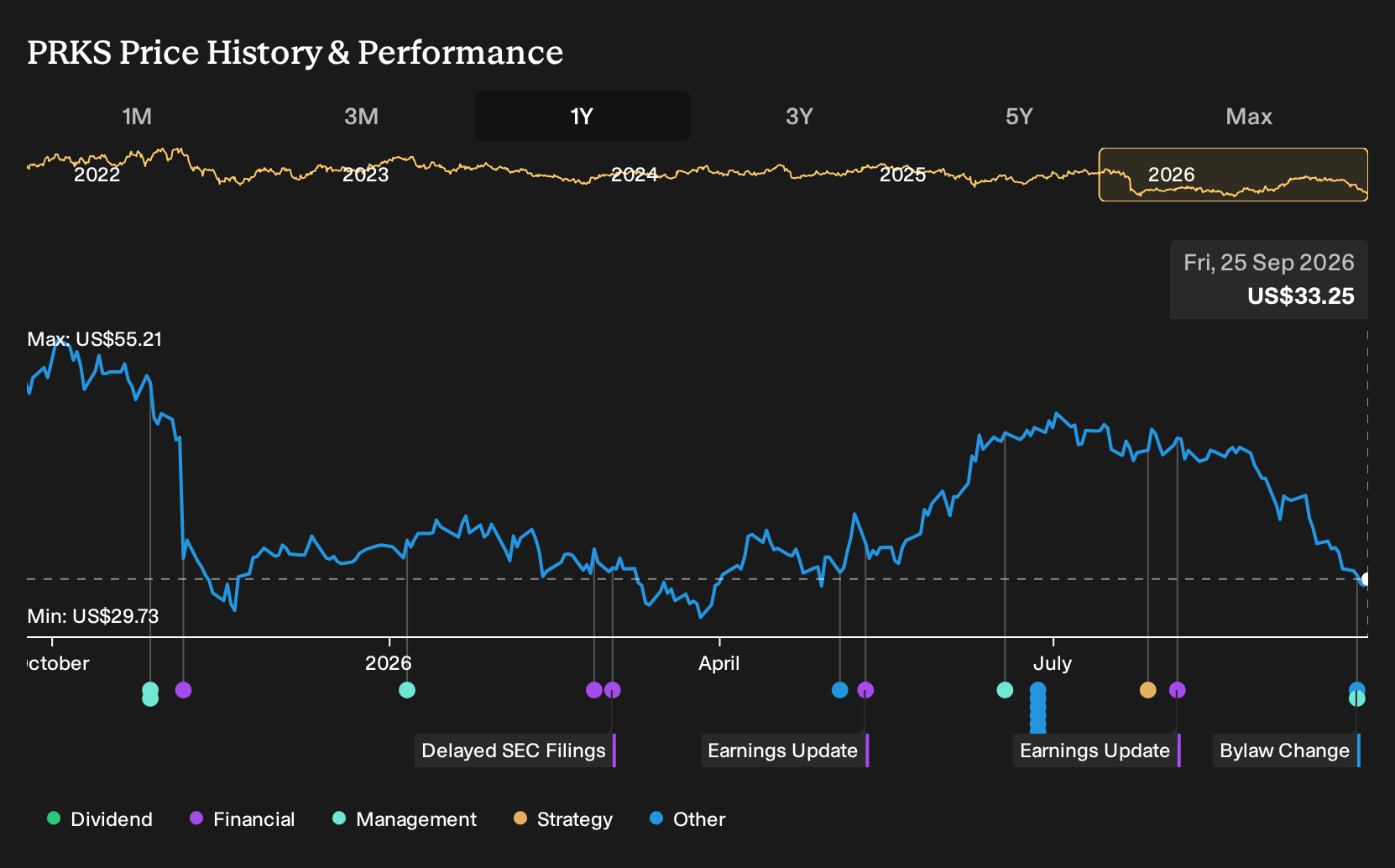
- On September 22, 2026, United Parks & Resorts amended its bylaws to separate the CEO and President roles and promoted long-time operator Kyle Miller to President, with Scott Maupin moving into the Chief Parks Operating Officer position after serving as Co-Chief Parks Operating Officer.
- The split between CEO and President, combined with promotions for leaders rooted in park operations, signals a push to refine day-to-day execution and clarify who owns guest experience, commercial strategy, and park performance after the planned departure of Chief Commercial Officer Christopher Finazzo.
- We will now look at how United Parks & Resorts' new CEO–President split could reshape the existing investment narrative for the business.
Scan how United Parks & Resorts’ leadership reshuffle compares with other operators tightening execution by reviewing our hand-picked list of solid balance sheet and fundamentals (24 results).
United Parks & Resorts Investment Narrative Recap
To own United Parks & Resorts, an investor needs to be comfortable with a ride that is heavily tied to guest volumes, in-park spending and weather, while believing that new attractions, digital tools and underused land can keep demand coming. The leadership changes do not alter that core bet. The key near-term catalyst still sits in how upcoming seasons convert strong bookings into actual attendance and spending.
The biggest current risk remains pressure on pricing power and margins if promotions stay heavy while costs, including labor, marketing and weather-related expenses, stay elevated. Management reshuffling looks incremental for now. It may support execution, but it does not remove exposure to Orlando concentration, severe weather or softer pass trends.
The bylaw amendment that separates the Chief Executive Officer and President roles is the announcement that matters most here. United Parks & Resorts has effectively created a structure where the President’s remit can be tightly focused on operations and guest delivery, while the Chief Executive Officer and board retain control over broader capital allocation, risk and long-term priorities.
For catalysts like new rides, events and hotel tie-ups to translate into better attendance and per-guest spending, execution in the parks has to be sharp, especially with rising expenses and interest costs that are not fully covered by earnings. A President steeped in park operations could help tighten cost control, staffing and pricing decisions, although the underlying weather and demand risks do not change.
United Parks & Resorts’ current analyst narrative points to revenues of US$1.8b and earnings of US$181.1 million by 2029, built on assumed yearly top line growth of 3.2% and an earnings step up of roughly US$47.5 million from the US$133.6 million reported today.
Uncover why United Parks & Resorts' fair value indicates a 42% potential upside to its current price, which could narrow quickly.
Exploring Other Perspectives
For United Parks & Resorts, the bearish twist is all about earnings power. Some of the lowest analysts were pencilling in revenue of about US$1.8b but only US$138.1 million in earnings by 2029, well below the US$181.1 million consensus. That more cautious view treated higher costs and softer attendance as lasting issues. The new CEO and President split, plus fresh operating leadership, could change how you think about that gap. It is worth comparing both sets of expectations yourself.
Form Your Own Verdict
Don't just follow the ticker. Dig into the data and build a conviction that's truly your own.
- A great starting point for your United Parks & Resorts research is our analysis highlighting 4 key rewards and 3 important warning signs that could impact your investment decision.
- See our latest analysis for United Parks & Resorts. The report includes a comprehensive fundamental analysis summarized in a single visual, the Snowflake, making it easy to evaluate United Parks & Resorts' overall financial health at a glance.
Looking for more United Parks & Resorts investment ideas?
If the leadership story at United Parks & Resorts has sharpened your focus on quality and risk, it can help to broaden the watchlist with other companies that meet clear fundamental tests using the Simply Wall St Screener.
- For investors who want a margin of safety built into the numbers, consider companies that screen as mispriced relative to their fundamentals through the 32 high quality undervalued stocks.
- If capital preservation and steadier return profiles matter most to you, filter for businesses with stronger balance sheets and lower risk profiles using this 30 resilient stocks with low risk scores.
- When the goal is resilient cash generation and cleaner finances, broaden your watchlist with companies from this curated list of solid balance sheet and fundamentals (24 results).
This article by Simply Wall St is general in nature. We provide commentary based on historical data and analyst forecasts only using an unbiased methodology and our articles are not intended to be financial advice. It does not constitute a recommendation to buy or sell any stock, and does not take account of your objectives, or your financial situation. We aim to bring you long-term focused analysis driven by fundamental data. Note that our analysis may not factor in the latest price-sensitive company announcements or qualitative material. Simply Wall St has no position in any stocks mentioned.
Have feedback on this article? Concerned about the content? Get in touch with us directly. Alternatively, email editorial-team@simplywallst.com