


Will Apprenticeship Push Change Bank of America (BAC) Stock Narrative
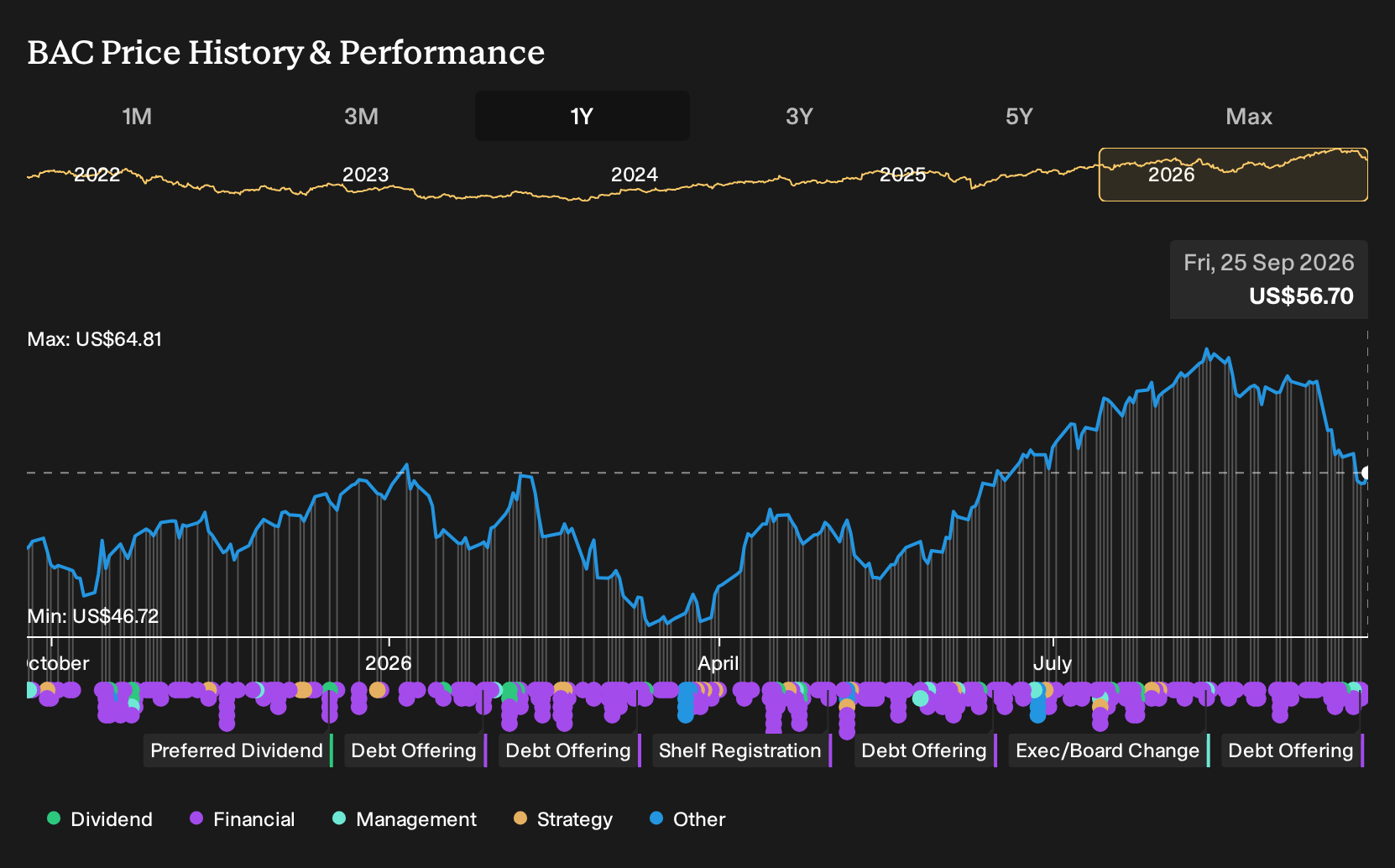
- Bank of America recently completed a series of senior unsecured fixed income offerings totaling more than US$239 million and confirmed regular dividends across multiple preferred stock series, while also adding a senior hire in Australian power, utilities and infrastructure advisory.
- The firm is pairing these funding and capital decisions with a US$150 million, five year workforce development pledge and 1,000 additional apprenticeships, which ties balance sheet flexibility directly to long term talent and execution capacity.
- We will now look at how Bank of America's expanded apprenticeship and workforce investment could influence its longer term investment narrative.
Scan how Bank of America’s recent bond issuance and capital decisions compare with peers by reviewing our hand picked list of solid balance sheet and fundamentals (24 results).
Bank of America Investment Narrative Recap
To own Bank of America, you need to be comfortable with a large, diversified lender whose earnings are closely linked to funding costs, credit quality and fee activity. The near term swing factor is how net interest income and trading or banking fees hold up, given that management expects softer investment banking and flat sales and trading.
The biggest risk still sits in market and credit stress that could pressure funding costs, deposit competition and loan losses. Recent senior unsecured bond issues totaling around US$239 million appear operational rather than transformational, so they do not materially change the short term catalysts or the key risk picture.
The fresh round of senior unsecured fixed income offerings, such as the US$100 million 4.75% notes due 2027 and the ladder of callable MTNs out to 2041, matters most for how you think about Bank of America’s funding mix and interest rate positioning. These deals extend term funding and lock in fixed coupons on the liability side.
That funding activity sits alongside ongoing preferred dividends and the US$150 million workforce and apprenticeship commitment. Together, they put the focus on execution. Investors now have to watch whether balance sheet flexibility, hiring plans and any future capital returns can offset softer capital markets income if bond market volatility and economic uncertainty persist.
Bank of America Earnings Expectations Behind the Apprenticeship Push
Bank of America’s workforce expansion sits against analyst forecasts that point to a bigger business over the next few years and a different earnings mix. Consensus assumptions tie the training spend, capital allocation choices and future profit potential together in one set of revenue and earnings targets.
Bank of America's narrative projects US$137.1b revenue and US$38.0b earnings by 2029. This rests on 6.4% yearly revenue growth and about US$5.9b earnings increase from US$32.1b today.
Analysts currently expect earnings of US$32.1b to move to US$38.0b by 2029, with profit margins edging from 28.2% to 27.7% over roughly the same horizon. That implies more absolute profit, but on slightly slimmer margins, which puts more weight on execution, operating discipline and the ability to keep credit costs and operating expenses in line.
On these projections, Bank of America would be trading on a P/E of 13.7x those 2029 earnings compared with 13.2x today, and above the cited US banks industry multiple of 12.3x. The analyst group is using a discount rate of 8.7% and expects the share count to decline by about 5.25% per year over the next three years, which concentrates any future earnings across fewer shares.
To align with the consensus valuation, an investor would need to be comfortable with the idea that revenue could reach about US$137.1b and earnings about US$38.0b by 2029, while the stock trades on that higher P/E multiple. That links the apprenticeship and workforce investments directly to the ability to deliver on digital initiatives, credit growth and cost control that underpin these revenue and profit assumptions.
Uncover why Bank of America's fair value indicates a 20% potential upside to its current price, which could narrow quickly.
Exploring Other Perspectives
Three fair value estimates from the Simply Wall St Community cluster between US$68.11 and US$90.57, so some private investors see Bank of America as much cheaper than others. Set that against risks such as higher funding costs or weaker credit quality, and you get a wide valuation spread. Use it as a prompt to weigh multiple viewpoints.
Explore 2 other Bank of America fair value estimates, including one that suggests the potential for as much as 60% upside from the current price.
Decide For Yourself
Don't just follow the ticker; dig into the data and build a conviction that's truly your own.
- A great starting point for your Bank of America research is our analysis highlighting 5 key rewards that could impact your investment decision.
- See our latest analysis for Bank of America. The report includes a comprehensive fundamental analysis summarized in a single visual, the Snowflake, making it easy to evaluate Bank of America's overall financial health at a glance.
Looking for more Bank of America sized investment ideas?
If Bank of America has helped sharpen how you think about risk, reward and valuation, it can be useful to apply the same lens to a broader watchlist using the Simply Wall St Screener.
- For investors who want quality at a reasonable price, scan a curated set of attractively priced businesses with solid fundamentals through the 32 high quality undervalued stocks.
- If steady income matters to you, focus on companies that combine higher yields with resilience by reviewing the 8 dividend fortresses.
- When capital preservation is a priority, narrow your search to financially robust businesses with lower risk profiles using the 30 resilient stocks with low risk scores.
This article by Simply Wall St is general in nature. We provide commentary based on historical data and analyst forecasts only using an unbiased methodology and our articles are not intended to be financial advice. It does not constitute a recommendation to buy or sell any stock, and does not take account of your objectives, or your financial situation. We aim to bring you long-term focused analysis driven by fundamental data. Note that our analysis may not factor in the latest price-sensitive company announcements or qualitative material. Simply Wall St has no position in any stocks mentioned.
Have feedback on this article? Concerned about the content? Get in touch with us directly. Alternatively, email editorial-team@simplywallst.com