


Did Stronger 2026 Guidance Just Shift Levi’s (LEVI) Investment Narrative?
- UBS recently updated its outlook on Levi Strauss, projecting stronger revenue trends that support a higher fiscal 2026 earnings guidance framework.
- The bank also flagged Levi Strauss tariff assumptions as a swing factor, since aligning guidance with current rates could materially shift projected profitability.
- We will now look at how Levi Strauss earnings guidance and tariff assumptions could reshape the broader investment narrative around the business.
Levi Strauss Investment Narrative Recap
To own Levi Strauss, you need to believe the brand can keep turning its global reach, DTC push, and category expansion into steady earnings, even with slower expected revenue growth of 5.1% a year. UBS calling out potential upside from stronger top line and tariff assumptions speaks directly to that earnings quality question.
The near term hinge is how management frames fiscal 2026 guidance on the October 7 call. Any change in tariff assumptions or cost outlook matters, because tariff risk and high SG&A already cap margin flexibility. If guidance stays conservative on tariffs, the incremental impact of this news is limited.
The launch of the Fashion Renewable Collaborative with Marks & Spencer and Schneider Electric is the announcement that ties in most cleanly. Tariffs and input costs sit on one side of the margin story. Energy choices and supplier efficiency sit on the other. Investors care about both because together they shape how much of any revenue uplift falls through to profit.
FRC’s focus on renewable electricity in manufacturing touches Levi Strauss where its supply chain is most exposed. Progress here could support long term cost stability and help offset structural pressures from tariffs or higher DTC spending. Execution will be slow and operational, not headline driven, but it sits squarely in the same risk and catalyst bucket you are weighing today.
What The Levi Strauss Consensus Is Actually Pricing In
Levi Strauss' story in the analyst models is very specific. The group of forecasts points to revenue rising by 5.1% a year, profit margins moving from 8.4% today to 10.9% in three years, and earnings lifting from US$554.1 million now to US$839.5 million by 2029. That is roughly a US$285 million increase in profit, which is the gap you are being asked to underwrite.
Levi Strauss' narrative projects US$7.7b revenue and US$839.5 million earnings by 2029. This assumes 5.1% yearly revenue growth and an earnings increase of about US$285 million from US$554.1 million today.
To get there, the consensus view assumes a tighter share count, with shares outstanding drifting down by about 1.53% annually for the next three years. That shrinking equity base helps earnings per share reach US$2.11 by 2029 even before you think about what tariffs, sourcing, or DTC reinvestment do to the income statement. It is a reminder that buybacks and fewer shares can shoulder some of the earnings per share burden if operating progress is slower than hoped.
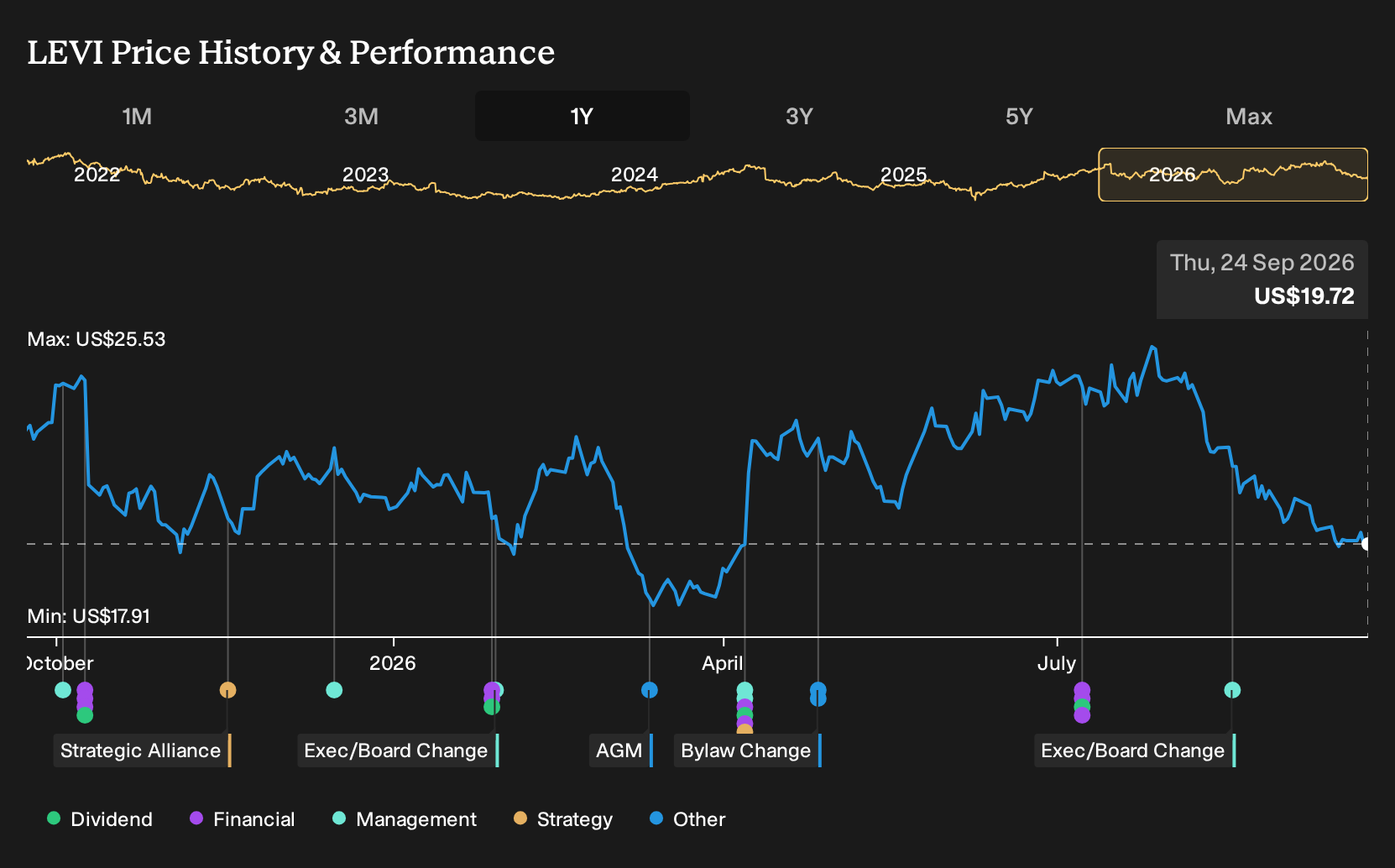
On valuation, the numbers show what belief the current research is anchored on. The average price target of US$28.20, versus a recent share price of US$24.62, assumes Levi Strauss can support a P/E of 16.1x on those 2029 earnings. That multiple sits below the current 17.1x that investors are paying today for the same business and below the 20.5x being used for the broader US Luxury peer group in this framework.
The spread between the most optimistic target of US$34.00 and the most cautious at US$25.00 highlights how differently people are weighing tariff scenarios, DTC margin outcomes, and the staying power of the brand. The 12.7% gap between the current share price and the consensus target is simply the arithmetic output of those assumptions filtered through a 9.2% discount rate, not a guarantee of where the stock goes.
For your own work, the key question is simple. Do you think Levi Strauss can reasonably reach US$7.7b of sales and US$839.5 million of earnings by 2029 while living with the tariff and SG&A constraints already on the table? If your answers on revenue durability, tariff pass through, and cost discipline differ from the street, your view on fair value will probably differ too.
Uncover why Levi Strauss' fair value indicates a 43% potential upside to its current price. This gap could narrow quickly as sentiment shifts.
Exploring Other Perspectives
One bullish twist on Levi Strauss centers on tariffs as a potential upside lever rather than just a cost risk. The most optimistic analysts were already penciling in about US$8.2b of revenue and US$927.0 million of earnings by 2029 before this UBS update. You can read those forecasts as a bet that tariff pressure eventually eases, and the new guidance debate may push those views even further apart.
Explore 3 other Levi Strauss fair value estimates, including one that suggests as much as 43% upside from the current price.
Form Your Own Verdict
Don't just follow the ticker; dig into the data and build a conviction that's truly your own.
- A great starting point for your Levi Strauss research is our analysis highlighting 5 key rewards and 1 important warning sign that could impact your investment decision.
- See our latest analysis for Levi Strauss. The report includes a comprehensive fundamental analysis summarized in a single visual, the Snowflake, making it easy to evaluate Levi Strauss' overall financial health at a glance.
Looking for more Levi Strauss investment ideas?
If Levi Strauss has sharpened your thinking on brands, cash flow, and risk, it can be useful to pressure test that framework against a wider set of businesses using the Simply Wall St Screener.
- For investors who care most about quality at a sensible entry price, scan a curated 30 high quality undervalued stocks that combine solid fundamentals with disciplined valuations.
- If balance sheet strength is your first filter, start with a list of solid balance sheet and fundamentals (24 results) that can handle setbacks without constantly reaching for new capital.
- When capital preservation matters as much as upside, look through a 30 resilient stocks with low risk scores that aim to keep volatility and fundamental risk in check.
This article by Simply Wall St is general in nature. We provide commentary based on historical data and analyst forecasts only using an unbiased methodology and our articles are not intended to be financial advice. It does not constitute a recommendation to buy or sell any stock, and does not take account of your objectives, or your financial situation. We aim to bring you long-term focused analysis driven by fundamental data. Note that our analysis may not factor in the latest price-sensitive company announcements or qualitative material. Simply Wall St has no position in any stocks mentioned.
Have feedback on this article? Concerned about the content? Get in touch with us directly. Alternatively, email editorial-team@simplywallst.com