


Defense AI Spending Could Lift These Underfollowed U.S. Government IT Stocks
A federal court just shut Anthropic out of Pentagon AI work, and that vacuum could matter far more for listed defense and government IT integrators than any headline about a private AI champion. Defense buyers still need AI tools, secure cloud pipelines and cleared integrators to stitch everything together. This article walks through 3 stocks from the screener that appear positioned to pick up attention as spending and risk are reassessed.
The 3 stocks highlighted below are just a sample, with the full screen surfacing 50 more U.S. listed defense and government IT integrators with equally compelling stories around DoD work, secure cloud and AI enablement that are not covered in this article. To explore the full universe, analyze and identify the highest conviction setups directly inside the U.S.-Listed Defense and Government IT Integrators with Established DoD AI Contracts screener.
Lyntris (LYNX)
Lyntris is a defense technology specialist for the connected battlespace, building sensor hardware, embedded software and data platforms that align closely with Department of Defense (DoD) grade, AI capable communications and IT integration. The business generates about US$451 million from Aerospace & Defense work and carries a market value near US$1.5 billion.
Lyntris gives investors pure play exposure to secure, multi domain connectivity that sits inside DoD and allied programs where AI ready data and communications are becoming core requirements. The stock currently appears in some screens as high growth and potentially mispriced. However, the investment thesis relies heavily on how an unresolved funding pressure develops in relation to future contract execution.
That funding overhang is exactly what you need to stress test with the DCF valuation analysis for Lyntris to see how much execution risk is already baked in.
Satellogic (SATL)
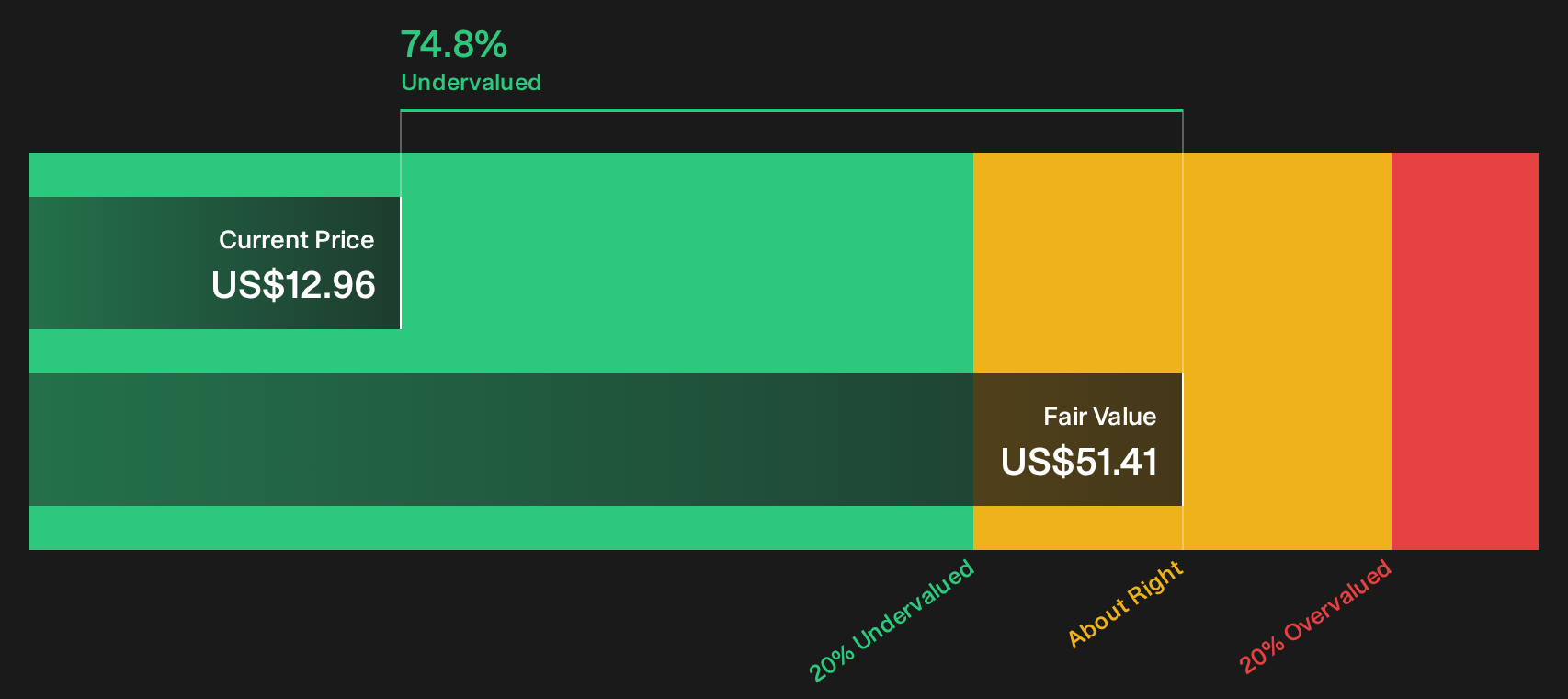
Satellogic is a vertically integrated earth observation specialist that designs, builds and operates imaging satellites for government and commercial clients, an approach that fits this screener’s focus on AI heavy defense and IT workflows. It generated about US$31.9 million from building satellite constellations and carries a market value near US$847.1 million.
For a Pentagon that suddenly needs alternative AI and geospatial partners, Satellogic offers a ready built imaging, processing and sovereign constellation platform that already targets defense, intelligence and government monitoring missions worldwide.
"The Merlin constellation, funded by a US$30 million customer contract and designed to remap the planet daily at 1 meter resolution with in orbit AI processing, positions Satellogic to serve both defense and commercial use cases that rely on continuous monitoring."
What happens to margins and funding needs if a single large government buyer leans harder into that kind of always on capacity?
That funding question is only the first layer, with the full narrative for Satellogic showing how contract structure, capital needs and competitive pressure could be accelerating or quietly stalling Satellogic.

AECOM (ACM)
AECOM plugs into this screen as the infrastructure consultant that U.S. public agencies already trust for complex, secure projects. This is exactly where future defense IT and AI integration work is likely to be stitched into real world facilities and mission systems.
AECOM provides consulting, design and program management across transport, water, environmental and energy projects, with the Americas segment generating about US$11.8b of its roughly US$15.4b in revenue and a market value near US$7.9b.
"A legacy Construction Management project created a $337 million hole in reported profitability."
What really matters for investors is how one large, long lived project risk shapes future margins and confidence in that government focused backlog.
That is exactly where the full narrative for AECOM unpacks whether AECOM's setback is masking a stronger, higher quality government engine that is starting to accelerate.

Seeking Fresh Alternatives Before They Fly
New ideas often move first, and early money may focus on quiet breakout momentum before prices start moving significantly. Scan fresh candidates while they are under the radar for now and consider them carefully.
- Spot resilient compounding potential by scanning a curated 30 resilient stocks with low risk scores that keeps risk scores tight while others focus on volatility.
- Track potential income opportunities by reviewing a hand picked 8 dividend fortresses that aims to keep cash returns flowing even when prices drop and sentiment cools.
- Explore developments in AI-related infrastructure by checking a focused set of 85 AI infrastructure stocks that support data, chips and power.
This article by Simply Wall St is general in nature. We provide commentary based on historical data and analyst forecasts only using an unbiased methodology and our articles are not intended to be financial advice. It does not constitute a recommendation to buy or sell any stock, and does not take account of your objectives, or your financial situation. We aim to bring you long-term focused analysis driven by fundamental data. Note that our analysis may not factor in the latest price-sensitive company announcements or qualitative material. Simply Wall St has no position in any stocks mentioned.
Have feedback on this article? Concerned about the content? Get in touch with us directly. Alternatively, email editorial-team@simplywallst.com