


Palo Alto Networks Is Turning OpenAI and Anthropic Into a New Revenue Opportunity
Artificial intelligence is making hackers more dangerous, but it could also provide the technology needed to stop them. Palo Alto Networks (PANW) is pursuing a new cybersecurity service powered by advanced AI models from OpenAI and Anthropic.
The company announced Unit 42 Continuous Frontier AI Defense, a subscription-based service designed to identify security vulnerabilities before hackers can exploit them.
Palo Alto's stock has had a strong year, up 107% so far in 2026. And as artificial intelligence continues to expand through seemingly every industry, Palo Alto and other cybersecurity stocks are poised to benefit.
About Palo Alto Stock
Palo Alto Networks, which is based in Santa Clara, California, is a leading cybersecurity company with more than 80,000 global enterprise customers. Its products use AI, machine learning, and automation to identify threats and respond. The company has network security, cloud security, and security operations products and currently has a market cap of $319 billion.
Shares are up 88% in the last year, soundly beating the S&P 500 Index ($SPX), but not as strong as the triple-digit one-year returns seen by Fortinet (FTNT) and CrowdStrike (CRWD). Palo Alto’s forward price-to-earnings ratio of 93 is also on the rise, having increased by more than 70% in the past 12 months.
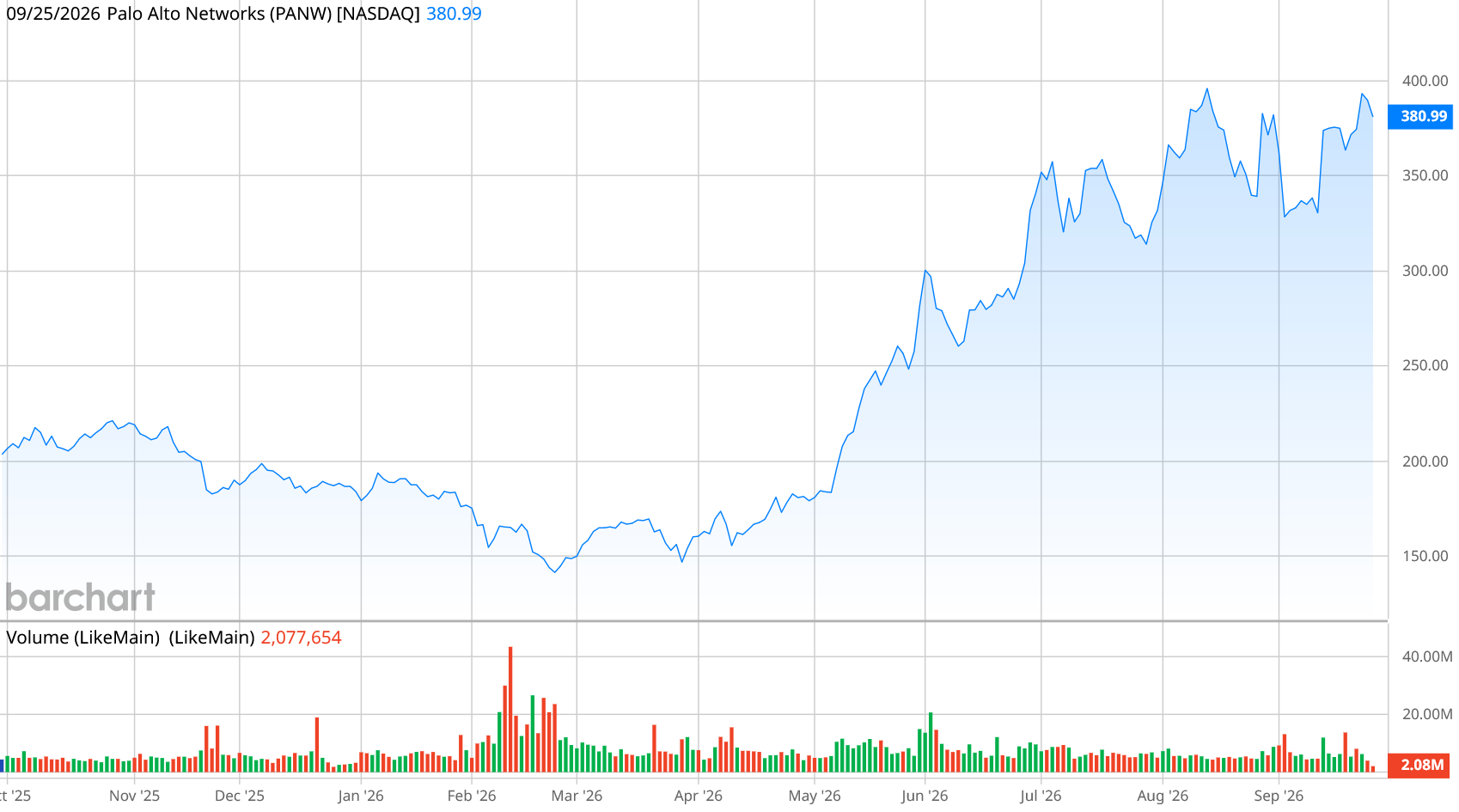
But Palo Alto’s performance has been strong, and its established customer base provides its new AI-powered cybersecurity business with a significant potential client base. The new offering uses OpenAI's GPT-5.6-Cyber and Anthropic's Claude Mythos 5, as well as other AI models, to examine networks, applications, and cloud infrastructure for vulnerabilities. It is available globally through annual subscriptions, with pricing determined by the AI models customers select. Palo Alto hasn't disclosed expected revenue from the service, making its near-term financial impact difficult to quantify.
Beats on Earnings
On Sept. 1, the company reported its earnings for the 2026 fiscal year as well as its fourth quarter (ending July 31). Quarterly revenue was $3.41 billion, up 34% from a year ago. The company reported a GAAP net loss of $282 million, down from a net income of $254 million in the same period a year ago. Adjusted earnings of $1.02 per share beat expectations of $0.98 per share.
Full-year revenue was $11.48 billion, up from $9.22 billion in fiscal 2025.
CEO Nikesh Arora said the company added nearly $1 billion net new next-generation security annual recurring revenue (NGS ARR). “The latest advancements in AI are elevating cybersecurity to the top of the CIO priority list, and will serve as durable tailwinds as we progress towards our $20 billion FY30 NGS ARR target.”
For the first quarter of the 2027 fiscal year, management is expecting NGS ARR of $9.54 billion to $9.56 billion, up 63% from a year ago, and total revenue in the range of $3.3 billion to $3.31 billion. Full-year guidance includes NGS ARR of $11.075 billion to $11.175 billion and revenue from $14.1 billion to $14.2 billion.
What Do Analysts Expect for PANW Stock?
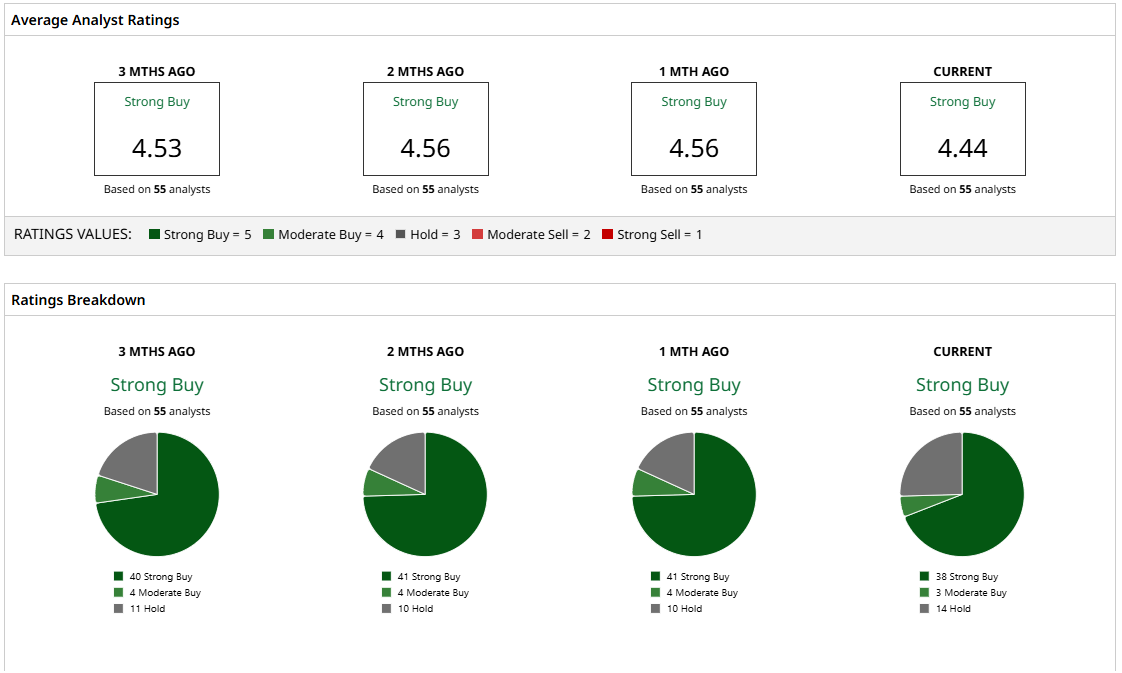
Analysts are largely bullish on PANW stock, although their price targets don’t indicate a lot more growth ahead. A total of 55 analysts who cover the stock have a consensus “Strong Buy” recommendation, but the mean price target of $396.59 is only a few dollars, or 4%, above the current stock price.
However, Palo Alto’s newest initiative to incorporate AI into its Unit 42 cybersecurity product seems to have potential. The company said it invested $17 million developing and validating the technology and in internal testing identified a year's worth of security exposures in just three weeks.
If Palo Alto’s new product can use powerful AI models to help it gain an advantage in a very competitive cybersecurity industry, analysts may begin to rerate the stock and adjust their price targets accordingly.
On the date of publication, Patrick Sanders did not have (either directly or indirectly) positions in any of the securities mentioned in this article. All information and data in this article is solely for informational purposes. For more information please view the Barchart Disclosure Policy here.