


Can Best Buy (BBY) Justify Its Price After Raised Earnings?
Best Buy has ridden a strong three year run in its share price, and fresh headlines around its partnership with Amazon now put the focus squarely on whether the current valuation is properly supported by earnings.
- Over the past 3 years the stock has returned 52.8%, which puts real pressure on the question of whether the underlying profit engine has kept pace with the market price.
- The extended Fire TV partnership with Amazon and the higher long term earnings outlook may support expectations for steadier profitability and cash generation than investors had pencilled in before.
- Your read on Best Buy is one view; the desks covering it have another. See what analysts think Best Buy's shares could be worth.
For investors, the debate is whether Best Buy's earnings today and the expectations embedded in them are strong enough to justify where the stock now trades.
If you want a sense of how Best Buy's earnings story compares with other potential opportunities tied to profitability, it is worth lining up the numbers against 30 high quality undervalued stocks.
Is Best Buy Fairly Priced on Earnings?
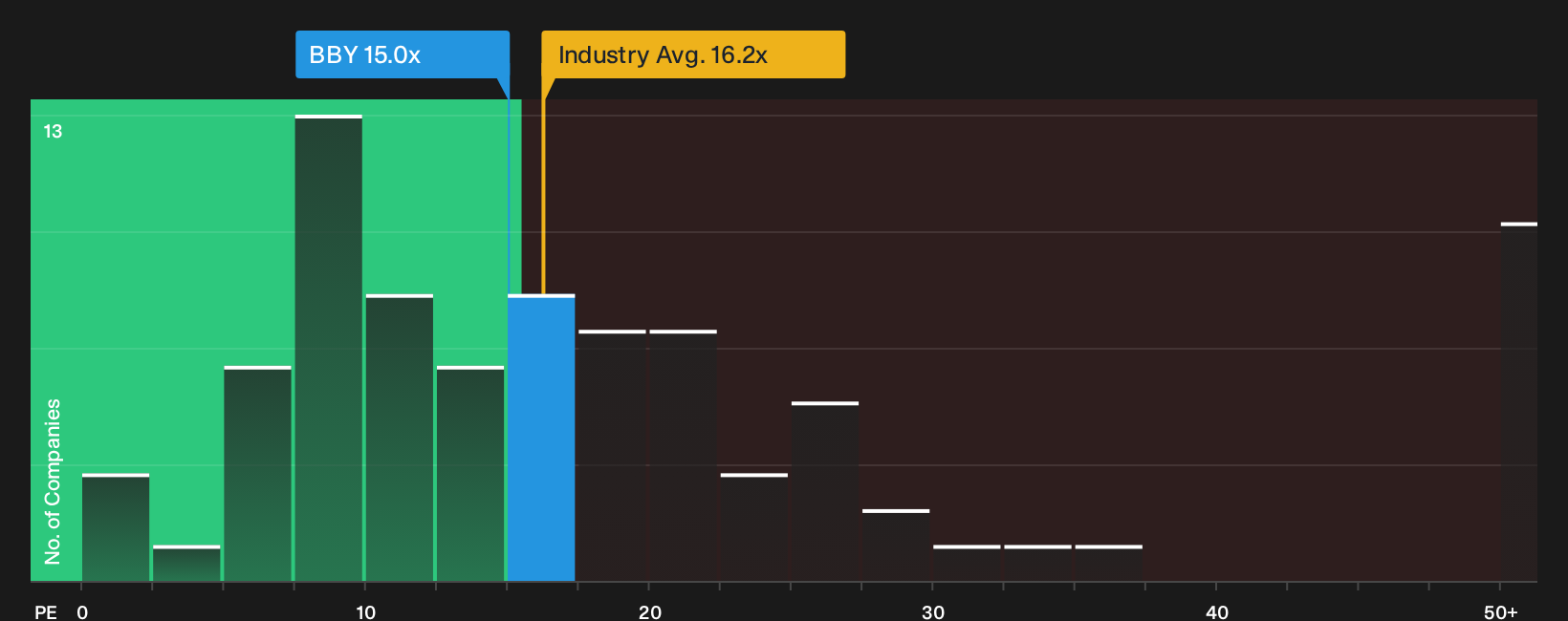
P/E works well for Best Buy because earnings are a key focus for a mature retailer with a long track record of profitability. The stock trades on a P/E of 15.0x, which is slightly below the Specialty Retail industry average of 16.2x and close to the peer group at 16.3x. Based on the tailored fair multiple used here, which reflects Best Buy's own mix of growth prospects, margins, size and risk, the current P/E sits near the level that model would suggest for the business.
Because the extended Fire TV partnership with Amazon has already fed into higher earnings guidance, a lot of that improved outlook is arguably already reflected in the present multiple rather than sitting on the sidelines as upside. For an investor weighing Best Buy today, the key question is whether the quality and durability of its profits justify paying roughly this market level for each dollar of earnings, or whether the current tag demands a wider margin of safety than the P/E is offering. Explore the numbers behind Best Buy's P/E valuation.
The Best Buy Narrative: What Would Justify Today's Price?
Simply Wall St Narratives pick up where that Best Buy valuation puzzle leaves off. They spell out which assumptions on growth, margins and earnings would need to hold for the stock to be worth meaningfully more or less than today's price, and each one treats fair value as a thesis about Best Buy's business that you can revisit over time instead of a single frozen snapshot.
One of the top community narratives on Best Buy: roughly fairly valued
"Launch and scaling of Best Buy's online marketplace add significant product assortment, improve customer digital experience, and broaden participation in profitable retail media revenue streams…"
Discover why this Narrative puts Best Buy at roughly fairly valued.
One more Best Buy question before you move on
Price multiples tell you what the market pays for Best Buy today, but a key consideration is how professional analysts think this business might look a few years from now. Explore where analysts expect Best Buy to be in a few years.
This article by Simply Wall St is general in nature. We provide commentary based on historical data and analyst forecasts only using an unbiased methodology and our articles are not intended to be financial advice. It does not constitute a recommendation to buy or sell any stock, and does not take account of your objectives, or your financial situation. We aim to bring you long-term focused analysis driven by fundamental data. Note that our analysis may not factor in the latest price-sensitive company announcements or qualitative material. Simply Wall St has no position in any stocks mentioned.
Have feedback on this article? Concerned about the content? Get in touch with us directly. Alternatively, email editorial-team@simplywallst.com