


Trump Just Sent Greenland Mines Stock Soaring 370%. How to Play It Here.
President Donald Trump’s interest in bringing Greenland under U.S. control is hardly a secret. The semiautonomous territory of NATO ally Denmark has long been on his radar. Perched above the Arctic Circle, the world’s largest island occupies a strategically vital position, putting it squarely at the crossroads of global security, trade, and natural resources. And rising geopolitical tensions, climate change, and shifts in the global economy have only increased Greenland’s importance.
The island is rich in minerals and sits in a strategically important position along the Arctic and North Atlantic approaches to North America. For the U.S., that combination makes Greenland much more than a remote Arctic territory. It is an increasingly essential piece of the broader security and resource picture. That spotlight intensified this week after Trump announced a new deal with Denmark covering security arrangements in Greenland.
The agreement paves the way for the U.S. to build two new military bases on the Arctic territory while also easing tensions over Trump’s repeated calls for the United States to take over Greenland. Wall Street wasted little time reacting. The new deal sparked a sharp rally in several U.S.-listed companies with exposure to Greenland, as investors zeroed in on the island’s strategic importance and mineral potential.
Among the long list of beneficiaries was Greenland Mines (GRML), whose shares rocketed an eye-popping 230.5% on Sept. 21. With Greenland once again in the spotlight, the latest deal has put GRML firmly on investors’ radar. So, what’s behind the stock’s explosive move, and what does the renewed focus on Greenland mean for the company? Let’s take a closer look at GRML.
About Greenland Mines Stock
North Carolina-based Greenland Mines is a micro-cap company focused on unlocking mineral opportunities in Greenland. The company was formerly known as Klotho Neurosciences, Inc. before changing its name to Greenland Mines in March 2026 following its acquisition of Greenland Mines Corp. The transaction gave Greenland Mines an indirect 80% interest in the Skaergaard Project in Southeast Greenland, while its shares began trading under the GRML ticker on Nasdaq in March 2026.
The Skaergaard Project is at the heart of the company’s mining portfolio. Covering roughly 877 square kilometers, the project is being explored for palladium, gold, and platinum, along with potential critical minerals such as vanadium and gallium. Greenland Mines is advancing further exploration, drilling, and resource-development work as it assesses the project’s broader potential. The company is also pursuing the Sarfartoq Rare Earth Project in southwest Greenland, adding another potential source of critical minerals to its portfolio.
More broadly, Greenland Mines is looking to build a multi-asset platform with exposure to rare-earth magnet materials, precious metals, and select midstream processing opportunities. Its strategy also extends beyond individual projects, with the company advancing a broader North Atlantic Critical Metals Corridor vision designed to link Greenland’s mineral resources with allied downstream jurisdictions and industrial infrastructure.
Currently valued at a market capitalization of about $35.55 million, the micro-cap company has found itself squarely in the spotlight as Greenland-linked equities rallied sharply on Monday, with investors increasingly viewing the island’s mineral deposits through a Western-security lens rather than a purely geological one.
That shift in investor attention has translated into a remarkable run for GRML. The stock jumped a jaw-dropping 230.5% on Sept. 21, followed by another 50.2% gain on Sept. 22. Over just the last five trading sessions, GRML shares have jumped an extraordinary 370%, dramatically outpacing the broader S&P 500 Index ($SPX), which has gained approximately 1% over the same stretch.
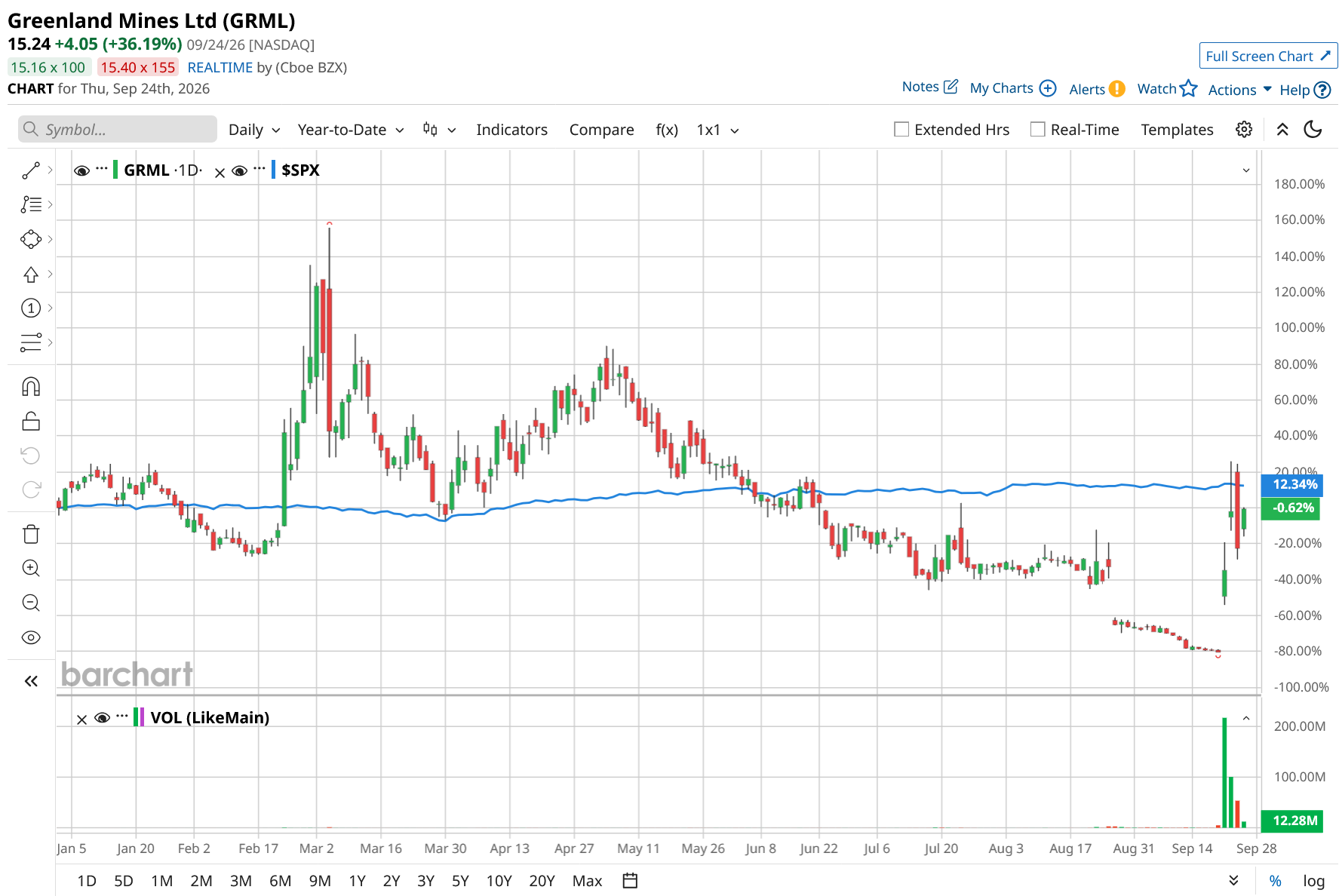
The Financial Picture
Greenland Mines may be sitting on a growing portfolio of mineral assets, but the company is still firmly in the exploration stage and has yet to generate a dollar of revenue. GRML reported zero revenue in 2025 and remained pre-revenue through the first six months of 2026. For the six months ended June 30, 2026, the company reported a $17.54 million net loss, while operating expenses came in at roughly $15 million.
GRML ended the period with approximately $9.34 million in cash and cash equivalents and $11 million in net working capital. And exploration doesn’t come cheap. In its latest 10-Q filing, Greenland Mines said it has incurred, and expects to continue incurring, high professional costs simply to remain a publicly traded company, in addition to significant expenses associated with exploration and evaluation work at the Skaergaard Project.
Still, the company has recently given its balance sheet a meaningful boost, completing a $42 million equity financing at $12 per share. The fresh capital is expected to fully fund the company through its core 2027 milestones, taking some of the pressure off its near-term cash runway. Even better for existing shareholders, the financing allowed management to terminate its continuous at-the-market (ATM) equity offering facility, eliminating a potential source of further share dilution.
How Will the New Deal Impact Greenland Mines?
Greenland Mines was quick to welcome the formal signing at the United Nations General Assembly of the new security agreement between the United States, the Kingdom of Denmark, and Greenland, just hours after the deal was signed. The agreement formalizes the framework announced on Sept. 18 and represents a significant step toward strengthening long-term security across the Arctic and North Atlantic. It also highlights just how important Greenland is becoming to the United States and the broader Western alliance.
“Today’s signing moves Greenland’s strategic importance from concept to action,” said Bo Møller Stensgaard, President of Greenland Mines. He argued that security goes well beyond military access and infrastructure, extending to the supply chains that underpin modern defense, energy, and advanced technology. In his view, responsibly developing Greenland’s rare earths and critical metals is itself a form of “security in the making.”
Stensgaard pointed to the company’s Sarfartoq and Skaergaard projects, saying Greenland Mines could help turn Greenland’s mineral resources into secure, allied supplies for the United States, Europe, and the broader Western alliance. Speaking to InvestorNews on Tuesday, Stensgaard said the U.S.-Denmark-Greenland agreement would “show a commitment to the Arctic and show a commitment to Greenland” while underscoring the region’s growing strategic importance.
He said the agreement could help reduce uncertainty around investments in Greenland and bring “a new support, a new commitment” to the Arctic, potentially “opening up new doors for new developments.” Stensgaard also said the agreement could support Greenland Mines’ own infrastructure ambitions in the region. As he put it, “Infrastructure is sort of showing a commitment to an area,” adding that a mining project such as Greenland Mines’ could effectively sit in the gap between Iceland and Greenland.
Key Takeaways for Investors
GRML’s rally has been anything but ordinary. Greenland Mines shares surged more than 200% on Monday as Greenland-linked stocks moved sharply higher, before continuing to trade actively during Tuesday’s session. But moves of this magnitude in a micro-cap stock can reverse just as quickly as they arrive. The recent surge appears to reflect heightened investor sentiment around Greenland’s strategic importance and the new security agreement, rather than a fundamental change in the company’s underlying projects.
Importantly, Greenland Mines itself acknowledges that its plans come with significant risks. The company remains a development-stage business with no Mineral Reserves at either project, meaning its assets have not yet reached the stage of established economically mineable reserves. The Sarfartoq Initial Assessment is preliminary and includes Inferred Mineral Resources, which are too speculative geologically to be categorized as reserves. Greenland Mines cautions that there is no certainty the results of the assessment will ultimately be realized.
For investors watching GRML, the story therefore goes well beyond the stock’s eye-popping recent gains. The company has potentially valuable exposure to Greenland’s critical-mineral resources, but those assets remain at a relatively early stage, while the stock’s recent surge has significantly increased market attention. With sentiment running hot and the underlying projects still carrying substantial development risk, GRML may be one to keep firmly on the radar rather than chase the crowd.
On the date of publication, Anushka Mukherji did not have (either directly or indirectly) positions in any of the securities mentioned in this article. All information and data in this article is solely for informational purposes. For more information please view the Barchart Disclosure Policy here.