


The sharp rise in US bond yields impacted emerging Asia! Interest spreads on bonds are approaching record lows, and capital outflow risks are heating up
The Zhitong Finance App won. A number of strategists said that the sharp rise in US Treasury yields has pushed interest spreads between emerging Asian bonds and US bonds to record levels, increasing the risk of capital outflows from the region.
Driven by strong economic data and weak auction demand, the 10-year US Treasury yield soared 16 basis points to 5.11% on Wednesday, the highest since 2007. This extended the yield discount on Malaysian 10-year treasury bonds to the deepest level since 2007, while interest spreads between Indonesia and Thailand are approaching record lows.
Stephen Qiu, chief foreign exchange strategist for emerging markets at BI, said, “Long-maturing emerging Asian bonds are particularly vulnerable to higher US bond yields, especially in low-yield markets such as South Korea and Thailand.” The rise in US bond yields may “either trigger foreign capital outflows or reduce net foreign capital inflows from bonds in the region.”
For emerging Asia, widening interest spreads and potential capital outflows could have a range of consequences, including downward pressure on local currencies. Regional central banks may then be forced to maintain high domestic interest rates to defend the local currency, which may also drive up borrowing costs.
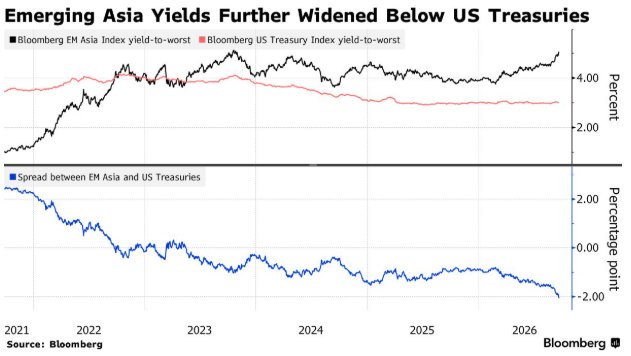
In contrast, yields in emerging Asia rose moderately by only 5 basis points in Malaysia and Thailand on Thursday. Thanks to stable domestic inflation and local currency resilience, they avoided the serious sell-off experienced by US bonds.
This week, the discount on Malaysian 10-year treasury bonds extended to 122 basis points, the deepest since 2007; similar interest spreads on Thai 10-year treasury bonds reached 290 basis points, approaching a record low.
At the beginning of this month, interest spreads on 10-year treasury bonds between China and the US also widened to the widest level ever recorded, while interest spreads on Indonesian treasury bonds narrowed to 196 basis points, approaching an all-time low.
“The continued upward trend in US bond yields has indeed brought an unsettling background to bond investors,” said Homin Lee, senior macro strategist in Singapore at Lung Audahen. “But it also reveals the resilience of the Asian dollar and local currency bond markets, with the exception of Indonesia and the Philippines, which are more vulnerable.”