


If Kevin Warsh Keeps Rates Elevated, These 2 Stocks Are Built to Handle It
Key Points
After the Federal Reserve's latest interest rate hike, the market now thinks another one or two could be come before the year's end.
Higher rates typically pressure stocks.
However, some stocks have business models that perform better in a rising-rate environment.
After much anticipation, Federal Reserve Chairman Kevin Warsh and the Federal Open Market Committee (FOMC) raised the benchmark overnight federal funds rate by a quarter point, bringing the target range to 3.75% to 4%. It was the first time in three years that the FOMC raised rates. The vote was unanimous.
The future remains murky, but the market currently expects at least one more rate hike this year and potentially two, according to CME Group's FedWatch tool.
Missed Nvidia in 2009? This Rare Signal Is Flashing Again. In 2009, a "Double Down" signal flashed for a little-known chipmaker called Nvidia. For the first time in years, that same "Total Conviction" signal is flashing for a company 1/100th the size of Nvidia. Continue »
Furthermore, the FOMC's recent dot plot from its September meeting, which shows each member's expectations for where the federal funds rate will be in the future, indicates that most members of the committee don't expect rate cuts until at least 2028.
If this scenario plays out, here are two stocks built to handle it.

Fed chairman Kevin Warsh. Image source: The White House.
Visa
Visa (NYSE: V), the largest payments network in the world, should prove resilient in an elevated-rate environment.
People will see the Visa logo on debit and credit cards, but it is not actually extending any credit. Rather, the company helps route transactions between various parties and takes a small fee as a percentage of each transaction, essentially collecting a toll on an electronic highway.
Rising interest rates are coinciding with stubborn inflation, making everything more expensive. Still, the economy, by many benchmarks, is still performing well.
This is good for Visa because when economic activity is robust, there is more spending through its network, leading to more fee income. And when goods and services get more expensive, because Visa charges a fixed rate, its fees should rise as well, making it a strong hedge against inflation.
In its third quarter of fiscal 2026 (ended June 30), payments volume and processed transactions rose 10% year over year, while net revenue jumped 14%.
On the company's earnings call, Chief Financial Officer Chris Suh told analysts that management expects net revenue growth to be in the low-double-digit percentage range: "For drivers, we are assuming that the broader consumer spend stability continues from a macro perspective. Our overall drivers remain resilient and strong."
If the economy slows down or tips into a recession, that could hurt transaction volume, so it bears monitoring, but that's not the outlook right now.
Wells Fargo
Many investors will assume that rising interest rates are not good for banks. But that's not always the case. Rising rates can create a beneficial environment for bank stocks, but it's a balancing act.
Typically, banks benefit from rising interest rates when the yield curve is steep, meaning bonds with shorter maturities yield less than longer-dated ones. That's because banks typically borrow money at short-term rates and lend it out at longer-term rates. However, rising rates can also increase deposit costs and lead to customer credit stress.
The yield curve has been flattening of late, with the spread between the yields on the two- and 10-year U.S. Treasury notes still technically steep but much less so than before.
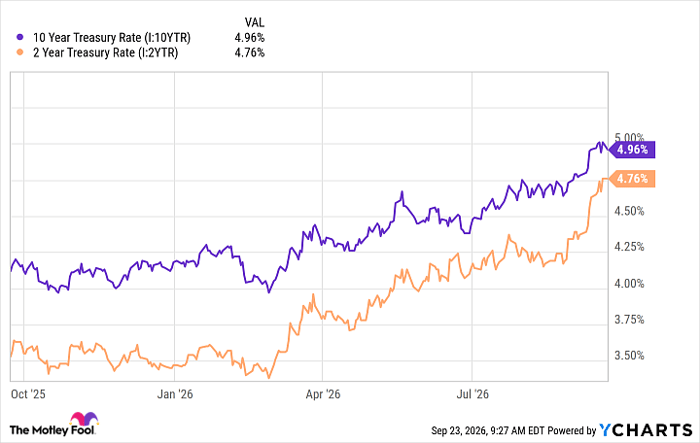
10-Year Treasury Rate data by YCharts.
Still, net interest income (NII) -- which is essentially the spread revenue that banks make between what they pay on deposits and other funding sources and the interest they earn on loans and bonds -- has largely moved higher during the past year. NII made up more than 54% of total revenue at Wells Fargo in the second quarter.
During the second quarter, management reaffirmed its outlook for full-year NII to be roughly $50 billion, up from nearly $47.5 billion in 2025.
Overall, credit at the bank still looks quite benign, with total nonperforming assets trending down during the past year.
Deposit costs are likely to continue to creep up, but I still expect earnings and revenue to perform well unless the yield curve were to invert, which could add more pressure on banks, but over time.
Wells Fargo is an advertising partner of Motley Fool Money. Bram Berkowitz has no position in any of the stocks mentioned. The Motley Fool has positions in and recommends CME Group and Visa. The Motley Fool has a disclosure policy.