


Texas Solar Boom Puts Vistra Stock And 2 Power Plays In Focus
Texas just quietly took the solar crown from California, and that shift is already rippling through the grid and into listed companies that touch Texas power. For investors, a state where solar is cheaper than new coal and where population is climbing can mean fresh revenue streams and fresh risks. This article walks through 3 Texas renewable and grid focused stocks exposed to that story and what their exposure might mean for your portfolio.
The three stocks below are just a starting sample. The full Texas Renewable Power Producers and Grid Operators screen surfaced 26 more companies with equally compelling narratives tied to this theme. To identify and analyze which of those could be your highest conviction Texas power plays, head straight to the Texas Renewable Power Producers and Grid Operators screener.
Clearway Energy (CWEN)
Overview: Clearway Energy operates a large US portfolio of utility scale wind, solar and storage assets that supply contracted clean power.
Operations: Clearway Energy generates all of its US$1.6b revenue in the United States, with US$1.3b from Renewables & Storage and US$320 million from Flexible Generation.
Market Cap: US$6.3b
Clearway Energy matters for this Texas focused screen because it already runs a sizeable fleet of grid scale renewables built around long term power contracts, so any shift in solar economics or storage demand can feed directly into how its future project mix looks.
"Growing focus on grid connected storage and hybrid projects, such as the Honeycomb battery portfolio and potential hybridization of existing solar fleets, aligns the company with power markets where renewables and storage are expected to be cost competitive. This can support higher future contracted revenue and potentially more stable earnings."
What really moves the needle for Clearway Energy from here is how a single pressure on its future contract terms shapes long run cash flows.
That contract pressure is only the starting point, and the full narrative for Clearway Energy unpacks how Clearway Energy’s project pipeline, capital costs and payout ambitions could be quietly decoupling.

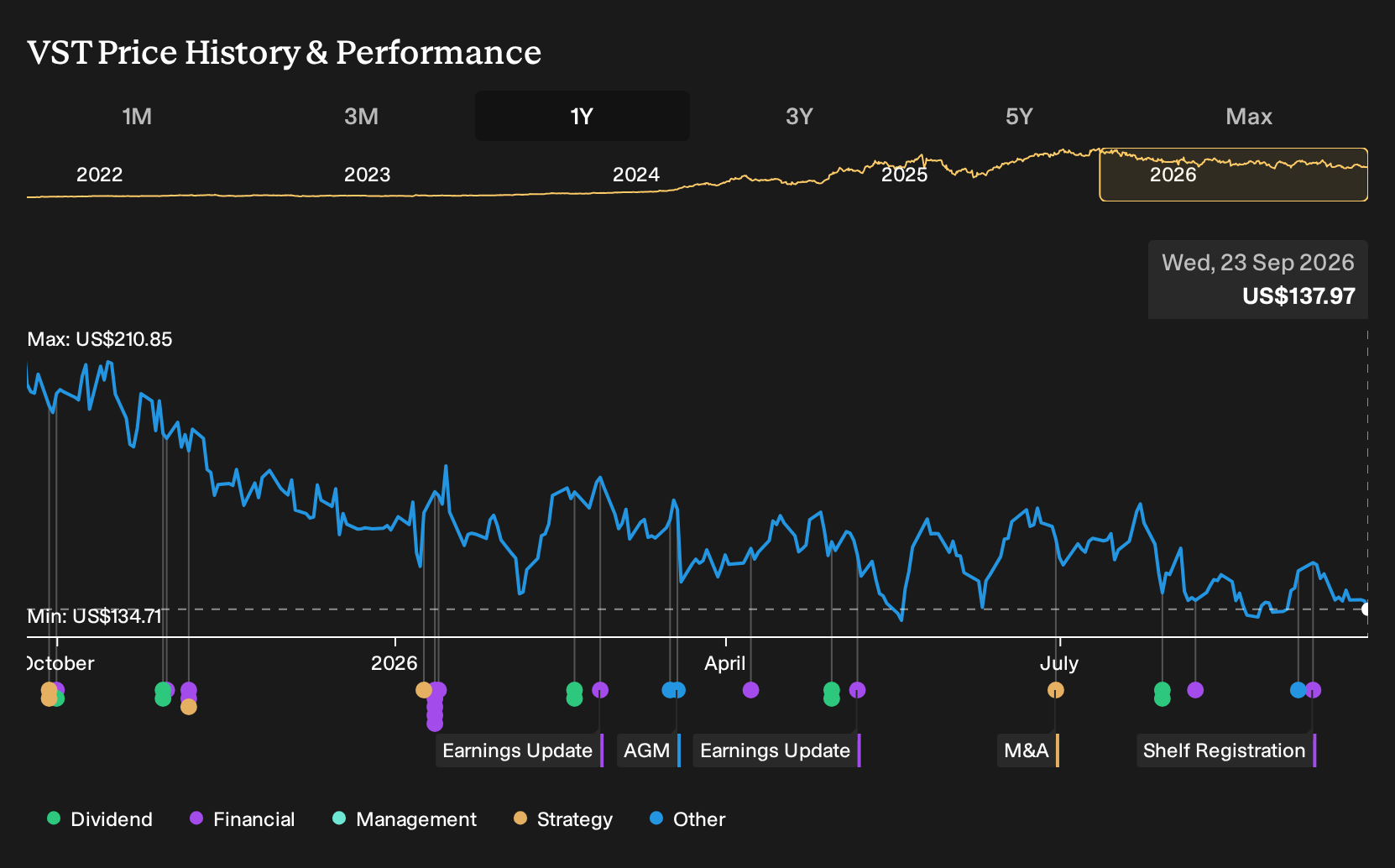
Vistra (VST)
Overview: Vistra is a Texas based integrated power producer and retailer that supplies electricity and gas to around 5 million US customers.
Operations: Vistra generates US$19.2b in revenue in the United States, with US$14.9b from Retail, US$7.8b from Texas, US$6.5b from East, and smaller contributions elsewhere.
Market Cap: US$47.1b
Vistra matters for this Texas focused screen because it links a large ERCOT generation fleet with a big retail book. Shifts in how Texas sources and prices power directly affect both sides of its business.
"In January 2026, Vistra signed 20-year power purchase agreements to supply Meta with more than 2,600 megawatts of nuclear electricity across three PJM plants, the largest nuclear uprate ever backed by a single corporate customer. Weeks later, Vistra agreed to buy Cogentrix Energy's gas fleet for $4.7 billion, adding roughly 5,500 megawatts of dispatchable capacity."
What happens to Vistra’s Texas margins if one key assumption about long term demand from power hungry customers quietly shifts direction?
If that demand picture has you thinking about how Vistra’s ERCOT exposure, retail book and recent deals fit together, the full narrative for Vistra maps where the pressure and upside could accelerate.
CenterPoint Energy (CNP)
Overview: CenterPoint Energy is a Houston based utility holding company that runs key electric and natural gas networks across several US states.
Operations: CenterPoint Energy generates all of its US$9.6b revenue in the United States, with US$5.2b from Electric and US$4.4b from Natural Gas.
Market Cap: US$24.9b
CenterPoint Energy matters in this Texas focused screen because its Houston wires, pipes and ERCOT exposure sit where solar growth meets rising urban demand.
"CenterPoint Energy expects to grow non-GAAP EPS at the mid to high end of a 7% to 9% range annually through 2028 and through 2035, which ties long dated earnings growth directly to its US$66.7b capital investment plan and large-load expansion, and therefore to future revenue and earnings."
What investors really need to watch is how one evolving cost of funding those projects shapes both future bill pressure and earnings quality.
That funding tension is exactly what the full narrative for CenterPoint Energy unpacks. It shows where CenterPoint Energy’s capital plan, customer bill pressure and earnings quality might quietly be decoupling.

Seeking Fresh Alternatives Beyond Texas?
New themes can move fast. By the time everyone spots the breakout, early momentum is already flying. Scan fresh, under the radar ideas before the crowd and act now.
- Ride potential income momentum by tracking reliable high yield payers through the 7 dividend fortresses while payout strength and balance sheet quality still look aligned.
- Spot early AI infrastructure trends by combing through 85 AI infrastructure stocks before demand stories are fully priced and the strongest operators stop looking overlooked.
- Position ahead of grid upgrade waves by reviewing the curated 39 power grid technology and infrastructure stocks while these capital intensive plays are still under the radar for now.
This article by Simply Wall St is general in nature. We provide commentary based on historical data and analyst forecasts only using an unbiased methodology and our articles are not intended to be financial advice. It does not constitute a recommendation to buy or sell any stock, and does not take account of your objectives, or your financial situation. We aim to bring you long-term focused analysis driven by fundamental data. Note that our analysis may not factor in the latest price-sensitive company announcements or qualitative material. Simply Wall St has no position in any stocks mentioned.
Have feedback on this article? Concerned about the content? Get in touch with us directly. Alternatively, email editorial-team@simplywallst.com