


Heated debt risks have sparked a wave of hedging! Nvidia (NVDA.US) CDS ranks among the most active products in the US market
The Zhitong Finance App learned that after Nvidia (NVDA.US) issued $25 billion in corporate bonds in June this year, derivatives related to this artificial intelligence (AI) chip giant have now become one of the most actively traded varieties in the US credit default swap (CDS) market as investors seek to hedge their debt exposure.
Nicholas GoDec, head of fixed income tradable commodities and commodities at S&P Dow Jones Indices, quoted DTCC data as saying that in the past six months, market participants traded credit protection against $6.9 billion in debt, compared to only US$640 million in nominal transactions in the previous six months.
The surge in trading volume is the main reason Nvidia was included in the latest round of S&P's CDX investment-grade index, which officially came into effect on Monday. Nvidia is one of the most liquid constituents in the 47th series of the index, which is used as an indicator to measure the market's perception of credit risk. Other companies in the same series include technology companies Oracle (ORCL.US), Amazon (AMZN.US), Google (GOOGL.US), Broadcom (AVGO.US), Meta Platforms (META.US), and Microsoft (MSFT.US).
Nicholas Godec said, “There has been a huge increase in CDS transaction volume associated with these companies. And as financing activities continue in data centers and other areas, there is no sign that this trend will stop anytime soon.” SpaceX (SPCX.US) is also among the six companies that joined the index this week, and both companies issued $25 billion in investment-grade bonds in June.
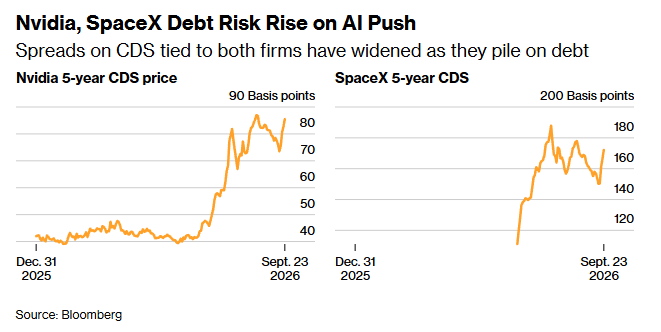
Nvidia and SpaceX debt risks have risen, driven by the AI boom
When S&P Dow Jones Indices rebalances the CDX index in March and September every year, it examines a number of factors, including CDS liquidity, credit ratings, and the issuer's debt structure. Newly included constituent stocks will reset the index's term and will generally increase trading volume. This index adjustment, combined with the rise in US Treasury yields, led to a widening of the index's interest rate spread.
The demand for credit default swaps comes from investors seeking to hedge against potential losses due to rising debt from hyperscalers (hyperscalers). At the same time, Wall Street banks are also buying credit protection to reduce their risk exposure to these borrowers, so that banks can continue to expand their business dealings with these companies.
Since this year, after massive borrowing and Nvidia's announcement of a series of AI-related infrastructure deals, the cost of providing default protection for Nvidia's debts has doubled, causing investors to worry about its overall debt burden.
Jigar Patel, macro credit strategist at Barclays, said: “For anyone looking to hedge against AI specific risks, the volume of AI-related single-name CDS contracts has always been amazing. I think this makes them a better alternative to hedging.”
S&P Dow Jones Indices adjusts the swap index for the US high-yield market twice a year. The next adjustment is expected on Monday.