


IonQ Just Proved the Biggest Threat to Quantum Computing Scaling Was an Illusion
The technology sector frequently obsesses over limits. For years, the narrative surrounding quantum computing followed a predictable script: physical qubits are too fragile, environmental noise is too disruptive, and correcting those errors requires too much power. Wall Street watched as heavyweights poured capital into complex engineering, worried that the traditional supercomputers needed to manage quantum mistakes would become an unsustainable financial and computational burden.
Ultimately, this skepticism created a major valuation bottleneck for pure-play quantum stocks. Sharp investors stayed on the sidelines, waiting to see if a quantum machine could ever run long calculations without grinding to a halt. However, IonQ (IONQ) may have just proved that the massive roadblock everyone feared might have been an illusion all along.
The Monster Under the Bed Was an Optimization Problem
To understand why IonQ just changed the conversation, we must look at the dreaded decoder bottleneck. In quantum computing, physical qubits are easily disrupted. To fix this, researchers group physical qubits into more stable “logical qubits.” But sorting through the firehose of error data generated by these logical qubits in real time historically required immense classical computing power. The industry consensus assumed that as a system scaled, an operator would need to buy a room full of supercomputers just to keep the quantum computer from pausing to catch its breath.
Surprisingly, IonQ just blew that assumption apart in a technical research paper published on arXiv. Here is what the numbers tell us from their benchmark tests:
- 408 logical qubits simulated across 88 memory blocks and magic factories.
- 31.5 million individual quantum operations executed at the “MegaQuOp” scale.
- 0.02% processing delay (stretch time) introduced under standard operational noise.
- 1 single standard CPU handled the entire real-time workload.
Instead of a multi-million-dollar supercomputer cluster, IonQ ran its full Walking Cat dual-decoder pipeline continuously in the background using a single, off-the-shelf central processing unit. The computational monster under the bed wasn't an unyielding law of physics; it was a software problem that IonQ just solved.
How IonQ Stacks Up Against the Competition
This milestone completely alters IonQ's commercial scaling roadmap. By proving that classical hardware overhead does not grow exponentially with quantum expansion, IonQ can scale without drowning in infrastructure costs. Ironically, while larger tech giants chase raw physical qubit counts that require massive refrigeration and classical support systems, IonQ’s trapped-ion architecture is carving out a highly efficient path to fault-tolerant commercialization.
IonQ's underlying business looks solid, especially following its recent vertical integration milestone of closing the SkyWater Technology acquisition to handle chip manufacturing in-house.
Financial Metric |
IonQ |
Rigetti Computing (RGTI) |
| Q2 2026 Revenue Growth (YoY) | 287% ($80.05 million actual) | 185% (5.1 million actual) |
| Raised Full-Year 2026 Guidance | $450 million to $460 million | No guidance provided |
| Liquidity & Cash Runway | $2.0 billion in cash/investments (Q2 2026) | $393.7 million in cash/investments (Q2 2026) |
| Remaining Performance Obligations | Up 297% ($42=85 million) | Up 686% ($40.7 million) |
Granted, IonQ is valued aggressively at roughly 15 times its projected 2028 sales and is expected to remain unprofitable for the foreseeable future. That said, its fortress balance sheet of $2.0 billion against a manageable debt-to-equity ratio of 1.03 gives it a luxury its pure-play peers simply do not have: time to commercialize.
Bottom Line
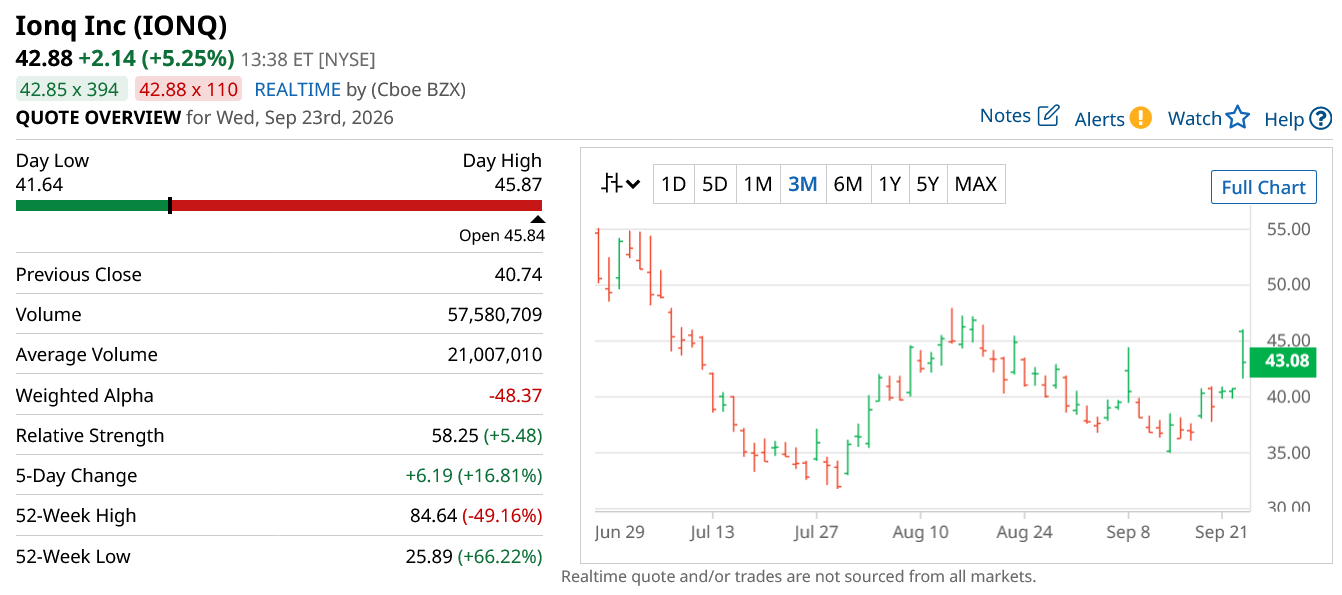
In short, IonQ's demonstration removes the primary engineering shadow hanging over its long-term scaling strategy. Shares have climbed 6% so far in today's trading following the news, pushing the stock's price/book above the 5x mark as the market began pricing in a more realistic path to commercialization.
However, smart investors will remain clear-eyed: this test was a benchmark simulation, not a physical 408-logical-qubit computer running on a desk today. Volatility will remain intense, as evidenced by its wide 52-week trading range of $25.89 to $84.64.
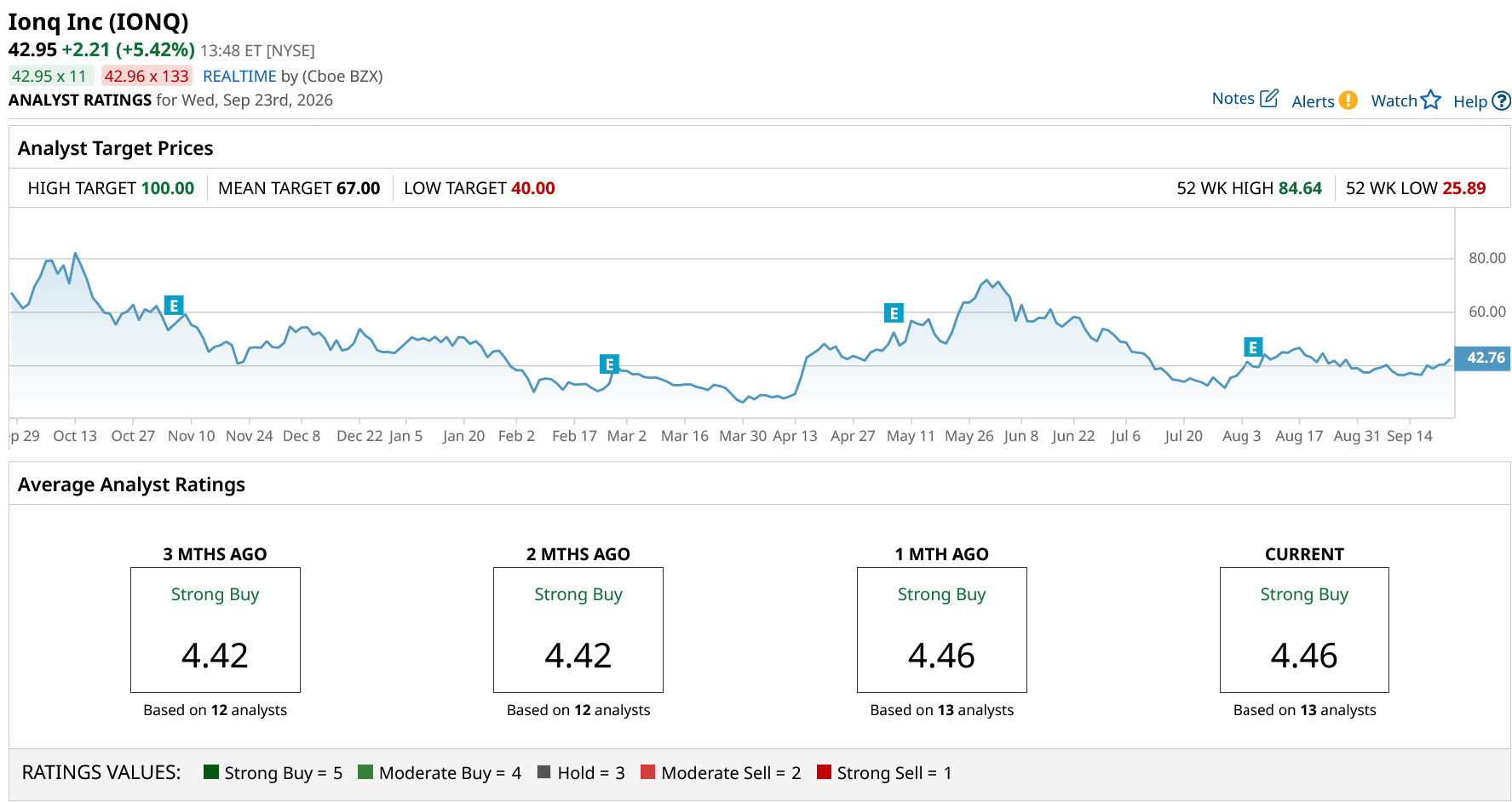
Wall Street is exceptionally bullish on IONQ stock, with a consensus “Strong Buy” rating among the 13 analysts covering it. The mean price target of $67 per share implies 49% potential upside over the next year.
Regardless of short-term price swings, the investing thesis has strengthened. With full-year 2026 revenue guidance recently hiked to a record range of $450 million to $460 million, IonQ is no longer just a pre-revenue science project. It is a vertically integrated, rapidly growing quantum computing platform that just proved its biggest existential threat was nothing more than an illusion. For investors with a five-to-10-year horizon who can stomach the volatility, IONQ is a buy.
On the date of publication, Rich Duprey did not have (either directly or indirectly) positions in any of the securities mentioned in this article. All information and data in this article is solely for informational purposes. For more information please view the Barchart Disclosure Policy here.