As the “big shorts” increase shorting, Citigroup Fuguo continues to sing Duomiguang (MU.US): Storage supply is still tight, and the upward profit cycle is not over
The Zhitong Finance App learned that recently, Michael Burry, who has the title of “Big Short,” said that it has increased its short position on Micron Technology (MU.US), and at the same time, there seems to be some disagreement on Wall Street — Citi raised the target price and Wells Fargo cut it down. However, unlike Burry, the two investment banks are still optimistic about this memory chip vendor.
Citibank analyst Atif Malik raised Micron's target price from $1,150 to $1,300, maintaining a “buy” rating. Wells Fargo's Aaron Rakers lowered the target price from $1,525 to $1,400, but the rating remained “increased.”
Malik's reason for raising its target price is straightforward — DRAM pricing is much better than expected. Citi raised Micron's profit forecasts for both the August and November fiscal quarters because both the DRAM and NAND markets continued to be in short supply. Specifically, Citi expects the average sales price of hybrid DRAM to rise 20% month-on-month in the August fiscal quarter and another 13% in the November fiscal quarter; NAND will rise even more sharply, reaching 34% and 15%, respectively.
The investment bank also specifically mentioned that Micron's stock price may usher in a wave of increases before the SEMICON West exhibition on October 13, because semiconductor equipment vendors are expected to discuss the shortage of DRAM at that time.
Citi's judgment on NAND is also worth paying attention to. Although consumer demand for NAND weakens due to limited supply from PC and mobile phone customers, demand for enterprise-grade SSDs continues to grow, driven by AI reasoning, enough to offset the weakness on the consumer side.
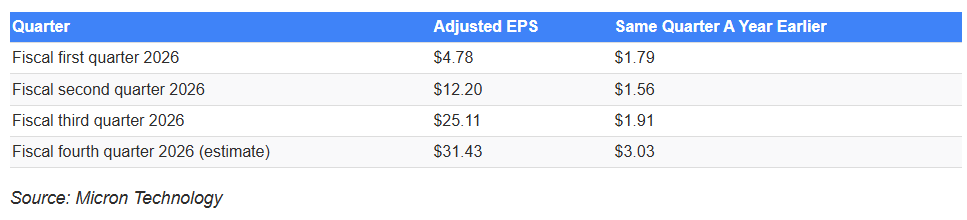
Wells Fargo's actions are contradictory — the target price was lowered by 8%, but Rakers instead raised its earnings per share forecast for the 2027 and 2028 fiscal years by more than 10%. The reduction in the target price is not due to weakening profits, but rather a greater discount on the “uncertainty of peak profit.” Rakers wrote in the report that investors will continue to debate whether Micron's EPS can reach $200 per share in the 2028 fiscal year.
His recent judgment has not changed -- the three factors “tight storage supply, expanded strategic customer agreement (SCA), and strong execution by Micron” still support the upward trend in performance. Wells Fargo expects DRAM and NAND supply to fall short of demand by 2027, and Micron has signed 16 SCAs, and these agreements provide “downside protection and a price bottom line.”
Speaking of data: the price increase in the third quarter was more drastic than predicted by the model
Bank of America Securities analyst Simon Woo released a channel survey last week, adding real ammunition to those who are bullish. Research shows that in the third quarter of 2026, the average price of most DRAM products increased 20% to 30% month-on-month, and NAND increased by more than 15%. This figure is much higher than TrendForce's July forecast of 13% to 18%.
What is more noteworthy is the signal: hyperscale cloud vendors have signed new contracts and agreed to pay a higher DRAM price in the first quarter of 2027 than in the fourth quarter of 2026. Buyers actively accept price increases and lock expectations into contracts, which is unusual in the history of the storage industry.
Bank of America also raised the average DRAM price forecast from 2027 to 2028 by 8% to 12%, and raised the 2030 global memory market forecast from 1.8 trillion US dollars to 2.0 trillion US dollars. However, Bank of America didn't just sing too much — they expect the 2028 price to fall by about 10% from the 2027 high, which is considered a “soft landing.”
Stifel analyst Brian Chin's views are more aggressive. He predicts that DRAM bit supply will need to increase by 40% to 50% or more in 2027 to actually close the gap between supply and demand, while the actual growth rate that can be achieved is probably only 15% to 20%. In the report, Chin wrote, “We believe the continuity of this storage upcycle is still underestimated.”
Burry steps up to go short
However, amid much buzz, Michael Burry posted on Substack on Tuesday that he had increased Micron's short position “on a considerable scale.” The investor, famous for “The Big Short,” quoted Acer CEO Chen Junsheng's comment that the increase in memory chip production in mainland China may eventually ease supply restrictions, putting pressure on prices, and the impact will become apparent around the end of 2027.
Bury's logic is: part of the shortage of traditional memory stems from manufacturers shifting production capacity to HBM for AI. Now that production of ordinary memory is recovering, the gap between supply and demand will gradually narrow. His short positions are not limited to Micron, but also AI-related targets such as semiconductor ETF-iShares (SOXX.US) and Palantir Technologies (PLTR.US).
Burry clearly questioned the memory chip maker's valuation. He described these companies' stock prices as “rising to an outrageous level compared to themselves,” and predicted that once the cycle was reversed, the relevant individual stocks would face a “sharp sell-off.”
What investors really care about
The current Micron divide is ultimately a question: when will the storage industry's capacity expansion actually catch up with demand. What the bulls are seeing is AI-driven structural demand growth, revenue visibility locked in by the Changxie Association, and the continuing scarce supply and demand pattern; bears are betting on the price pressure brought about by the gradual recovery of the supply side and the expansion of production by Chinese manufacturers.
Micron's current forward price-earnings ratio is about 7.3 times, which is almost the cheapest in the technology sector. However, there is a reason why cheap is cheap. The market's discounted valuation of storage stocks is because the industry is too cyclical, and everyone is afraid to take over at the top of the cycle.
TD Cowen's Krish Sankar thinks this round isn't the same as before. His reason is that demand for DRAM now increasingly comes from AI data centers rather than mobile phones and PCs, and the sustainability and scale of demand is not on the same level as in the past. Sankar's target price for Micron is 1,600 US dollars. His valuation logic is not based on higher profit predictions, but rather believes that the market should give Micron a higher price-earnings ratio.
However, Sankar also acknowledged that Micron has gone through about 80% of the typical profit margin expansion cycle, and the room for future profit forecasts to continue to be drastically revised is narrowing.
Micron's upcoming fourth-quarter earnings report to be released on September 30 may provide some new clues to this debate.