


The “profit bubble theory” is overstated! Goldman Sachs: AI spending is unlikely to drop until 2028
The Zhitong Finance App notes that the AI investment boom is expected to remain an important support for corporate profits until at least 2027. Goldman Sachs said that AI spending is unlikely to decline absolutely until 2028 or later.
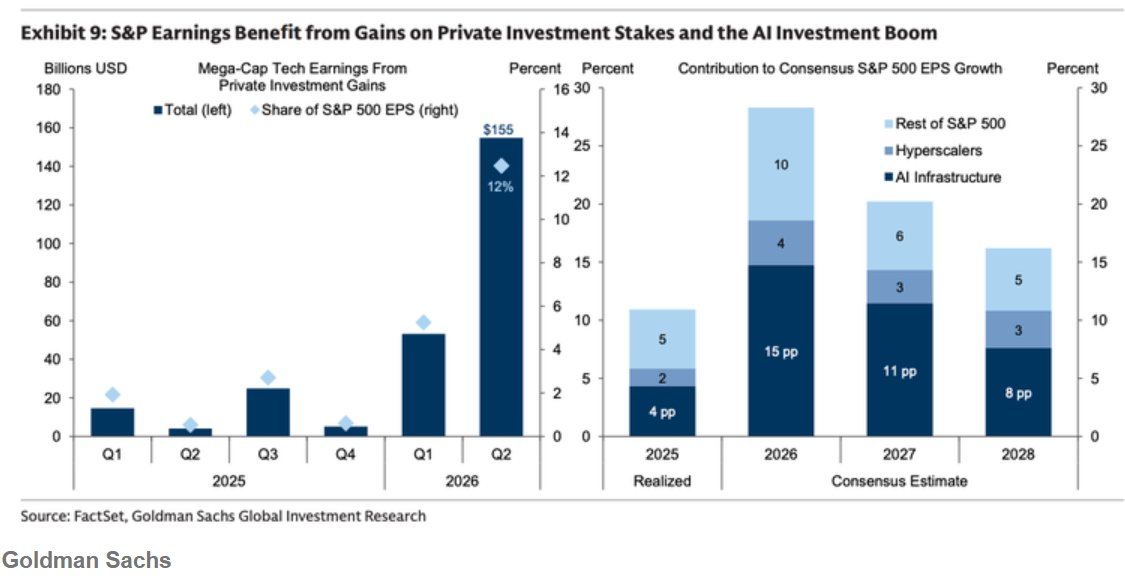
Goldman Sachs chief economist Jane Hazus said that earnings per share of the S&P 500 index are expected to increase by 36% in 2026, driven by private equity investment income and unexpected dividends from AI investments, which cover the expansion of profit margins of semiconductor and storage companies.
Goldman Sachs does expect this unconventional growth rate to cool down. Goldman Sachs's US stock strategists believe the S&P 500 EPS growth rate will slow to 11% in 2027 as private equity returns gradually subside and AI spending gets closer to peak. However, Hazus said that the slowdown is likely to be much greater only when AI investment begins to decline definitively — and Goldman Sachs believes this situation is unlikely to occur until 2028 or later.
Goldman Sachs believes that the statement about the profit bubble is overstated, although due to the AI-driven boost, the company's current profit is indeed in a “excessive profit” state compared to a more normal cycle.
According to estimates, AI infrastructure contributed about 15 percentage points to the S&P 500 EPS growth in 2026, 11 percentage points in 2027, and 8 percentage points in 2028; hyperscale cloud service providers contributed 4, 3, and 3 percentage points, respectively.
The test is 2028
The judgment that “AI spending will definitely not drop until 2028” is not an exception on Wall Street. Over the past few months, mainstream investment banks have intensively raised S&P 500 profit expectations — differences are no longer in the direction, and how long can I actually carry the index's profit growth.
Morgan Stanley's upgrade is the most aggressive. Andrew Hitz, the bank's chief cross-asset strategist, raised the 2026 S&P 500 profit growth forecast sharply from 17% to 23% in the mid-term outlook. The core reason is that the wave of AI capital expenditure is reshaping the “inelastic demand” of the US economy. The capital expenditure of large cloud computing companies is expected to reach 805 billion US dollars in 2026, almost double the forecast a year ago.
However, Damo also showed another side of growth. The capital expenditure of the four major cloud vendors Microsoft, Alphabet, Amazon, and Meta is expected to increase 57% in 2027 compared to 2026. The bank has lowered the four 2027 free cash flow forecasts, believing that AI-related loans will need to be increased before cash flow catches up with capital expenditure.
The main line of J.P. Morgan's narrative is “from promised spending to delivering revenue.” The bank raised its profit forecast twice during the year, raising the S&P 500 EPS forecast from $350 to $365 in 2026 and from $390 to $420 in 2027. The target point for the end of the year rose to 8,000 points.
Its strategist pointed out that as backlog orders gradually turned into confirmed revenue, cloud business growth was strongly supported, helping to prove that expanding AI capital expenses were “worth the money” and ease market concerns about return on investment capital (ROIC).
Notably, Komo did not raise the valuation assumption — the forward price-earnings ratio remained around 20 times, which meant that its bullish logic almost completely bet on profit fulfillment.
Barclays and HSBC are more vocal. Vinu Krishner, head of US stock strategy at Barclays, raised the year-end target to 7,950 points, saying that the “bright” earnings season led by the tech sector strengthened the AI-supported long-term profit growth logic and raised the 2026 EPS forecast sharply from $337 to $365; but he also confessed that he had doubts about the persistence of AI spending, inflationary stickiness, and more hawkish interest rate prospects, and that valuation assumptions were restrained as a result.
Nicole Inui, head of stock strategy at HSBC, raised the target by 450 points to 8,100 points at once. S&P 500 profits are expected to increase by nearly 40% in the first half of 2026, and still 25% in the second half of the year.
UBS places special emphasis on the “prepaid” nature of demand — pre-purchase computing power orders from hyperscale cloud vendors have reached 2 trillion US dollars, and it is estimated that about half of the 2026 index profit growth will come from the technology sector.
Overall, Wall Street has few objections to “AI is the core engine of the S&P 500 EPS”. The real differences are on three points: the speed of capital expenditure to revenue conversion, how to finance the free cash flow gap, and who to hand over the growth baton after spending spikes around 2028.