


Costco Earnings Bull Put Spread has a High Probability of Success
Costco Wholesale (COST) is an American multinational membership-only warehouse club headquartered in Issaquah, Washington, and one of the world's largest retailers, offering bulk groceries, general merchandise, and services at low prices to its paying members.
The company operates a membership-fee-driven business model across hundreds of warehouses worldwide, generating steady, recurring revenue from renewals alongside its retail sales, and is known for its Kirkland Signature private label and high membership loyalty.
Costco has stayed above the expected range following four of their six most recent earnings announcements.
COST Earnings Bull Put Spread
With earnings set for September 24th after the market close, implied volatility on COST stock is through the roof.
Implied volatility is sitting at 23.64% compared to a twelve-month low of 17.30%.
That means, it’s a great time to be an option seller.
If you have a bullish outlook for Costco for their earnings announcement, then a bull put spread is a great strategy to employ.
To execute a bull put spread, an investor would sell a naked put and then buy a further out-of-the-money put to create a spread.
A bull put spread is considered less risky than a naked put, because the losses are capped thanks to the bought put.
Potential Benefits
Bull put spreads offer several advantages for options traders seeking to generate income while managing risk.
They provide a defined-risk strategy, allowing traders to know their maximum potential loss upfront.
Additionally, bull put spreads benefit from time decay, as they profit from the erosion of extrinsic value over time.
This time decay accelerates as the expiration date approaches.
Bull put spreads will benefit from the drop in implied volatility that always occurs after an earnings announcement.
Potential Risks
While bull put spreads offer enticing benefits, they also come with inherent risks.
One significant risk is the potential for substantial losses if the underlying stock's price declines sharply.
Traders must also consider the possibility of early assignment, which can occur if the stock price moves below the short put option's strike price before expiration.
It's essential for traders to thoroughly understand and manage these risks when implementing this options strategy.
Selling a COST Bull Put Spread
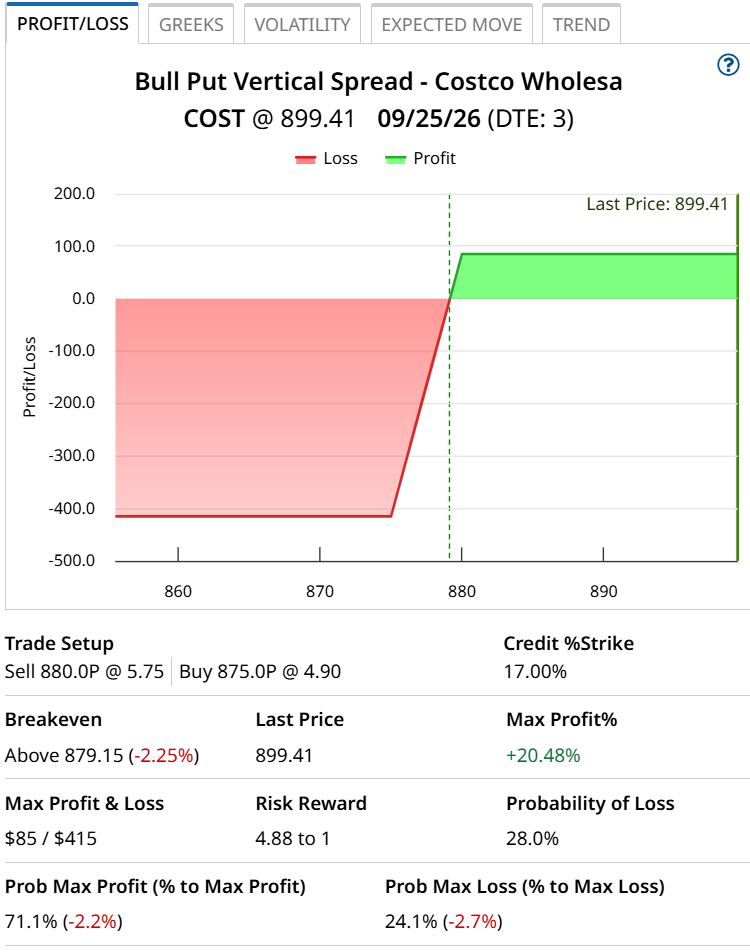
A trader selling the September 25th, $880-strike put and buying the $875-strike put on COST would receive around $85 into their account and would have a maximum risk of $415.
That represents a potential 20.48% return on risk between now and September 25th if COST stock remains above $880.
If COST stock closes below $875 on September 25th, the trade loses the full $415.
The breakeven point for the bull put spread is $879.15 which is calculated as $880 less the $0.85 option premium per contract.
Company Details
The Barchart Technical Opinion rating is a 100% Sell with a Average short term outlook on maintaining the current direction.
Long term indicators fully support a continuation of the trend.
Of the 36 analysts covering COST, 20 have a Strong Buy rating, 4 have a Moderate Buy rating, 11 have a Hold rating and 1 has a Strong Sell rating.
Conclusion
Selling a bull put spread on COST ahead of earnings can offer traders an opportunity to capitalize on anticipated bullish sentiment while managing downside risk.
By carefully selecting strike prices and expiration dates, traders can position themselves to potentially profit from a favorable earnings outcome while limiting potential losses.
However, it's crucial for traders to conduct thorough analysis and adhere to risk management principles to navigate the inherent uncertainties associated with earnings events.
Please remember that options are risky, and investors can lose 100% of their investment.
This article is for education purposes only and not a trade recommendation. Remember to always do your own due diligence and consult your financial advisor before making any investment decisions.
On the date of publication, Gavin McMaster did not have (either directly or indirectly) positions in any of the securities mentioned in this article. All information and data in this article is solely for informational purposes. For more information please view the Barchart Disclosure Policy here.