


Learn Why The Bull Case For Amex Stock Could Change Following Business Banking Expansion
- American Express launched a new Business Savings account at a 2.95% APY with no monthly fees, integrated it into a unified Business Banking platform with Business Checking, and introduced an integrated payroll solution powered by Gusto along with new reward redemption options for Graphite Business Cash Unlimited Card Members.
- The expanded American Express Business Banking suite concentrates more small business cash management, payroll, and card rewards within the same ecosystem, which can deepen client relationships and increase operational stickiness for business customers.
- This article examines how American Express's investment narrative is influenced by its expanded Business Banking and payroll offerings.
American Express Investment Narrative Recap
Owning American Express means believing the premium payments and travel model can keep attracting high spending consumers and businesses, even as competition and digital wallets keep evolving. The near term story still hinges on maintaining card fee momentum while keeping rewards and servicing costs in check. Recent lounge news does not materially change that core equation.
The biggest operational risk remains rising customer engagement expense as rivals refresh perks and younger users experiment with alternative payment options. Lounge expansion in Canada is incremental. It supports the travel value proposition for premium cardmembers but is not a major swing factor for earnings or near term market sentiment.
The lounge partnership expansion with Aspire Pre Flight Hospitality in Canada is the clearest link back to American Express travel centric brand. Two new Aspire Amex Lounges in Calgary and Montréal, in addition to the 2025 opening, keep the travel benefits package tangible for cardmembers. More than 50,000 visits to the first lounge show customers are using these perks.
For potential catalysts, this kind of benefit can support retention for premium and small business cards that contribute to fee income and billed business. The operational question is whether growing lounge access and related benefits eventually requires higher ongoing spend on perks to preserve differentiation, at a time when competition, digital payment options, and potential margin pressure are already key risks for the stock.
American Express Business Banking Through the Numbers
American Express' push into Business Banking and payroll tools sits against analyst expectations that revenues will reach US$95.1b and earnings will come to US$14.8b by 2029. Consensus modeling implies American Express' revenue grows at about 11.4% a year, with earnings rising by roughly US$3.7b from US$11.1b today to that US$14.8b mark.
The business savings account, unified cash management, and Gusto powered payroll slot into that story as ways to keep more small business funds, transactions, and rewards activity inside the American Express ecosystem. For an investor, this is less about headline APY and more about how often a small business owner touches American Express products when paying staff, managing surplus cash, or redeeming card rewards. Each extra touchpoint can reduce the odds that a business shifts key relationships to a rival bank or fintech.
That stickiness matters when analysts already factor in profit margins slipping from 16.1% today to 15.5% in three years. If engagement costs rise as expected, products that tie together deposits, payments, and cards can help defend economics by lifting overall engagement per customer rather than just chasing new sign ups with richer perks. The expanded Business Banking suite effectively spreads the cost of rewards and servicing across more revenue streams from the same small business relationship.
There is a trade off. A broader small business offering usually means higher technology and compliance spending. Payroll in particular can be operationally complex and tightly regulated. If American Express needs to keep investing heavily to keep its platform competitive with full service banks and specialist payroll providers, the margin compression analysts already model could prove conservative on the cost side. Readers should watch how management discusses expense discipline around Business Banking on future calls.
At the same time, the analyst framework that leads to US$95.1b of revenue and US$14.8b of earnings by 2029 assumes a P/E of 20.7x on those earnings, compared with 21.6x today and well above the 8.7x cited for the broader US consumer finance group. To keep justifying that kind of earnings multiple, American Express needs a credible story that it can do more than issue premium cards. A visible small business cash management and payroll platform helps support that argument by signaling a deeper role in day to day commercial finance, not just travel and entertainment spend.
For you as a retail investor, the key filter is simple. Ask whether the Business Banking expansion makes it more plausible that American Express can reach the analyst consensus path for revenue, margins, and earnings without leaning only on higher card fees or ever richer rewards. If the answer is yes, the new savings, checking, and payroll bundle looks like part of the broader investment narrative rather than just a side product launch.
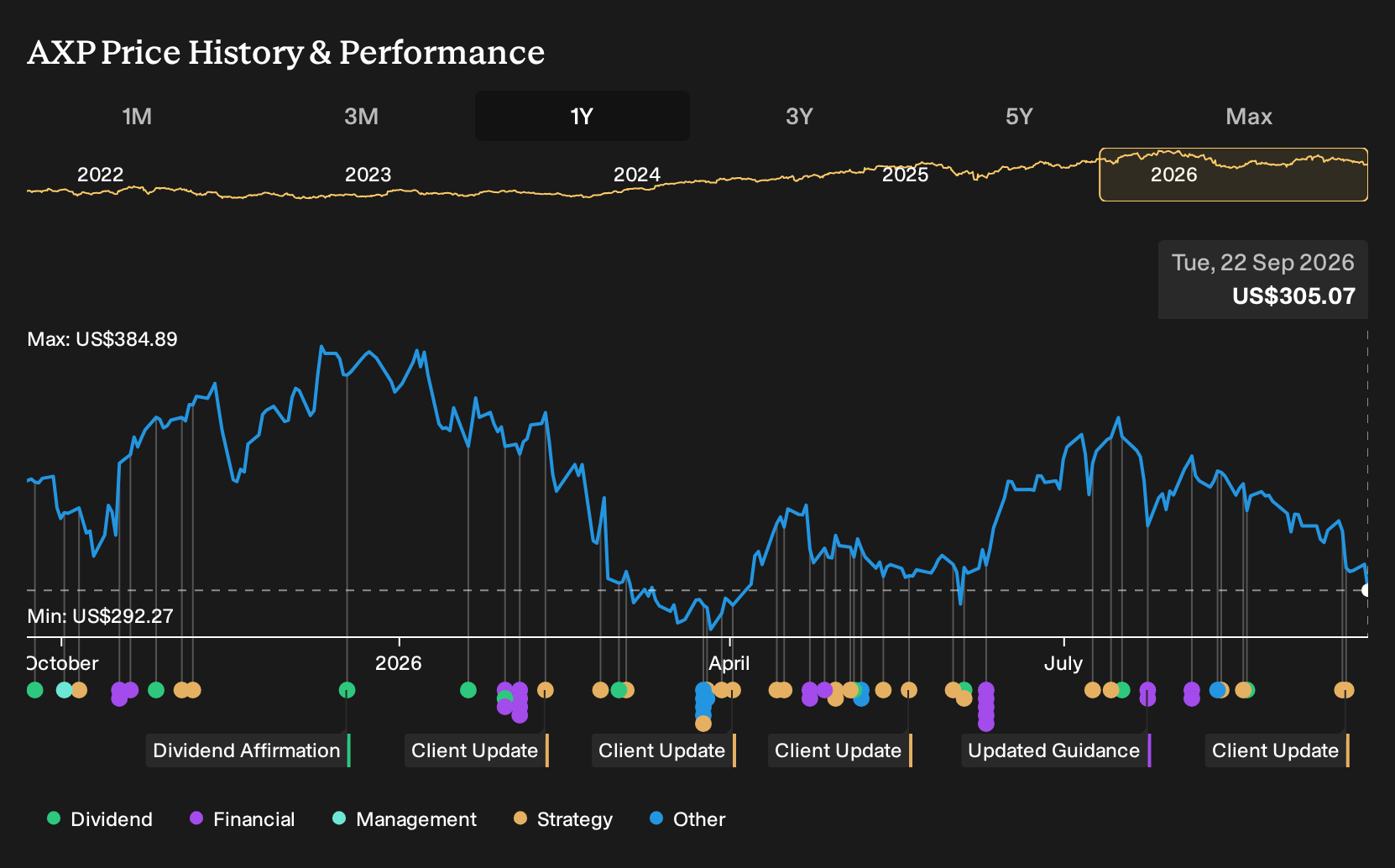
Uncover why American Express' fair value indicates a 23% potential upside to its current price. This represents a discount that could close faster than investors expect.
Exploring Other Perspectives
One tension point in the alternate view is lounge and rewards spend that does not translate into the revenue mix bearish analysts want to see. Those lower estimates still pencil in revenue of about US$96.4b and earnings near US$14.5b by 2029, yet they support only a US$315.0 price target. That is a much more cautious story. Both that pessimistic path and the consensus view were set before the Business Banking launch and new Canadian lounge expansion. So treat them as starting points rather than final answers, and explore how your own expectations differ.
Explore 7 other American Express fair value estimates, including one that suggests it could be worth just $315.00.
Form Your Own Verdict
Disagree with existing narratives? Extraordinary investment returns rarely come from following the herd, so go with your instincts.
- A great starting point for your American Express research is our analysis highlighting 4 key rewards and 1 important warning sign that could impact your investment decision.
- See our latest analysis for American Express. The report includes a comprehensive fundamental analysis summarized in a single visual, the Snowflake, making it easy to evaluate American Express' overall financial health at a glance.
Looking for more investment ideas beyond American Express?
If American Express has sharpened your sense of what a strong business model looks like, it can be useful to widen the lens and compare it with other listed companies that fit different risk and income profiles.
- For investors who care most about quality at a sensible entry point, scan a curated set of attractively priced companies through the 29 high quality undervalued stocks.
- If capital preservation sits higher on your list than aggressive upside, focus on businesses with steadier risk metrics via the 30 resilient stocks with low risk scores.
- When a resilient balance sheet matters more than headline hype, review companies with robust financial footing using the list of solid balance sheet and fundamentals (23 results).
This article by Simply Wall St is general in nature. We provide commentary based on historical data and analyst forecasts only using an unbiased methodology and our articles are not intended to be financial advice. It does not constitute a recommendation to buy or sell any stock, and does not take account of your objectives, or your financial situation. We aim to bring you long-term focused analysis driven by fundamental data. Note that our analysis may not factor in the latest price-sensitive company announcements or qualitative material. Simply Wall St has no position in any stocks mentioned.
Have feedback on this article? Concerned about the content? Get in touch with us directly. Alternatively, email editorial-team@simplywallst.com