


3 US Bank Stocks Facing The Biggest Interest Rate Test
Interest rates are no longer a background detail. With the Fed lifting its key rate to 3.75% to 4.00% and the 10 year Treasury yield near 5.0%, borrowing costs are biting, yet bank stocks in our US Large Cap Bank Stocks screener sit right in the crosshairs of this shift. This article walks through three large US lenders most exposed to this news, and why that exposure could either help or hurt your portfolio decisions.
The three large banks highlighted below are only a starting sample. The full US Large-Cap Bank Stocks screen surfaced 31 more institutions with equally compelling narratives that are not covered here.
To see the broader field and identify which lenders best fit your own risk, dividend, and balance sheet priorities, head straight into the US Large-Cap Bank Stocks screener to analyze, filter, and focus on your highest conviction ideas.
Nicolet Bankshares (NIC)
Overview: Nicolet Bankshares is a regional bank holding company offering traditional deposit, lending, and wealth services to households and businesses across the Upper Midwest.
Operations: Nicolet Bankshares generates about US$510 million in revenue from consumer and commercial banking services across the United States.
Market Cap: US$3.52b
Nicolet Bankshares fits the US Large-Cap Bank Stocks theme as a deposit-rich regional lender whose earnings are closely tied to net interest margins in a higher-rate environment. Recent net interest income trends, active buybacks, and a regular dividend give rate-focused investors several factors to monitor, particularly if a single key assumption about margin resilience begins to change.
If that margin story is what you care about most, start with the 3 key rewards and 2 important warning signs (1 is major!) to see what could quietly accelerate or cap Nicolet Bankshares from here.

Columbia Financial (CLBK)
Overview: Columbia Financial is a US bank holding company that provides lending, deposit, and financial services to households and businesses.
Operations: Columbia Financial generates about US$267 million in revenue from financial services entirely within the United States.
Market Cap: US$3.1b
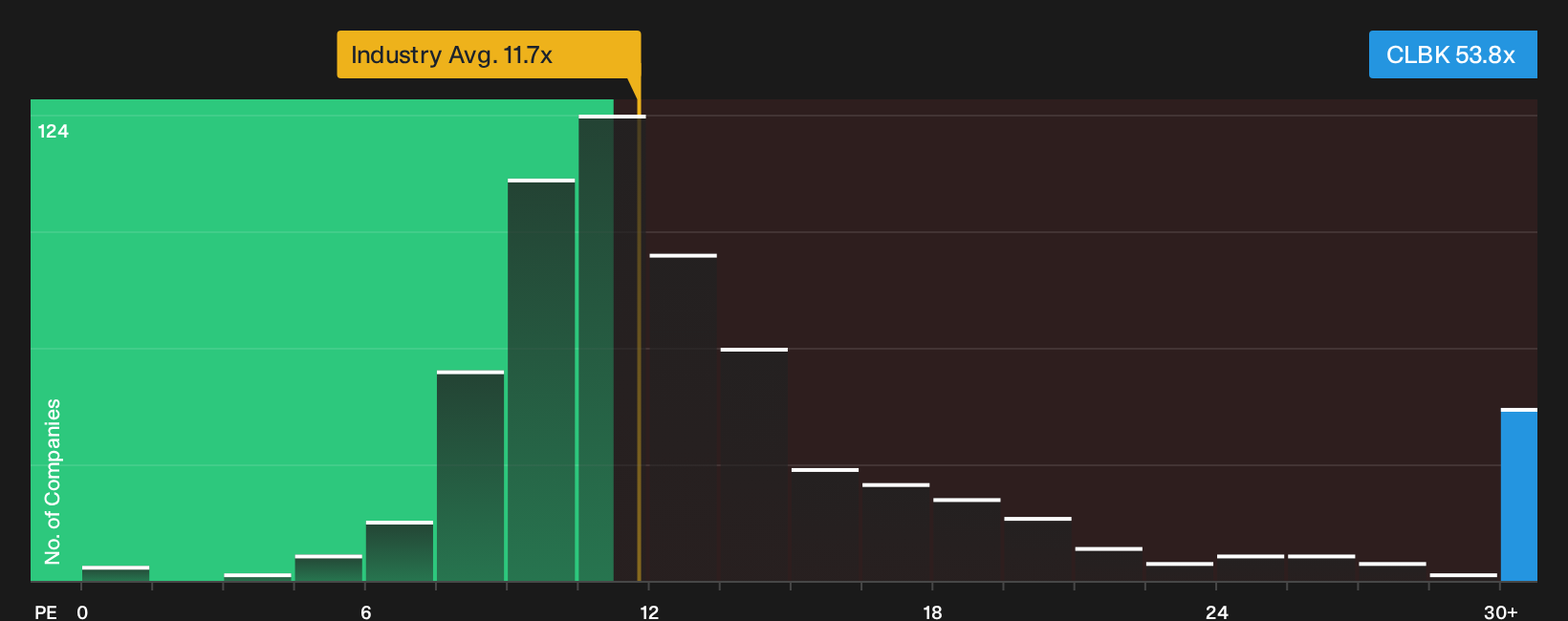
Columbia Financial is closely connected to the US Large-Cap Bank Stocks theme because its lending and deposit activities operate fully within the US rate system. Its recent earnings and margin strength are accompanied by a very high P/E multiple and modest ROE, which could change significantly if even a single source of pressure on funding costs or credit quality begins to emerge.
That valuation pressure point is exactly why it is worth scanning the 3 key rewards and 1 important warning sign before funding costs or credit trends start accelerating under the surface.
Northwest Bancshares (NWBI)
Overview: Northwest Bancshares is a large US savings bank holding company that focuses on deposit gathering and lending spreads across several Midwestern and Mid-Atlantic states.
Operations: Northwest Bancshares generates about US$654 million in banking revenue entirely from customers within the United States, tightly linked to domestic interest rates.
Market Cap: US$2.26b
Northwest Bancshares gives you exposure to the US Large-Cap Bank Stocks theme, with earnings closely tied to net interest income and a funding base that reacts directly to Fed policy and long-term Treasury yields.
"The successful completion and integration of the Penns Woods acquisition, with cost savings tracking ahead of original expectations and full run-rate efficiencies expected by mid-2026, should materially improve expense ratios and net margins going forward."
What really matters now is how one less visible shift in its funding mix shapes the next stage of Northwest Bancshares' margin story.
As that funding mix shifts, the full narrative for Northwest Bancshares shows how the Penns Woods integration, deposit behavior, and credit trends could be quietly reshaping Northwest Bancshares' next phase.

Seeking Fresh Alternatives Beyond Big Banks?
Fresh opportunities move fast. Breakout themes gather momentum, quiet winners keep flying under the radar for now, and latecomers get caught chasing. Spot the next wave and consider your options early.
- Target dependable cash flows and steady income by scanning a curated pool of companies in the 7 dividend fortresses before yields change or valuations adjust.
- Hunt for early-stage potential in under-followed businesses using the 17 high quality undiscovered gems while they are still flying below most investors' screens.
- Follow the buildout of next-gen infrastructure by tracking companies in the 87 AI infrastructure stocks while the theme is still under the radar.
This article by Simply Wall St is general in nature. We provide commentary based on historical data and analyst forecasts only using an unbiased methodology and our articles are not intended to be financial advice. It does not constitute a recommendation to buy or sell any stock, and does not take account of your objectives, or your financial situation. We aim to bring you long-term focused analysis driven by fundamental data. Note that our analysis may not factor in the latest price-sensitive company announcements or qualitative material. Simply Wall St has no position in any stocks mentioned.
Have feedback on this article? Concerned about the content? Get in touch with us directly. Alternatively, email editorial-team@simplywallst.com