


Postal Savings Bank Of China (SEHK:1658) Gains Ground, Is The Valuation Still Reasonable?
Postal Savings Bank of China (SEHK:1658) has drawn fresh attention after recent share gains over the past month, with the stock now at HK$5.42 and multi‑year total returns above 40%.
Recent trading has been gently supportive, with Postal Savings Bank of China posting a 9.73% 1 month share price return and a 7.65% 3 month share price return, while longer term investors are still sitting on a 62.47% 3 year total shareholder return, which suggests that momentum has been building rather than fading.
Scan how Postal Savings Bank of China’s recent momentum compares with other financials on our hand picked list of 174 high quality undervalued stocks.
Postal Savings Bank of China has clear scale and a solid recent track record in the market. After this latest climb, the key question is whether the current valuation still offers enough appeal for new investors.
Price-to-Earnings of 6.5x: Is it justified?
On earnings, the recent move in Postal Savings Bank of China leaves the stock trading on a P/E of 6.5x at a last close of HK$5.42. That level sits between the sector average and what regression analysis suggests could be a fairer multiple.
The P/E ratio compares the current share price with earnings per share. For a bank like Postal Savings Bank of China it reflects what investors are willing to pay today for each unit of profit, given its scale, credit risk profile, and growth outlook.
Postal Savings Bank of China carries a higher P/E than the Hong Kong Banks industry average of 5.2x, which implies the market is assigning a richer tag to its earnings stream. Yet the current 6.5x level is below an estimated fair P/E of 6.9x, which points to some room for the valuation multiple to move closer to that fair ratio if the business continues to back up its recent earnings growth and margin profile.
Against peers, the P/E of 6.5x is firmly above the 5.2x industry mark, which is a clear premium. However, it still sits under the peer average of 8.4x, so the market is pricing Postal Savings Bank of China as stronger than the sector overall but not at the very top end of the group.
Explore the SWS fair ratio for Postal Savings Bank of China.
Result: Price-to-Earnings of 6.5x (ABOUT RIGHT)
Still, Postal Savings Bank of China faces real pressure points, including fluctuations in credit quality in its domestic loan book and shifts in Chinese policy that could affect profitability.
Find out about the key risks to this Postal Savings Bank of China narrative.
Another View on Postal Savings Bank of China’s Value
The P/E story only goes so far. Our DCF model indicates a fair value estimate of about HK$11.30 per share, which is above the current HK$5.42 price. This suggests Postal Savings Bank of China could be trading below the value implied by these cash flow assumptions.
Look into how the SWS DCF model arrives at its fair value.
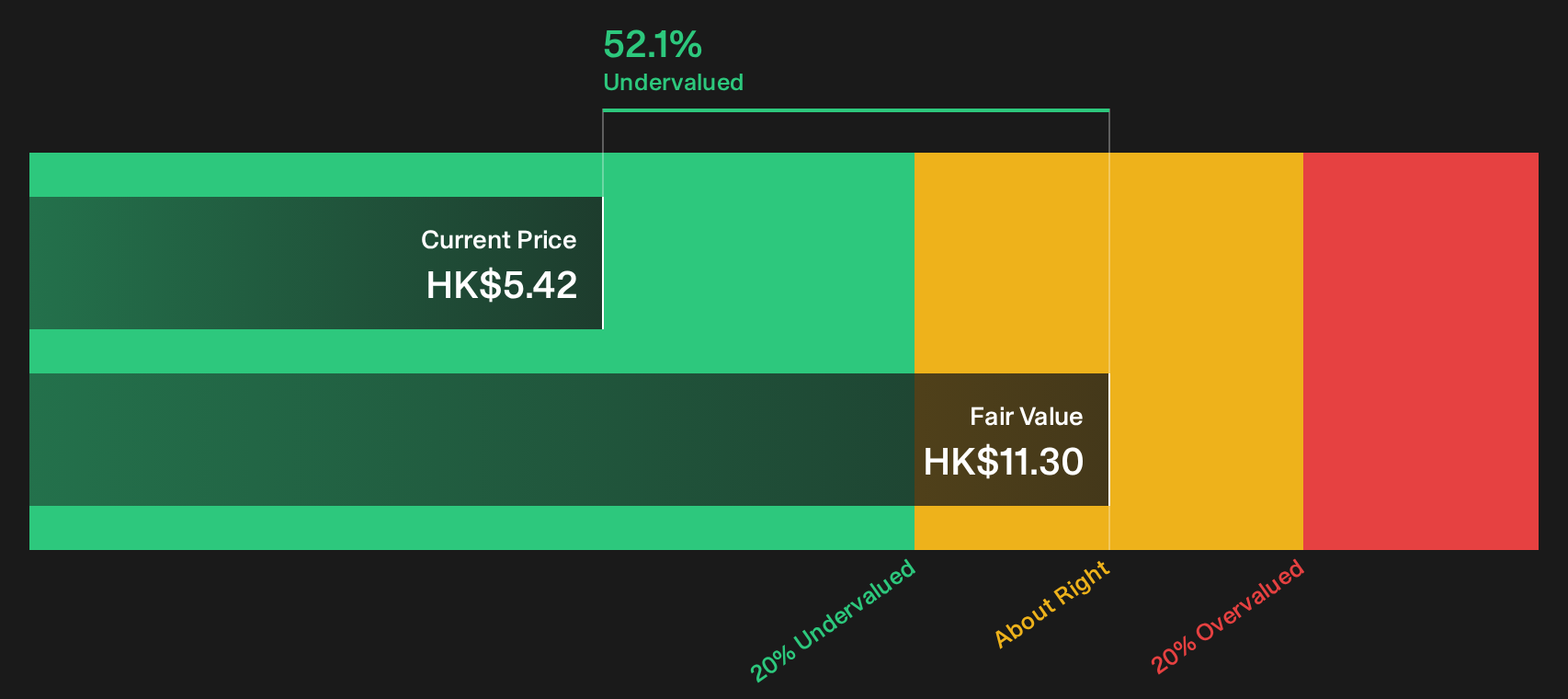
Simply Wall St performs a discounted cash flow (DCF) on every stock in the world every day (check out Postal Savings Bank of China for example). We show the entire calculation in full. You can track the result in your watchlist or portfolio and be alerted when this changes, or use our stock screener to discover 174 high quality undervalued stocks. If you save a screener we even alert you when new companies match - so you never miss a potential opportunity.
Next Steps
Comfortable with the balance of risks and rewards around Postal Savings Bank of China, or still on the fence? If you want to pressure test that view with a structured checklist of both potential upsides and concerns, take a closer look at the 3 key rewards and 1 important warning sign.
Looking for more investment ideas beyond Postal Savings Bank of China?
If Postal Savings Bank of China has sharpened your interest, do not stop here. Broaden your watchlist and pressure test your thinking with a few focused stock ideas.
- Target resilient balance sheets by scanning the list of solid balance sheet and fundamentals (198 results) that combine financial strength with disciplined fundamentals.
- Hunt for underappreciated opportunities by reviewing the 616 high quality undiscovered gems that pair quality metrics with relatively low market attention.
- Build a steadier income stream by checking the 161 dividend fortresses that could help anchor your portfolio with higher yielding payers.
This article by Simply Wall St is general in nature. We provide commentary based on historical data and analyst forecasts only using an unbiased methodology and our articles are not intended to be financial advice. It does not constitute a recommendation to buy or sell any stock, and does not take account of your objectives, or your financial situation. We aim to bring you long-term focused analysis driven by fundamental data. Note that our analysis may not factor in the latest price-sensitive company announcements or qualitative material. Simply Wall St has no position in any stocks mentioned.
Have feedback on this article? Concerned about the content? Get in touch with us directly. Alternatively, email editorial-team@simplywallst.com