


“Double drop in oil debt” breaks the siege of the AI market! The “gray rhino” fearless of the Fed's interest rate hike, tech stocks are in a frenzy
The Federal Reserve raised interest rates for the first time in three years, causing US stocks to fall for only one day.
Last Wednesday (September 16), the Federal Reserve raised the federal funds rate target range by 25 basis points to 3.75%-4.00%, the first rate hike since July 2023. On that day, the S&P 500 index fell about 0.4%, the Dow fell 1.2%, and the NASDAQ almost leveled off. The next day, the market turned upside down: the NASDAQ rose 1.69%, the S&P rose 1.14%, the Dow rose 0.62%, and the Philadelphia Semiconductor Index rose about 3.1%.
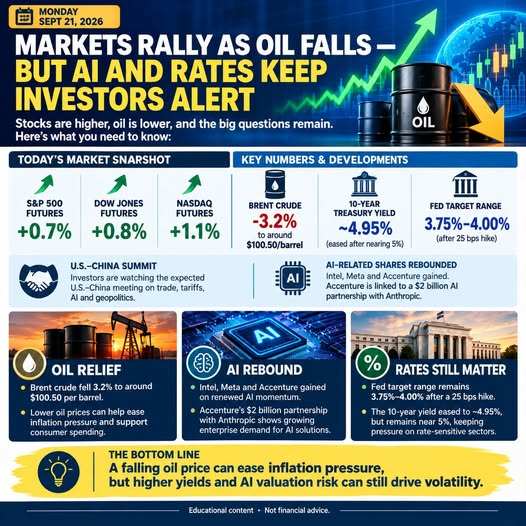
By this Monday (September 21), the rebound escalated into a full-blown outbreak. According to reports, the NASDAQ rose about 1.6%, S&P rose about 1%, Intel surged 13%, AMD rose 9.2%, and crossed the market capitalization threshold of about 1 trillion US dollars. Micron continued to rise 2.3%, and the Philadelphia Semiconductor Index closed up around 4%; the European stock market rose 1.12%, and the Korea Composite Index rose 1.65%. On the same day, Brent crude fell along with the 10-year US Treasury yield — Brent fell below $100 in the intraday period, and US crude oil (WTI) fell nearly 5% to around $95; the 10-year US Treasury yield closed at 4.945%, down about 10 basis points from 5.041% (19-year high) set last week.
On the face of it, this is “another round of AI”; what actually broke the siege for the bulls was actually a double drop in oil debt — short-term pressure from energy inflation and the squeeze on valuations from high interest rates, which at the same time gave half a sigh of relief.
Two sets of screenplays in three days
Looking at the market from September 16 to 21, the two screenplays are clearly distinguished.
On the day of the meeting, the market traded according to the “austerity script”: interest rate hikes were in line with expectations, but the Federal Reserve raised its policy path expectations at least once more during the year; Chairman Walsh emphasized after the meeting that he would work to bring inflation back to the 2% target; the statement also removed previous statements that attributed high inflation to “a supply shock driving up prices in some industries, including energy,” and renamed it “inflation is still high.” This means that the Federal Reserve no longer sees inflation as a temporary phenomenon that can be “turned a blind eye” — the Dow fell 1.2% on the same day, the most direct response.
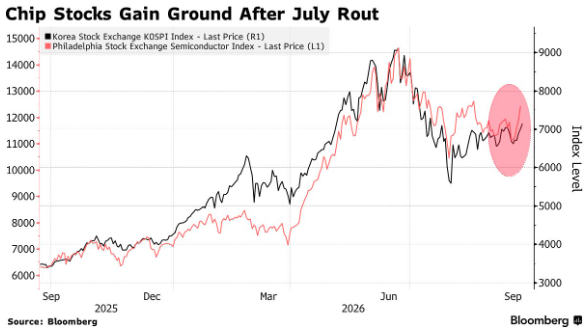
Starting the next day, the market switched to an “AI script.” One of the triggers was Asian data: South Korea's exports in the first 20 days of this month were the highest in the same period in history, and chip demand was the main driver. More importantly, the AI hardware chain shows no signs of “weakening demand”: Microsoft, Meta, Google, and Amazon have not announced plans to cut AI capital expenses, and there are no clear signs that demand for GPUs, servers, and storage is weakening. As a result, capital returned to the AI and semiconductor sector, where it had fallen even more — on Monday, Bitcoin rose to $85,221, a new high since January, and the restoration of risk appetite also spilled over to crypto assets.
Double drop in oil debt: the real ammunition for bulls
The real foundation of this round of backlash is that two things happened at the same time.
The first is the price of oil. Brent surged above $109 last week, then fell back to around $100 on Monday and fell below $100 in the intraday period. The reason is not that risks in the Middle East have been lifted, but rather that there are visible signs of recovery on the supply side: Saudi exports have recovered to slightly above 4 million b/d since September, while in August they once fell to 2.4 million b/d, the lowest since at least 2013.
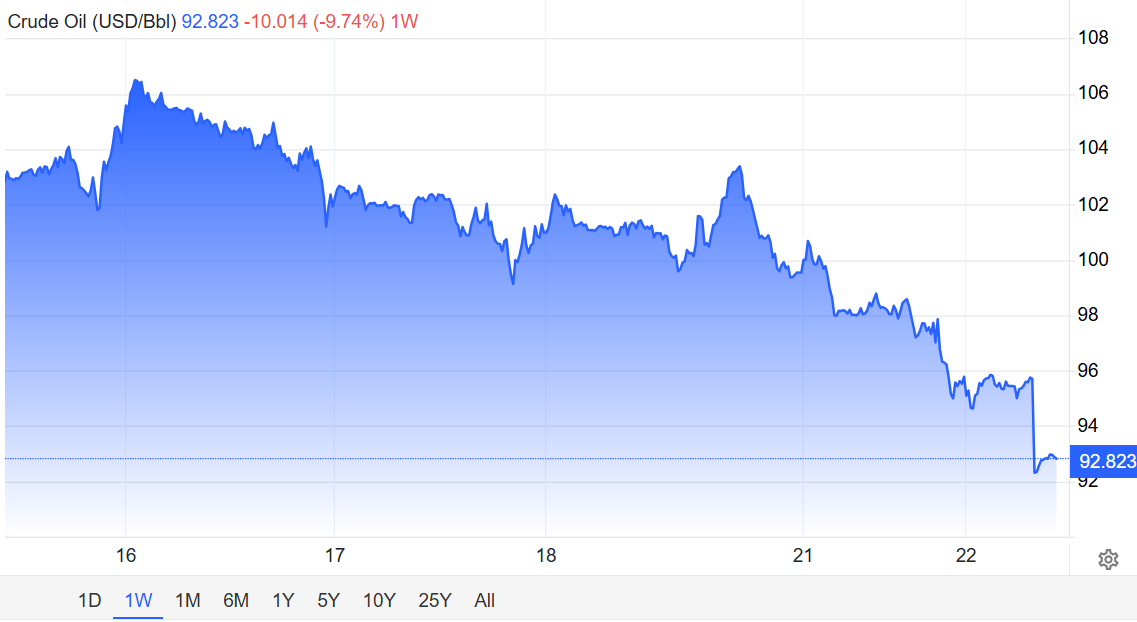
According to satellite data, the average flow of Saudi crude oil through the Strait of Hormuz in the six days up to September 20 was 2.9 million barrels per day, far higher than about 700,000 barrels in August. Furthermore, Trump said it was “possible” to meet with Iranian President Pezzahizyan during the UN General Assembly, and the opening of a diplomatic window further lowered the geographical premium.
The second is US debt. The bond market experienced a sixth consecutive week of sell-off last week: the 10-year yield once surpassed 5%, the first time since 2007, and the 30-year period closed at 5.4% after hitting a 22-year high; once the two-year period rose to 4.75%, the highest in more than two years. On Monday, as oil prices declined, the yield curve declined across the board: 4.738% for the two-year period, 4.825% for the five-year period, 4.945% for the 10-year period, and 5.281% for the 30-year period. Eurozone and UK 10-year bond yields declined by about 5 basis points at the same time.
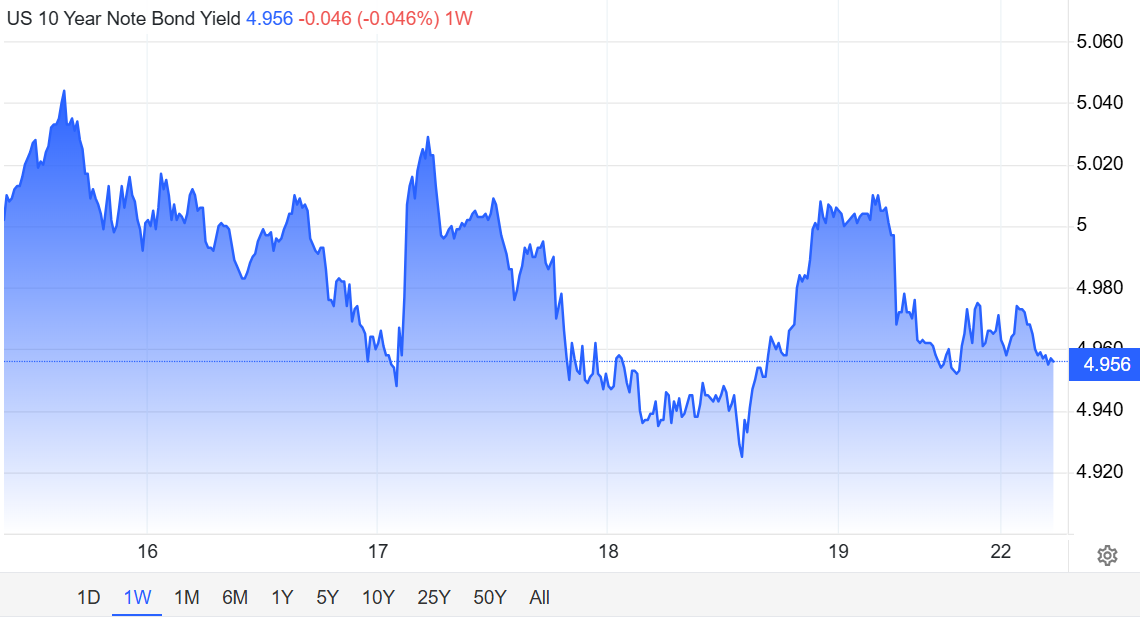
The logical chain is not complicated: oil prices determine inflation expectations, inflation expectations determine long-term interest rates, and long-term interest rates determine discount rates for highly valued growth stocks. When the “energy shock-inflation-interest rate hike” chain shows two signs of easing at the same time, the longest-lasting asset such as AI benefits first. Goldman Sachs FICC Global Co-Head Segal once hit the nail on the head: instead of buying long-term US bonds, it's better to do more computing power — even if the 10-year yield returns to around 5%.
AI optimism boosts growth
The AI narrative underpinning this round of rebound did get hard evidence this week.
On Monday, Meta Platforms' newly launched AI smart device, Muse, was initially sought after by consumers, igniting market expectations that demand for computing power would surge after large-scale popularization of AI agents, and capital poured into chip stocks such as AMD, Intel, and Arm.
After its launch, Muse quickly climbed to the top of the Apple App Store free app rankings, showing initially strong consumer demand. This performance has reignited the market's imagination for the popularity of AI agents, and further expanded investors' focus from GPUs required for AI model training to computing resources such as CPUs required for AI agents to operate.
Meta released Muse earlier this month and positioned it as a personal AI agent capable of directly performing tasks on behalf of users. Compared to traditional chatbots that are mainly responsible for generating text or answering questions, Muse can help users complete practical tasks such as online shopping, buying movie tickets, and reserving services.
Wedbush analyst Matthew Bryson said that AI agents rely on a large number of computation-driven applications, and in this market, major computing vendors include Intel and AMD.
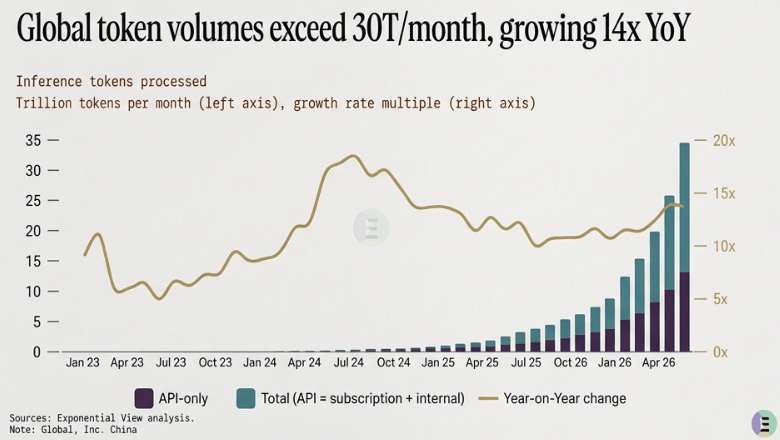
Storage is currently the most critical link. Intel CEO Chen Liwu warned at the AI Infrastructure Summit in Santa Clara on September 15: the price of some memory products has risen to 5 to 7 times the original price, the memory costs of low-end phones and notebooks already account for 70%-80% of the machine's material costs, and “production capacity is very limited, and many businesses are delayed because they can't get enough memory”; his answer after seeking evidence from three major global storage vendors was “there will be no relief until 2028.”
Jefferies analyst Jacky He said that as AI agents gain wider consumer adoption, higher AI reasoning, task orchestration, and infrastructure workloads are expected to drive server CPU demand growth.
The same industry data confirms: Gartner expects global storage revenue to reach US$837.3 billion, up about 280% year on year, and the share of storage in total semiconductor revenue will rise from 27% to 54%; TrendForce data shows that server DDR5 contract prices rose 93% to 98% in the first quarter and 53% to 58% in the second quarter, narrowing to 13%-18% in the third quarter. Micron's gross margin reached 84.9% in the previous fiscal quarter, and DRAM prices rose about 60% month-on-month. This is the foundation of the industry led by Micron and AMD.
Orders and prices on the computing power side are also talking. Nvidia said in August that Vera Rubin has begun production and delivery and has received purchase orders from hyperscale cloud vendors, AI cloud service providers and system vendors; its data center business revenue in the last fiscal quarter was US$89 billion, up 117 percent year over year, and revenue from hyperscale customers more than doubled year on year. Pricing in the computing power rental market has not been relaxed: Nebius plans to increase the price of H100, H200, B200, and B300 on-demand instances by about 17%-21% starting October 1.
The covered half: interest rates haven't loosened
What we really need to be wary of is that this round of carnival is based on the interpretation that “the pace of austerity may slow down,” and interest rate expectations themselves have not relaxed.
According to CME FedWatch data, the futures market's probability of raising interest rates by another 25 basis points in October has risen to 55%, up from less than 43% a week ago; the probability of raising interest rates at least once more before the end of the year is about 89%. The bitmap shows that most officials expect another rate hike during the year. Chicago Federal Reserve Chairman Goulsby further amplified this risk on Monday: he said that inflation may have surpassed the impact of tariffs and oil prices over the past 18 months, and strong demand is also driving up prices. If the main line is “demand is overheated,” “the interest rate reaction will be more aggressive and more forward-looking.”
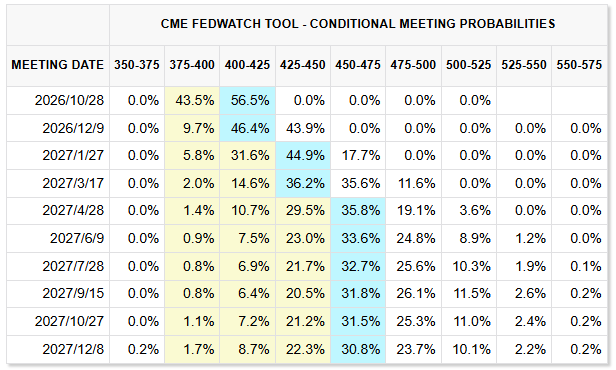
The tougher voice came from the seller. Bank of America strategists warned earlier that investors should prepare for the Federal Reserve to push the benchmark interest rate above 5%. The reason is that Walsh said last week's rate hike only removed “a dose of easing,” indicating that officials did not think that monetary policy had suppressed the economy. The structure of the bond market also confirms this differentiation: short-term (two-year) yields are still near the high level since July 2024, while the long term is declining as oil prices fall back — market pricing is not “the end of austerity,” but “the short-term pressure on inflation has temporarily abated.”
Opportunity or risk: three variables determine future market conditions
First, can oil prices actually stabilize. Beacham, IG's chief market strategist, was quite restrained in his judgment: “Maybe last week felt a bit apocalyptic, but now it's just softened a bit. However, the direction of oil prices is clearly still upward; this is only a slight correction.”
Citigroup's former currency official and CBA commodity director Dahl gave a more specific timeline: the buffer for global crude oil and refined oil inventories “has declined from 15 to 20 weeks estimated two weeks ago to 5 to 10 weeks.” Supply side mines have also not been cleared — Yemen's Houthis attacked Saudi Arabia over the weekend, issued an air strike warning, and Libya's largest oil field cut production by more than half due to pipeline shutdowns. If the energy shock continues, Yardeni Research's warning will come true: “The longer the energy shock lasts, the higher the risk of secondary inflation.”
Second, can AI's capital expenditure continue to be realized. The strongest argument for the bulls comes from Sima Shah, Chief Global Strategist at Principal Asset Management: “Central banks are raising interest rates to deal with inflation, not to slow the economy, which means that austerity will be gradual and limited. Higher interest rates may prevent further valuation expansion, but they are unlikely to substantially suppress profits or derail the broader bull market.”
The corresponding fact is that hyperscale manufacturers have not cut orders, and the order book for memory and computing power is still growing. The risk is whether these orders can be converted into revenue and profit as scheduled — which is the key reason why Micron's earnings report will be released on September 30.
There is another side to the same set of facts: costs are reversing along the same chain. Nvidia has decided to increase the price of AI server products by at least 15% starting next year, due to rising storage costs; Intel plans to raise PC processor prices by another 10% on October 5, the third price increase since the end of 2025. For cloud vendors, this means that the unit price of AI capital expenditure is rising; the funding for capital expenditure itself is already tight — according to reports, technology companies have provided up to $300 billion in guarantees for data center and chip financing in the past year, leaving most of their obligations outside of their balance sheets.
Third, how much carrying capacity is left in the market. One easily overlooked sign is market breadth: the share of bearish voters with voting rights rose to 53.3% at the end of last week, the highest since May 2025; only about 30% of the S&P 500 constituent stocks stood at the 50-day EMA. This means that this round of rebound is more like a regrouping of capital on a handful of AI and semiconductor leaders, rather than a return to overall risk appetite — once any of the oil debt falls, concentrated chips will also amplify the retracement.
Wall Street analysts are still divided. Shah represents the long version of “austerity is gradual, profit is king,” Beacham and Dahl represent the short version where “oil prices are only briefly easing and the buffer is being exhausted,” while statements from Goulsby and Bank of America strategists suggest that the “gray rhino” of interest rate hikes has not left — it is only temporarily covered by a double drop in oil debt.