


Rising energy prices exacerbate the risk of rising inflation The Reserve Bank of Australia is expected to implement the fourth rate hike in the year next week
The Zhitong Finance App learned that as rising energy prices further highlight the upward risk of inflation, economists said that the Reserve Bank of Australia will raise key interest rates next week and warned of a possible further rate hike in November. Current pricing in the money market shows that the probability that the Reserve Bank of Australia will raise the cash interest rate by 25 basis points to 4.6% next week is about 90%. If the Reserve Bank of Australia raises interest rates as scheduled, this will be the fourth time this year that the central bank has raised interest rates.
James McIntyre, an economist who previously thought the Reserve Bank of Australia would keep interest rates unchanged for the rest of 2026, said in a research report: “Repeated hawkish signals indicate that the RBA's remaining patience is running out. Further energy price escalation may encourage companies to pass on higher investment costs to consumers”.
James McIntyre isn't the only market person who recently changed interest rate expectations for the Reserve Bank of Australia. ANZ currently expects the Reserve Bank of Australia to raise interest rates again in September, while maintaining expectations for a November rate hike. UBS Group, on the other hand, adjusted the benchmark scenario to consecutive interest rate hikes in September and November. Both institutions expect the key interest rate to rise to 4.85%, which will be the highest level since 2008. The Commonwealth Bank of Australia, on the other hand, moved the interest rate hike forecast from November to next week on the grounds that the price of Brent crude oil remained above $100 per barrel.
The Reserve Bank of Australia was once one of the pioneers in tightening monetary policy in developed economies. The first three policy meetings this year raised interest rates to curb the rising inflationary pressure. In recent weeks, the Federal Reserve, the Bank of Japan, and the European Central Bank have all raised borrowing costs as energy prices have soared and the Middle East conflict is unlikely to end in the near future.
The Reserve Bank of Australia's 9-member committee will meet from September 28 to 29. RBA Chairman Michele Bullock said on Friday that some of the upward inflation risks previously highlighted by the bank “seem to be becoming a reality.” She will attend a fireside conversation at 1 p.m. Sydney time, which is expected to release hawkish signals.
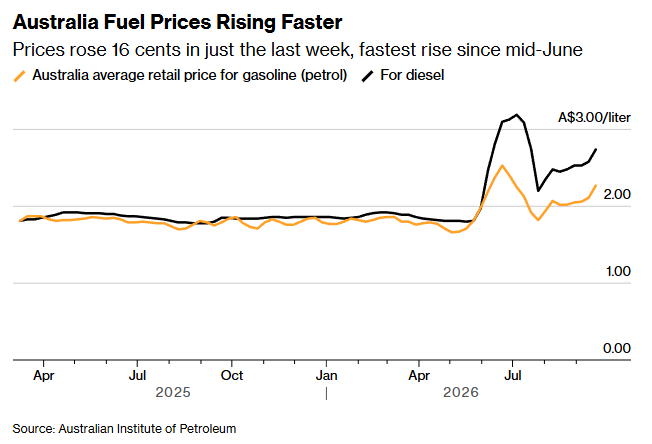
Fuel prices rise in Australia
James McIntyre pointed out that Australia's per capita diesel consumption is among the highest in the world, and freight companies will pass on higher diesel prices to companies through fuel surcharges. Diesel prices have risen sharply this year as geopolitical conflicts have intensified global fuel supply constraints.
Additionally, Reserve Bank of Australia Assistant Governor Sarah Hunter also explained some of the issues facing the committee in a podcast released early Tuesday. Sarah Hunter said, “The Middle East conflict and its impact on oil prices — if you've refueled your car recently, you've probably noticed this.” “The committee was very clear that even though they didn't raise interest rates, they are still very concerned about inflation. In our view, the risk of inflation is clearly biased towards the upside.”