


3 Defense Stocks With Earnings Growth Over 9%
Fresh sanctions that target buyers of Russian oil and those helping Moscow evade restrictions keep energy security and geopolitical risk in sharp focus. That prompts governments to prioritize air power, surveillance and missile defense. Investors looking at businesses tied to aircraft, satellites and military hardware may view this as a continuing spending theme. This article highlights three stocks from this aerospace and defense supply chain that may be worth a closer look.
The three examples below are only a small sample of the Aerospace and Defense idea, and the full screen surfaced 313 more companies with equally detailed stories that are not covered here. If you want to go wider than this shortlist and focus on the opportunities that best match your own criteria, head straight into the Aerospace And Defense screener to identify, filter and analyze your highest conviction picks.
General Electric (GE)
General Electric, now operating as GE Aerospace, is a pure-play engine and systems supplier that sits right in the middle of the aerospace and defense theme. With commercial jet engines, military propulsion and high value maintenance work, its fortunes are tied directly to global flight activity and defense demand.
GE Aerospace generates most of its income from Commercial Engines & Services, which produced about US$37.7b of revenue. Defense & Propulsion Technologies added roughly US$11.5b and Corporate & Other contributed US$1.4b, and the group has an equity value of around US$326.1b.
"By running older engines through their rigorous "shop visit" cycles, GE extracts staggering margins."
What investors need to weigh is how one pressure on the supply chain could ripple through those high value service economics.
Those ripple effects are exactly what the full narrative for General Electric unpacks, separating durable engine economics from supply chain friction and highlighting where GE Aerospace’s story could be mispriced.

Kratos Defense & Security Solutions (KTOS)
Kratos Defense & Security Solutions gives you direct exposure to unmanned jets, missile propulsion and defense electronics that sit squarely in the Aerospace and Defense supply chain, with the bulk of its work ultimately tied to U.S. and allied security programs.
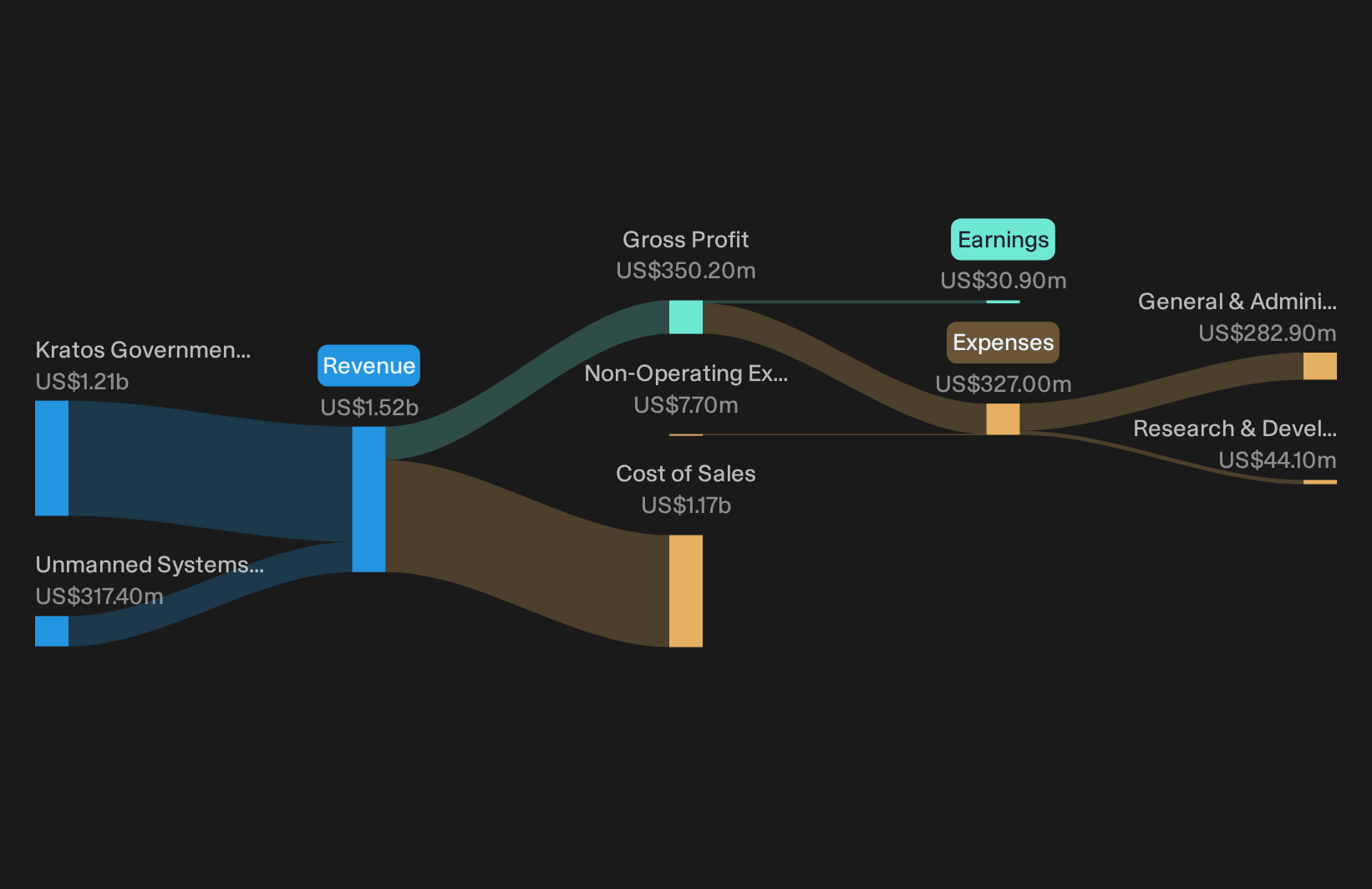
Kratos generates about US$317 million from Unmanned Systems and roughly US$1.2b from Kratos Government Solutions, with most activity in the United States, and the stock carries a market value of around US$8.9b.
For investors who want a focused play on affordable combat drones and hypersonic subsystems rather than broad defense conglomerates, Kratos can offer a more concentrated way to tap into this Aerospace and Defense theme.
"Kratos is well positioned to benefit from a historic surge in global defense spending and modernization initiatives by the U.S., NATO, and Pacific allies, as ongoing geopolitical tensions drive a multi-year expansion in defense budgets. This widespread increase in procurement is creating robust demand for Kratos' technologies and supporting high contract win rates, which should continue to drive strong top-line (revenue) growth and sustained backlog momentum."
What happens to Kratos’ margin potential if a single assumption about how quickly those funded programs convert into steady production slips even slightly?
If that timing risk is on your mind, the full narrative for Kratos Defense & Security Solutions shows how Kratos Defense & Security Solutions’ backlog, contracts and margins could be decoupling beneath the surface.
Boeing (BA)
Boeing is a major Aerospace and Defense contractor through its Defense, Space & Security arm, alongside its large commercial jet business and support services. It generates about US$43.4b from Commercial Airplanes, US$29.4b from Defense, Space & Security and US$21.3b from Global Services, with an equity value near US$156.7b.
Boeing matters for this theme because its defense, space and security programs anchor critical military aircraft and missile systems. Its commercial backlog and services work add scale that few peers can match, which creates a tension between opportunity and execution risk.
"Boeing's commercial backlog, reported at $522 billion with 5,900 aircraft sold firm into the next decade, has been cited by some analysts as a factor that could support long-term revenue growth relative to broader economic benchmarks and industry trends, particularly in the context of projections for global air travel demand through 2040."
A key question for investors is what happens to that potential upside if a single assumption about how quickly production stabilizes and flows through to cash and margins begins to slip.
If that question is front of mind, the full narrative for Boeing explains how Boeing’s backlog, execution risk and cash potential might be quietly decoupling.

Seeking Alternatives Before The Crowd Moves
Fresh ideas move fast. Breakout trends, early momentum and quietly flying under the radar for now can get caught by others if you wait. Scan fresh candidates and act now.
- Spot potential turnarounds early by reviewing the curated 17 high quality undiscovered gems before they shift from under the radar to fully priced.
- Track income opportunities that may hold up when prices drop by scanning the hand picked 7 dividend fortresses while the yields still look compelling.
- Position ahead of infrastructure momentum by checking the focused 40 power grid technology and infrastructure stocks while these enablers of future energy demand are still being priced as niche ideas.
This article by Simply Wall St is general in nature. We provide commentary based on historical data and analyst forecasts only using an unbiased methodology and our articles are not intended to be financial advice. It does not constitute a recommendation to buy or sell any stock, and does not take account of your objectives, or your financial situation. We aim to bring you long-term focused analysis driven by fundamental data. Note that our analysis may not factor in the latest price-sensitive company announcements or qualitative material. Simply Wall St has no position in any stocks mentioned.
Have feedback on this article? Concerned about the content? Get in touch with us directly. Alternatively, email editorial-team@simplywallst.com