


3 Global Bank Stocks Built For Sanctions And Payments Disruption
Sanctions headlines around Russian flows and banks like Standard Chartered, Citigroup and JPMorgan have turned the global payments plumbing into front-page news. That disruption can punish weaker institutions yet also reward large, well-capitalised players that handle compliance and transaction banking at scale. This article zooms in on three stocks from our global banks screener that look particularly exposed to this story and explains why that exposure could matter for your portfolio.
The three stocks below are only a sample of what this theme can touch, and the full screen surfaced 29 more large banks with similarly complex sanctions, payments and treasury stories that are not covered here. If you want to go beyond the short list and identify your own high-conviction ideas in this theme, head straight into the Large, Diversified Global Banks with Strong Compliance and Transaction Banking Franchises screener.
Banco Bilbao Vizcaya Argentaria (BME:BBVA)
BBVA fits this screener because it is a large, universal bank that already operates in cross border payments and corporate cash management. This makes its mix of emerging market exposure and transaction banking scale especially relevant for investors following sanctions developments.
BBVA runs a full-service banking model across retail, wholesale, investment and transaction banking, with sizeable revenue from Mexico (€12.4b), Spain including non core real estate (€9.2b), Turkey (€5.3b) and South America (€5.5b), and a market value of about €138.6b.
"BBVA is well positioned to benefit from the continued expansion of the middle class and rising financial inclusion in high-growth emerging markets like Mexico and Turkey, fueling sustained loan growth and fee-generating activity, which could positively affect revenue and earnings potential over time."
What matters now is how one unresolved pressure in its cross border flows shapes the next phase of earnings quality and pricing power.
That pressure point is exactly where the story gets interesting for you as a shareholder, and the full narrative for Banco Bilbao Vizcaya Argentaria unpacks how sanctions risk, capital allocation and transaction banking power might be decoupling.

Halyk Bank of Kazakhstan (LSE:HSBK)
Halyk Bank of Kazakhstan plugs directly into this global banks theme as a regional heavyweight in Central Asia, combining everyday retail finance with transaction services that keep cross border money moving for corporates and SMEs.
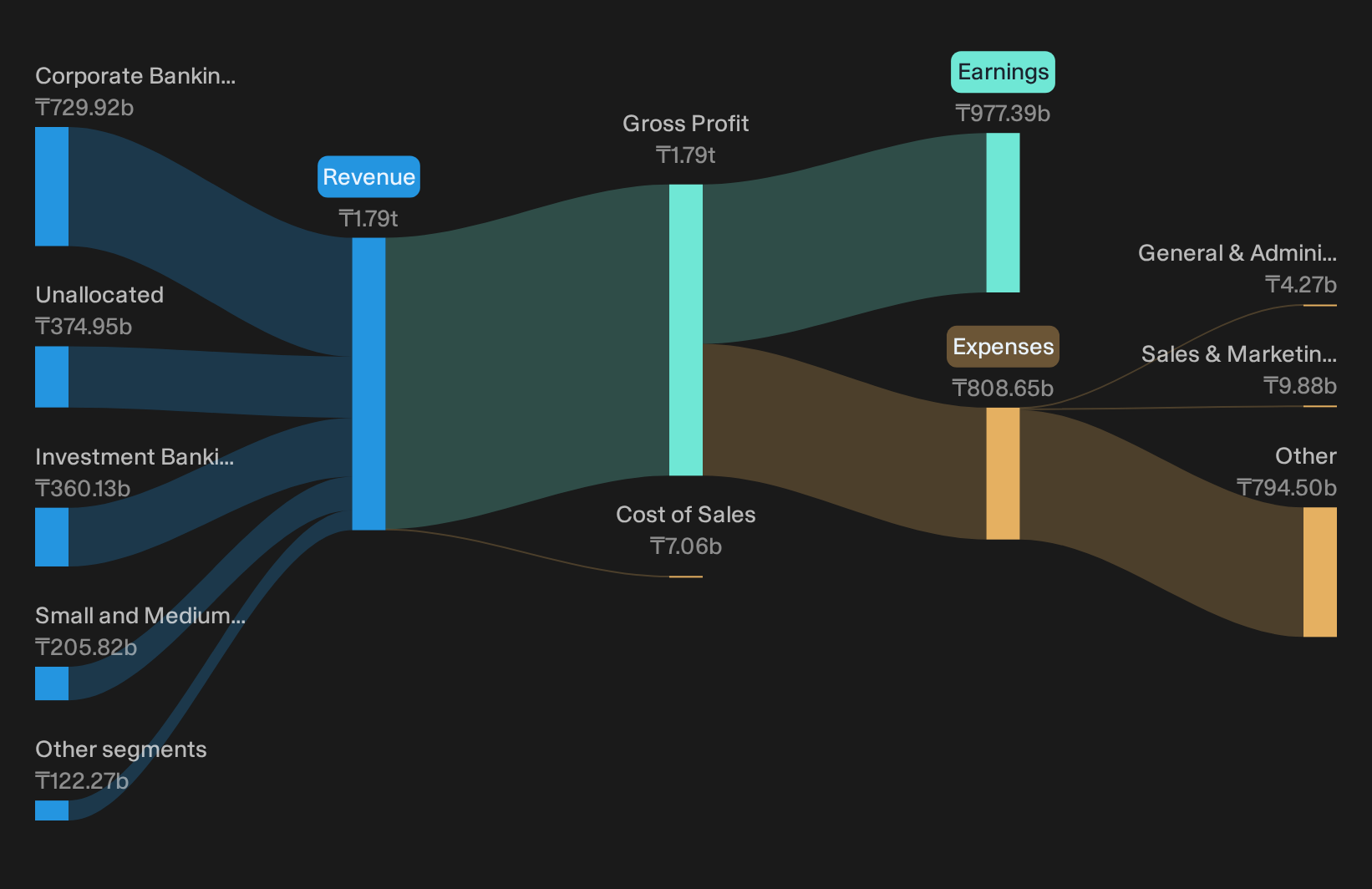
Halyk Bank of Kazakhstan operates as a universal bank across Kazakhstan and nearby markets, with corporate banking generating about KZT 729,918 million in revenue, investment banking KZT 360,129 million, SME banking KZT 205,817 million, retail banking KZT 120,436 million, and a market cap of roughly US$9.1b.
"Rising competition from fintechs and limited diversification outside Kazakhstan could pressure margins and increase vulnerability to local economic shocks."
The real test comes from how one quiet shift in regional capital flows affects the pricing power behind those transaction-heavy relationships.
That quiet shift is exactly where the story for Halyk Bank of Kazakhstan could accelerate. The full narrative for Halyk Bank of Kazakhstan shows how regional risks and payments flows might be reshaping its long term potential.
HSBC Holdings (LSE:HSBA)
HSBC Holdings is the purest expression of this theme, a universal bank built around cross border payments, cash management and trade finance, with much of its revenue tied to transaction heavy clients that prize trusted compliance and reliable treasury pipes.
HSBC runs a global banking and wealth platform, with Corporate & Institutional Banking generating about US$27.5b of revenue, Hong Kong US$15.2b, the UK US$12.6b, International Wealth & Premier Banking US$14.4b and a Corporate Centre loss of US$2.0b, and the group carries a market value of roughly £262.7b.
"The bank is intensifying investment in Asian wealth management and private banking, leveraging a strong brand and local presence in fast-growing wealth markets like Hong Kong, mainland China, and Southeast Asia; this creates an opportunity for HSBC to serve rising affluence and middle class expansion, with potential implications for future fee income, earnings resilience and margins."
What happens if one less visible regulatory and compliance pressure on those cross border flows starts to reshape how much of that margin actually sticks.
That kind of regulatory squeeze is exactly where full narrative for HSBC Holdings brings together compliance pressure, Asian wealth ambitions and the areas where HSBC Holdings could still be underappreciated by the market.

Seeking Alternatives Before The Crowd
Fresh opportunities do not wait. Breakout themes gain momentum while they are still under the radar for now. Scan what others miss and get in early.
- Target resilient income streams before yields get compressed by latecomers by running the 161 dividend fortresses to see which payers currently combine cash flow strength with staying power.
- Spot early movers in bleeding edge computing before headlines catch up by reviewing the curated list inside the 25 quantum computing stocks and filtering for your preferred risk profile.
- Track growth stories harnessing AI-driven healthcare momentum while it still matters by using the 131 healthcare AI stocks and focusing on balance sheets you trust.
This article by Simply Wall St is general in nature. We provide commentary based on historical data and analyst forecasts only using an unbiased methodology and our articles are not intended to be financial advice. It does not constitute a recommendation to buy or sell any stock, and does not take account of your objectives, or your financial situation. We aim to bring you long-term focused analysis driven by fundamental data. Note that our analysis may not factor in the latest price-sensitive company announcements or qualitative material. Simply Wall St has no position in any stocks mentioned.
Have feedback on this article? Concerned about the content? Get in touch with us directly. Alternatively, email editorial-team@simplywallst.com