


Private equity giant KKR (KKR.US) is betting $3 billion on South Korea's AI supply chain! Targeting data centers and power requirements
The Zhitong Finance App learned that KKR (KKR.US) is betting that Korea's central position in the global artificial intelligence (AI) supply chain will continue to drive demand in various fields from data centers to electricity. The private equity giant anticipates that as it invests around $3 billion in South Korea this year, the company will usher in more trading opportunities in South Korea.
Based on the calculation based on the disclosed transaction value and shareholding ratio, the scale of investment in 2026 set KKR's annual investment record in Korea. In addition to building AI infrastructure, new investment opportunities are also emerging as large Korean conglomerates reshape their business landscape and show a desire to bring in external investors.
South Korea is at the center of the global AI supply chain with Samsung Electronics and SK Hynix, two companies that are among the world's largest memory chip manufacturers. At the same time, the AI boom is generating demand for data centers, power, and other infrastructure, creating new investment opportunities outside of the semiconductor industry.
Chung Ho Park, head of KKR Korea, said that many Korean companies are increasingly focusing on their own business portfolios and making capital allocation decisions to further increase investment in core businesses. Chung Ho Park added: “We expect to continue investing around this opportunity, working closely with Korean companies, and using our complete toolbox to help create value.”
As KKR increased its bets, the scale of private equity investment in South Korea had reached about 37 billion US dollars by the beginning of September, and is approaching the annual record of 41.4 billion US dollars set in 2021. According to data provider Preqin, the rapid development of AI is driving further capital flows from chip makers to the infrastructure needed to support these companies, while also boosting the Korean stock market to record highs.
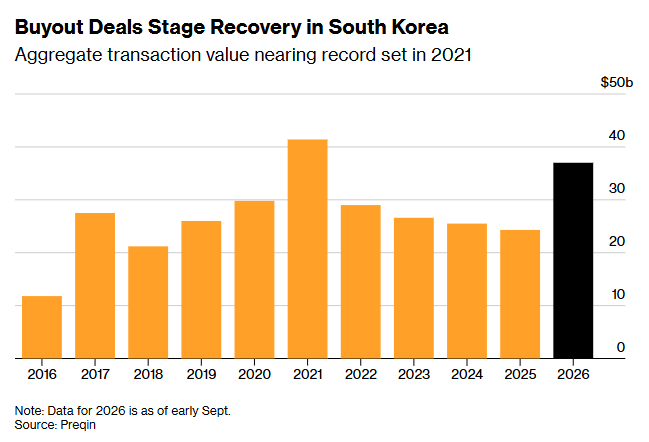
South Korea's takeover deals are recovering, and the total transaction volume is close to the record set in 2021
KKR is well positioned to profit from the restructuring of large Korean conglomerates. For example, KKR invested 1.22 trillion won (approximately US$880 million) in convertible bonds issued by Samsung SDS (IT services and digital logistics solutions subsidiary of the Samsung Group), and reached an agreement to cooperate with the company to carry out mergers and acquisitions, capital allocation, and AI business expansion.
In another deal involving a Korean consortium, KKR cooperated with a local fund to jointly invest 3.08 trillion won in SK Telecom's newly established data center business. This enabled KKR to simultaneously participate in two aspects of infrastructure construction in Korea: investing in data centers to drive the growth of electricity demand; on the other hand, building a renewable energy platform with SK Group to help meet the growing demand for electricity.
Keith Kim, KKR's infrastructure business partner, said South Korea is one of the most attractive renewable energy markets in Asia, and behind this is strong corporate demand for clean electricity in semiconductors, data centers, and manufacturing. He added: “We see this as a long-term opportunity and expect to continue investing through the platforms we have established in Korea to meet this demand.”
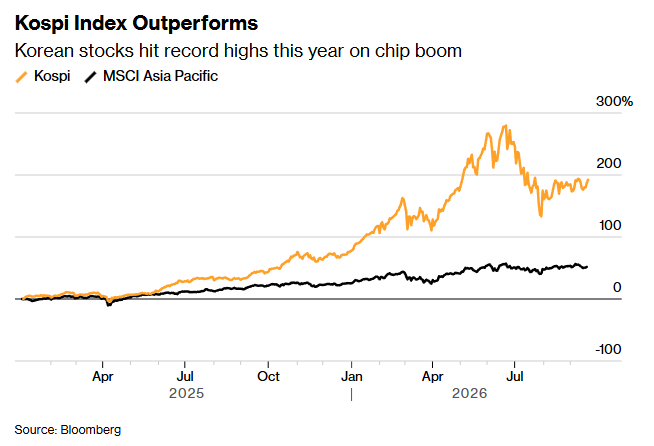
The Korean stock market hit a record high this year, driven by the chip boom
For KKR, the $3 billion investment scale will place South Korea among the company's top three markets for investment in the Asia-Pacific region in 2026. Meanwhile, Musinsa Co., one of KKR's portfolio companies, is preparing an initial public offering (IPO) in Seoul. The fashion retailer is seeking a valuation of up to 10 trillion won, almost three times that of when KKR led the $190 million financing round in 2023.
Other acquirers starting transactions in Korea include Blackstone Group (BX.US). The company joined forces with ESR Group Ltd. to acquire a majority stake in a logistics park this month. The transaction amount was not disclosed. In June of this year, Carlyle Group (CG.US) agreed to acquire Chung Ho Group; TPG (TPG.US) agreed to acquire a controlling interest in Lotte Leasing last month.
Adequate capital is raising the competitive threshold for investment companies. As large amounts of capital to be invested compete for transaction opportunities, and changes in the corporate governance and regulatory environment are reshaping how transactions are completed, simply having capital is no longer enough.
Chan Hee Cho, vice chairman of Bank of America Securities's Asian M&A business, said, “In such an environment, success will depend less and less on the ability to access capital and more on the ability to explore opportunities for differentiation and design complex transaction structures.”