


Gemini 4 is ready to go, and RSI has sparked a buzz about “AI R&D AI”! Alphabet (GOOGL.US), which Buffett bet at the closing time, ushered in a new round of outbreaks?
The Zhitong Finance App learned that US insurance and investment giant Berkshire Hathaway's investment scale and position bets on Google's parent company Alphabet (GOOGL.US) have formed a clear layout trajectory of “Buffett's large-scale position at the end of the helm and continued to expand Google's parent company position after Abell took over”. After Abell took over as CEO in January 2026, the total holdings of the two types of stocks (Alphabet's Class A shares and Class C shares) increased to about 578.35 million shares in the first quarter, and increased by about 48,144,600 shares in the second quarter, reaching about 105.98 million shares. The total market value at the end of the quarter was about 37.764 billion US dollars, accounting for about 12.6% of Berkshire Hathaway's 13F disclosed stock portfolio. After the merger of the two stocks, it became the agency's third-largest holdings.
According to Wall Street asset management giants and senior analysts who have long been bullish on the stock price trajectory of Google's parent company Alphabet, Google can simultaneously monetize global AI applications and multiple links in the computing power value chain — AI functions in search meet user needs, Gemini and enterprise products expand subscriptions and application revenue, and self-developed TPU AI computing infrastructure systems greatly expand the sales of computing power resources and generate computing power revenue. Google's cloud computing business sells B-side AI cloud computing capacity and models, and is open to AI application leader Anthropic's significant shareholder Another frontier AI big model ecosystem investment exposure.
The underlying technology and ecological advantage of Google's unprecedented AI wave in the world is that self-developed AI chips, model training, cloud AI inference computing services and Google's exclusive huge Google product distribution system can be collaboratively optimized: improved model capabilities can directly enter the existing Google online ecosystem and Internet product lines, and the usage demand of users and enterprises has increased dramatically and can be transformed into strong demand for TPU computing power resources, AI cloud computing services, and subscription services.
Financial data already reflects this transmission — Alphabet disclosed in the second quarter of 2026 that Google Cloud's revenue reached 24.8 billion US dollars, an increase of 82% over the previous year, operating profit margin reached 35.6%, and the contract backlog reached 514 billion US dollars. The company also made it clear that it is training a larger Gemini 4 base model. Seen from this perspective, Berkshire's heavy position corresponds to an AI business system that has already generated revenue and profits, and is expected to continue to expand market boundaries.
Berkshire relayed to increase positions, Gemini 4 and RSI sparked a buzz in the AI field, and the AI compound interest logic of Google's parent company Alphabet slowly unfolded
In the third quarter of 2025, Berkshire first disclosed that it held about 178.461 million Alphabet A shares, with a market value of about US$4.338 billion at the end of the quarter; after Abell took over as CEO in January 2026, the total holdings of the two stocks increased to about 578.35 million shares in the first quarter, and an additional 48,1446 million shares in the second quarter, reaching about 105.98 billion shares. The total market value at the end of the quarter was about US$37.764 billion, accounting for about 12.6% of its 13F disclosure portfolio.
This continuous increase in positions across management handoffs shows that Alphabet has moved from a new investment to a core configuration. Interpreted from investment logic, Google has the ability to generate cash from mature businesses, the world's most advanced AI research and development capabilities, and the world's top AI computing power resource system and AI application commercial distribution system, which allows long-term capital to simultaneously participate in the incremental market created by existing business benefits and new technology.
What is most noteworthy about Google's next-generation AI model, Gemini 4, is the possibility of simultaneous improvement of multiple abilities required to complete complex tasks and the training process of Google's AI big model entering the so-called RSI (“recursive self-improvement”) stage.
Recursive self-improvement (RSI) is not equivalent to a model suddenly gaining self-awareness; its current verifiable form allows AI to gradually participate in training strategy planning, algorithm generation, code writing, experimental design, result evaluation, bug fixing, and even the next few rounds of AI training. RSI may create a “second demand curve” for computing power that is independent of end user needs: training is no longer a “training-release-end”, but a continuous closed loop of models proposing algorithms, running hundreds to thousands of experiments in parallel, evaluating results, and initiating the next round of training.
According to some market sources, Google is suspected of quietly launching the flagship model Gemini 4 Pro under the name “gemini-3.8-flash” at the AI Arena Arena. According to some benchmark data that has been disclosed so far, it completely surpasses OpenAI's Astra and Anthropic's Fable 5.1 in terms of coding, intelligence, and reasoning, making it “the strongest AI model on the surface.”
According to the score data for the “Gemini 3.8 Flash” vest worn by Gemini 4 Pro, DeepSWE v1.1 was 88.7%, 1.8 percentage points higher than Astra's 86.9% in the same chart; GDPVal-AA v2 was 2064 Elo, Terminal-Bench 2.1 was 95.3%, and OSWorld-2.0 was 86.8%. These indicators involve software engineering, intellectual work, terminal operation, and computer use, respectively. If officially verified, it means that the model is expected to more fully implement the workflow of “understanding requirements — formulating a plan — calling tools — testing results”; presentations on web pages, SVG, 3D models, and playable games show intuitive applications of this ability.
In terms of the latest price circulating in the market, compared to Astra and Fable, it is also the most cost-effective of the “Big Three AI Models”. The input price is $2.25 per million tokens, and the output price per million tokens is $11.25. The combination of stronger task capabilities and lower calling prices is expected to lower the economic threshold for enterprises to adopt smart devices.
The computing power logic that Astra and the next generation Gemini point to is that AI is moving from answering questions to continuously executing tasks. Inference time scaling (test-time scaling), multiple rounds of tool calls, parallel exploration, and result verification will increase the calculation steps for complex tasks; longer contexts will also increase the capacity and bandwidth requirements for pre-filled calculations and KV caches. OpenAI recently revealed that Astra has enhanced programming, browsing, computer operation, and complex task execution capabilities, and expanded the scope of actual work that models can participate in. The product manager said that the surge in demand for Astra has put pressure on infrastructure; the company suspended new subscriptions and upgrades to the $200 monthly Pro 20X package since September 10, and existing subscriptions continue to be renewed normally.
The new generation of Gemini seems to have the technology and AI commercialization foundation to become a new strong bullish catalyst for Google's parent company's stock price. For Google's parent company Alphabet, the key advantage is the ability to jointly optimize these costs from chip to server: TPU, HBM, high-speed chip interconnection and scheduling software can collaborate to increase the amount of effective computing that can be delivered per unit of power consumption and hardware investment. As the cost of successful tasks per unit falls, and more programming and knowledge work becomes worth leaving to AI, the scale of the new tasks may drive the total computing power demand to continue to expand, thereby simultaneously increasing Gemini's payment requirements and Google Cloud's computing revenue.
Next-generation Gemini and the GPT-6 Astra big model launched by OpenAI have sparked a “AGI” buzz, and the RSI technology path focused on by AI leaders are expected to become the two core driving forces driving the exponential expansion of AI computing power requirements, namely the AI big model with better performance, the use of a wider range of AI application tools, and the next generation AI training path with stronger computing power requirements, which are an important basis for the continued growth in AI computing power infrastructure demand.
Among them, recursive self-improvement (RSI) has shown quantifiable engineering evidence: the Dream-RSI study published on September 14 allows the system to use historical exploration records to improve search branching, resource allocation, and termination strategies while keeping the underlying coding agent unchanged, and then put the better strategy into the next round of exploration; in VGG16 and LayerNorm kernel engineering tasks, the number of iterations required to achieve similar performance was reduced to about 1/2.43 and 1/1.79, respectively. This explores self-improvement at the strategic level, provides empirical support for “AI helps improve the AI development process”, and also opens up space for faster software optimization and lower computational costs.
Furthermore, if the next generation Gemini steadily brings stronger reasoning, coding, and computer operation capabilities into commercial products, Google will have an opportunity to drive a new round of revaluation through increased mission success rates, expanded enterprise adoption, increased cloud and subscription revenue, and improved profit expectations. The heated discussion between AGI and RSI can increase market attention, and Google's existing product portal, unique TPU computing power system, and profit base have made this round of technological progress seem to have the clearest transmission path for shareholder returns in the capital market.
Cash on the AI application side is superimposed on TPU computing power resources to monetize, and Wall Street bets on Google's dual-engine growth
Berkshire Hathaway's most popular artificial intelligence (AI) stock now seems like an extremely wise bargain purchase option. Missed the “first act” of AI megatrends? The second act could be 15 times larger. Most investors think they missed out on the AI flight because they didn't buy Nvidia at the historical level in 2005. However, according to the judgment of some Wall Street analysts, we have just reached the end of the “first scene of an unprecedented AI wave” — the end of the AI prototype development phase. “Act II” is a global promotion application.
Berkshire Hathaway's large-scale holdings and firm increase in positions with Alphabet can be seen as an important vote of confidence. In the second quarter, Berkshire bought more than 48 million shares of Alphabet's two types of shares in total. The combined holdings of the two types of stocks now account for about 12.6% of its stock portfolio. Alphabet is Berkshire's third-largest stock holding, which shows its strong confidence in the tech giant.
Although legendary investor Warren Buffett is no longer in the CEO's office, he initiated his first purchase of Alphabet before his term as Berkshire Hathaway CEO ended. At the end of last week, he announced that he would step down as chairman of the board and be replaced as honorary chairman. However, the current management is continuing his investment tradition, and recent initiatives have also shown strong confidence in Alphabet.
Google's parent company Alphabet has not concentrated all of its AI bets on one path. Instead, it's being broadly laid out. First, and most importantly, Alphabet's business is based on the Google search engine. By integrating AI overviews into search results, it provides users with a convenient AI portal. The vast majority of people will be exposed to generative AI for the first time through this feature, and thus enter the Google ecosystem.
Alphabet's big language model series, represented by Gemini, also ranks among the best-performing AI models, and provides a premium version that users can subscribe to, generating more revenue for Alphabet. If Alphabet's model is surpassed by competitors' products, it is also an important cornerstone investor in Anthropic, which developed the Claude series of AI models. Anthropic has also become one of the best choices and is expected to launch in the near future. The $2 trillion valuation sought by its management, if realized, will bring huge returns to Alphabet.
Finally, Alphabet also owns Google Cloud, an infrastructure platform that handles workloads for many AI companies. It leases large amounts of computing power to customers, and since its current capacity is insufficient to meet current needs, this business will continue to grow for a long time as more AI computing power is put into operation.
Alphabet is expected to benefit from AI in multiple ways. Although not everything it does will end up being a successful solution, if most of its bets end up being successful, it will be the biggest winner in the AI era.
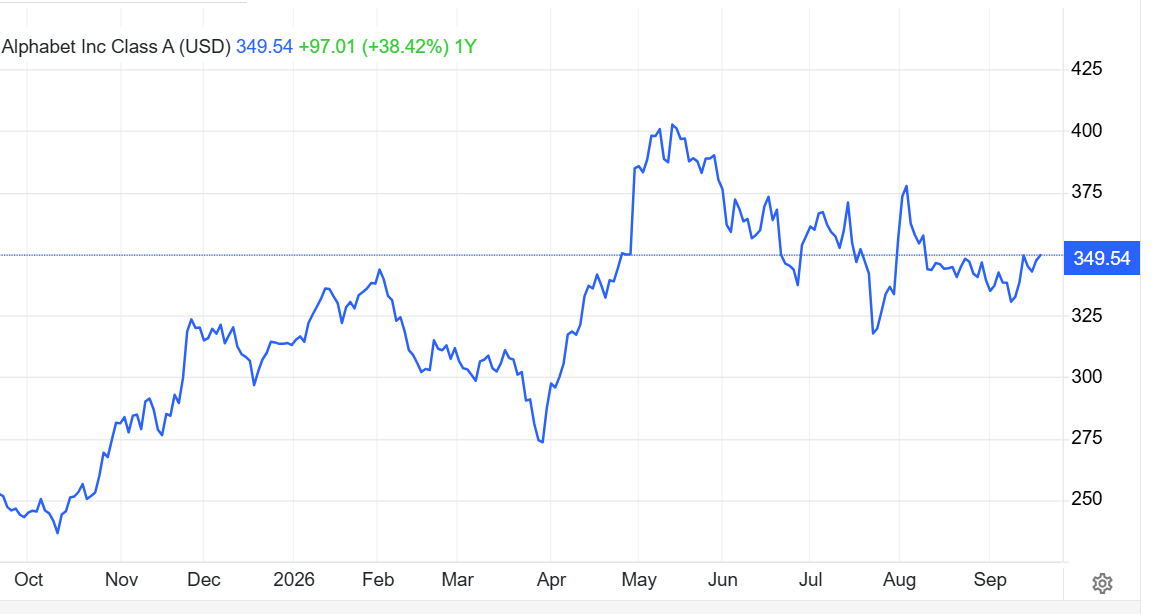
On Wall Street, analysts' average 12-month bullish target price for Google's parent company Alphabet was 428.41 US dollars, while the highest target price was set at 515 US dollars, corresponding to potential growth of about 22.56% and 47.34%, respectively. Here, the Class A stock GOOGL is uniformly used, calculated using the benchmark of the closing price of 349.54 US dollars for regular trading on September 18; the target price comes from the consensus of S&P Global Wall Street analysts disclosed by StockAnalysis, and the analysts' overall rating is a “strong buy.”
The highest price target comes from Citizens JMP analyst Andrew Boone, who previously reiterated a target price of $515 and a “outperforming the market” rating. The analyst's bullish logic mainly focuses on AI's ability to expand the range of issues that can be handled by search and enhance users' willingness to use it, thereby injecting a new round of strong growth momentum into Google's core advertising business portal.
Ivan Feinseth, an analyst from Tigress Financial, raised the target price to $485 on September 17 to maintain a “strong buy”, corresponding to a 38.75% increase in the same benchmark stock price. Its core logic includes: AI expands search activities and improves advertising effectiveness; Google Cloud accelerates growth and profit margin expansion strengthens profitability; and Gemini, self-developed TPU, and AI services open up new commercial channels. The analyst emphasized that the dual growth logic of “AI enhances the ability of AI applications led by search engines to generate cash while expanding revenue sources through next-generation models and AI computing power services”, the huge commercial user portal and self-developed AI computing power infrastructure can enable Google to meet AI needs in multiple areas.
Evercore ISI's Mark Mahaney raised the target price to $450. Actual research showed that AI products significantly improved the user experience of B-side and C-side users, improved user behavior supported revenue growth, and raised profit expectations further supported higher target prices; Evercore ISI research showed that in August 2026, 78% of respondents used Google as their preferred search engine, improving for four consecutive quarters from the previous 70% low. Based on this, analyst Mark Mahaney raised the 2026-2028 search revenue growth forecast. The 2028 gross revenue and operating profit forecast is about 4% to 5% higher than the market consensus.