


IPO outlook | Leading position+steady performance is a plus. How can Zhuochuang Information (301299.SZ) achieve the leap from “small but beautiful” to “big and strong”?
Zhuochuang Information's (301299.SZ) listing journey to Hong Kong ushered in the latest developments.
After first filing with the Hong Kong Stock Exchange on November 28 last year, Zhuochuang Information submitted a listing application to the main board of the Hong Kong Stock Exchange for the second time on August 25. Ping An Securities (Hong Kong) was its sole sponsor.
According to Insight Consulting data, in terms of revenue in 2025, Zhuochuang Information ranked first in the energy commodities sector in China's commodity information service industry, with a market share of about 31.9%; it also ranked second in China's commodity information service industry, with a market share of 12.4%.
Leading market positions have translated into tangible performance growth. According to the data, from 2023 to 2025, Zhuochuang Information's revenue was about 284 million, 294 million yuan, and 356 million yuan respectively, with a compound annual growth rate of 11.96%. Net profit for the same period was approximately 52.066 million, 70.59 million yuan, and 71.125 million yuan, respectively, with a compound annual growth rate of 16.88%.
Entering the first half of 2026, the growth trend continued. During the reporting period, revenue increased 8.26% year on year to 185 million yuan, and net profit surged 13.03% year on year to 41.292 million yuan. The profit growth rate was faster than revenue, and profit quality was further improved.
The leading position in the industry combined with steady growth performance is undoubtedly a plus point for Zhuochuang Information's Hong Kong IPO. However, on the other side of the coin, cyclical fluctuations inherent in the bulk information service industry and the industry's natural growth ceiling will still substantially suppress its valuation.
High gross profit, high financial quality and high stickiness, the “three highs” highlight outstanding fundamentals
From a fundamental perspective, Zhuochuang Information can be called a typical “small but beautiful” data company. This is reflected in various dimensions such as the company's good business model, realistic moat, high financial quality, and generous dividends.
Zhuochuang Information's business model is good because the company has turned commodity price information into a “reusable, pre-collectible, and highly sticky” business. The company has four major business segments, namely information services, digital intelligence services, consulting services, and exhibition services. The first two major services are mainly subscription models, and they are all standardized products that “build a library once and reuse by multiple customers”.
The advantages of this standardized product are reflected in the fact that after the “collection, cleaning, evaluation, and distribution” of data is completed once, the marginal cost of adding a new subscriber is very low, price data can be sold repeatedly, reports can be templated, and terminal/API can be called concurrently. Compared to project-based consulting firms, it doesn't have to compare people for every new contract; this is a typical data product model.
Thanks to the “one time collection, multiple customer reuse” model, Zhuochuang Information's gross margin continued to be high. The overall gross margin in 2025 was 62.74%. Among them, the gross profit margin of information services reached 70.39%, which highlighted the high gross profit advantage.
Judging from the billing model, Zhuochuang Information's information service uses an annual fee model and a terminal/API subscription model to form the company's basic pre-payment plan. The full payment for exhibition services and consulting services are collected per node. For ToB Data, the revenue predictability of this mixed fee model is far superior to the project system, and cash flow comes before revenue.
Under this mixed fee model, Zhuochuang Information's contract debt at the end of 2025 was 298 million yuan, while accounts receivable were only 11.5 million yuan. There was almost no problem with credit sales taking up capital. The company's net operating cash flow was higher than net profit to the mother all year round. The operating cash flow in 2025 was 97.78 million yuan, 1.49 times the net profit of 65.64 million yuan. The profit content was high, and almost all of the profits were real money.
However, good cash flow allows the company not to borrow money to expand, so debt is low and the asset structure is high quality. At the end of 2025, the company's interest-bearing debt was only about 11.27 million yuan, with an interest-bearing debt ratio of 2.8%. The vast majority of the balance ratio of 40.8% were operating contract liabilities and payables, not bank loans.
Abundant free cash flow compounded low debt, so that the company did not need to erode profits for interest expenses, nor did it need to dilute equity in order to expand. Instead, it had spare time to implement the generous policy of “dividends twice a year”. Since its listing, it has disbursed more than 325 million yuan, highlighting the company's high-quality fundamentals from the side.
In addition, Zhuochuang Information's business model does not rely on large customers, and once a single company does not renew contracts, it is highly sticky once used, because price data needs to be continuous and traceable. If the purchasing/transaction/risk control system embeds Zhuochuang price center, red peach/red period terminals, and APIs into the workflow, the value of such data is not “new”, but “continuous, comparable, and traceable” — the longer the same sample sequence, the higher the migration and verification costs of switching suppliers, and customer stickiness comes from this. This high level of stickiness at the customer level also forms a real moat for Zhuochuang Information.
The decline in ARPU has not stabilized, and the industry ceiling is suppressing future growth space
While seeing the highlights of Zhuochuang's news, the potential risks and challenges it faces in operating its business cannot be ignored — these factors will largely determine the company's valuation anchor level.
The first is the cyclical disturbance of the industry's performance release. Demand for commodity information services is essentially linked to price volatility and trading activity. Once energy, chemicals, agricultural products, metals, etc. enter a downturn or low fluctuation stage, traders, manufacturers, and investment and research institutions will prioritize reducing non-rigid information budgets, and subscription additions and renewal rates will all be under pressure. Although the company uses a pre-collection system, its size still fluctuates with the boom cycle, and it is not completely immune.
Second is the continued decline in ARPU for overall paying customers. According to the data, Zhuochuang Information's overall paid customer ARPU (including table) plummeted from 2,977 yuan in 2024 to 1,726 yuan in 2025, and further dropped to about 1004 yuan (half a year) in the first half of 2026.
The main reason for this decline is that after the merger of Wuxi in February 2025, a large number of customers with low customer orders poured in, the denominator expanded rapidly, and the consolidated revenue growth was limited, and the average value was passively diluted. The trend of ARPU in the information division confirms this more intuitively — from 1,666 yuan in 2024 to 935 yuan in 2025, and about 554 yuan in the first half of 2026.
It is worth noting that the revenue of digital intelligence services is about 25,700 yuan in 2024, 26,700 yuan in 2025, and 13,200 yuan in the first half of 2026 (the average annual discount rate is basically stable), indicating that the basic market with high added value has not yet collapsed, but the key is whether the low customer base can be migrated from one to the high customer order in the future through digital intelligence products such as data terminals, APIs, and price centers.
If the cross-selling conversion rate falls short of expectations, the expansion in the number of customers will only dilute revenue into more low-order accounts, making it difficult to translate scale growth into equal proportion of profit elasticity. Therefore, looking at the quality of growth, we must not only look at the apparent growth rate in the number of customers and revenue, but also track endogenous renewal rates, digital intelligence penetration rates, and stable inflection points of ARPU.
The third is the domestic industry ceiling's constraint on valuation space. According to Insight Consulting data, China's commodity information service market size (covering all service types such as price assessment, data intelligence, consulting, and exhibition) increased from 2 billion yuan in 2021 to 2.5 billion yuan in 2025. It is expected to reach 4 billion yuan in 2030, and the CAGR is 11.4% from 2026 to 2030. Among them, the growth rate of the traditional price assessment business, which accounts for 75% of the market, is only 2.6%, while the high-growth data intelligence sector is estimated to be only 1.3 billion yuan in 2030.
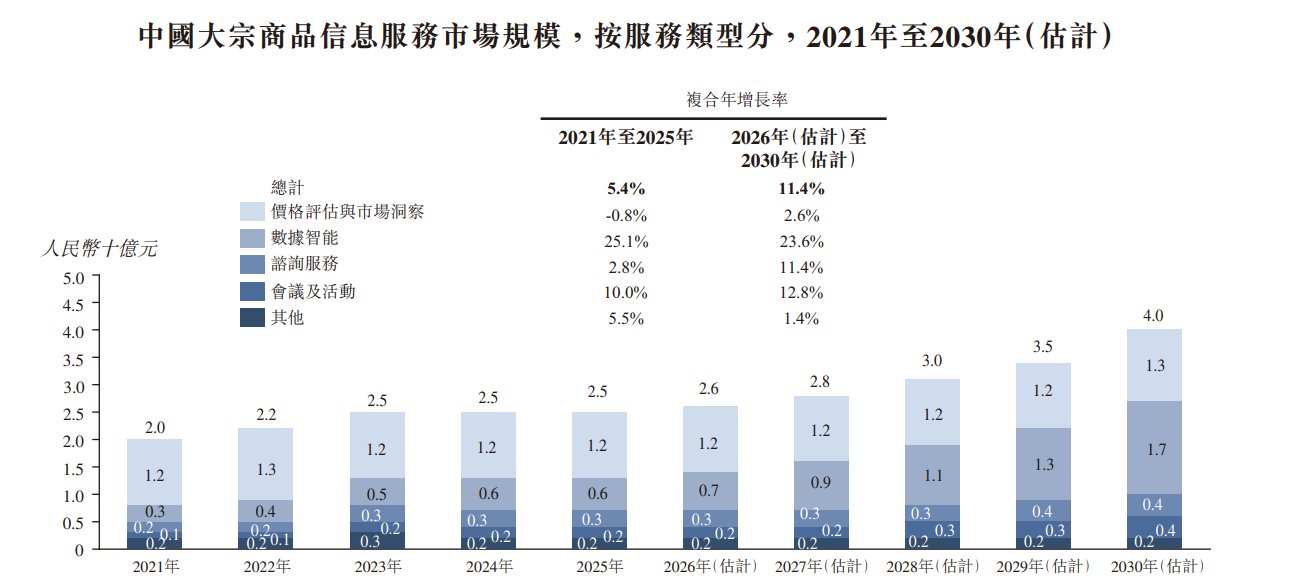
Although Zhuochuang is a leader in the energy sector (31.9% of the market), accounting for about 12.4% of the total domestic market, it is difficult to support the high valuation premium given to it by the market by 2030, with only an increase in the share of the stock market of 4 billion yuan.
Under such a difficult development situation, the key to Zhuochuang Information's breakthrough is whether it can achieve substantial breakthroughs in three directions. First, can digital intelligence services upgrade from a “supplementary business” to a “core growth pole” — digital intelligence accounts for only 23.2% of revenue in 2025. If products such as API calls, data terminals, and price prediction can pull ARPU back to an upward channel, the service market will far exceed the boundaries of traditional information.
Second, can the price benchmark actually go overseas — the global commodity information service is expected to be about 55.4 billion yuan in 2030, and Zhuochuang's overseas revenue share in 2025 is only 12.67%. If energy and chemical products can form a pricing voice in Asia and the world, the ceiling will rise sharply. Third, is it possible to make up for shortcoming categories such as steel and non-ferrous metals through mergers and acquisitions, and transform AI from a cost reduction tool into a fee-based decision-making product.
Only by achieving more significant results in digital and intelligent monetization, international expansion, and full category coverage can Zhuochuang Information hope to break through the valuation anchor of the 4 billion domestic market and achieve value revaluation from “small but beautiful” to “big and strong.”