


How Investors Are Reacting To Ameren (AEE) $900 Million Debt Offering
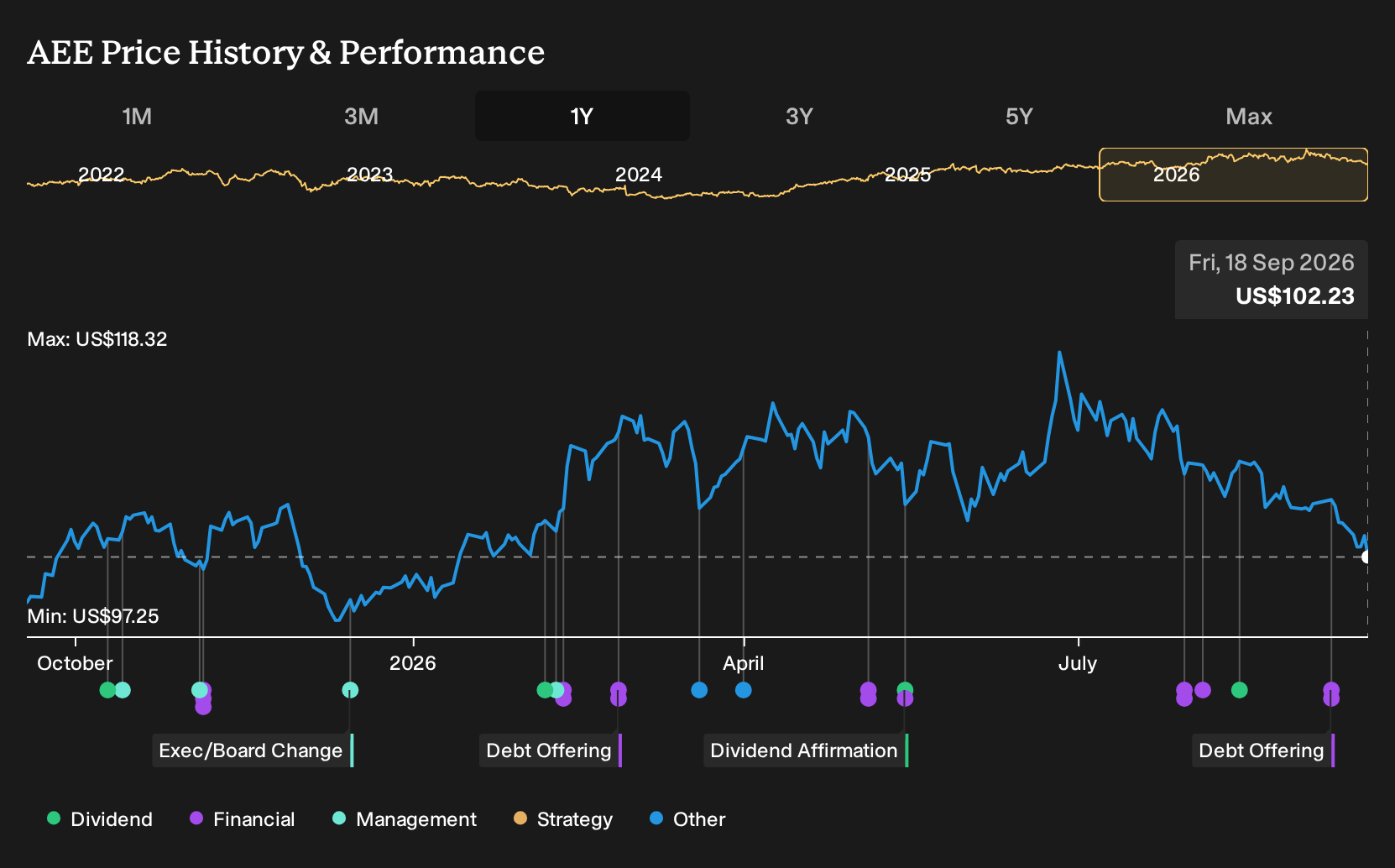
- Ameren has issued callable, subordinated fixed to floating rate notes due March 15, 2057, raising US$900 million in unsecured corporate debt. The company has also presented at the Barclays 40th Annual Energy-Power Conference in New York.
- This combination of long dated, junior funding and public engagement with institutional investors indicates active balance sheet planning around future infrastructure and grid investment needs.
- We will examine how Ameren's investment narrative around long term infrastructure spending is influenced by the new US$900 million subordinated notes.
Scan how Ameren’s funding move compares with other grid and infrastructure players by reviewing the hand picked 39 power grid technology and infrastructure stocks that could also be positioning for long dated investment cycles.
Ameren Investment Narrative Recap
To own Ameren, you need to believe in a long runway of regulated grid and generation investment tied to data centers, electrification and resilience spending. That story leans heavily on constructive regulators, timely project approvals and the continued availability of energy tax credits. The most important near term catalyst is progress on rate cases and large load agreements. The main risk is regulatory lag that leaves growing capex and operating costs only partly recovered in customer bills.
The new US$900 million subordinated notes do not radically change that near term setup. They are one more piece of funding in a plan that already assumes more than US$63b of capital projects, and they highlight the importance of balance sheet flexibility when debt is not fully covered by operating cash flow. For now, the bigger watchpoints remain demand realization from data center customers and any shift in federal or state policy support.
The fixed to floating rate notes due 2057 are the cleanest link between the recent headlines and Ameren’s execution risks. Long dated, unsecured, subordinated funding gives the utility another tool to support heavy grid, generation and transmission spending while it works through rate proceedings in Missouri and Illinois. That matters because the firm already relies entirely on higher risk funding sources rather than customer deposits.
For you as a shareholder, this bond issue feeds directly into two questions. First, how effectively management can match financing terms with projects that are subject to regulatory approval and uncertain data center ramp timing. Second, whether incremental interest costs and layered capital structures pressure dividend coverage over time, given that free cash flow currently does not fully support the 2.93% payout.
Ameren's current analyst narrative points to revenues of US$10.6b and earnings of US$1.9b by 2029, based on an assumed 7.6% yearly revenue growth rate and an uplift in earnings from US$1.5b today to US$1.9b. This is roughly a 27% increase in profit over that period.
Uncover why Ameren's fair value indicates a 17% potential upside to its current price that may not last much longer.
Exploring Other Perspectives
The Simply Wall St Community currently shows only 2 fair value estimates for Ameren, ranging from about US$95.28 to US$119.87 per share. That spread already points to wide disagreement before the US$900m subordinated notes and Barclays conference update. When you factor in data center demand risk, there is even more reason to weigh multiple viewpoints.
Explore another Ameren fair value estimate, including one that indicates up to 17% upside from the current price.
Reach Your Own Conclusion
Disagree with existing narratives? Extraordinary investment returns rarely come from following the herd, so consider forming your own view.
- A great starting point for your Ameren research is our analysis highlighting 3 key rewards and 2 important warning signs that could impact your investment decision.
- See our latest analysis for Ameren. The report includes a comprehensive fundamental analysis summarized in a single visual, the Snowflake, making it easy to evaluate Ameren's overall financial health at a glance.
Looking for more Ameren style investment ideas?
If the Ameren story has you thinking about where else long term capital could work hardest, broaden your watchlist with companies that share some of the same themes of resilience, balance sheet discipline and income potential.
- For investors focused on quality at a sensible entry point, scan a curated group of companies trading below their implied worth using the 35 high quality undervalued stocks.
- If capital preservation and steadier return profiles matter most to you, filter for businesses with stronger financial footing through the 30 resilient stocks with low risk scores.
- Income seekers who want yield backed by fundamentals can hunt for potential dividend payers with sturdier cash coverage using the 7 dividend fortresses.
This article by Simply Wall St is general in nature. We provide commentary based on historical data and analyst forecasts only using an unbiased methodology and our articles are not intended to be financial advice. It does not constitute a recommendation to buy or sell any stock, and does not take account of your objectives, or your financial situation. We aim to bring you long-term focused analysis driven by fundamental data. Note that our analysis may not factor in the latest price-sensitive company announcements or qualitative material. Simply Wall St has no position in any stocks mentioned.
Have feedback on this article? Concerned about the content? Get in touch with us directly. Alternatively, email editorial-team@simplywallst.com