


Is Microsoft (MSFT) Overvalued As AI Spending And Copilot Demand Build?
Microsoft (MSFT) has become a focal point again after a cluster of AI driven updates, including rising Copilot and Azure demand, higher data center spending, and new cloud partnerships.
Against that backdrop, Microsoft’s recent flurry of AI partnerships and rising Copilot and Azure usage is being weighed against heavier capital spending. The stock has posted a strong 90 day share price return of 34.42%, but its 1 year total shareholder return is down 3.88%. This suggests momentum has been strong in the short run while some investors reassess longer term risk and reward as AI spending ramps.
Compare Microsoft’s AI driven surge with a curated group of stocks exposed to the same theme by scanning the 88 AI infrastructure stocks now.
After a near vertical 90 day move and a 1 year return that has slipped, Microsoft now sits at a point where opinions split. Is the real upside still ahead, or has most of it already been priced in?
Most Popular Narrative: 18% Overvalued
Microsoft last closed at $493.78, while the most followed fair value narrative pegs the stock at $419.91, which frames the recent AI fueled move as richer than that reference point.
Microsoft rarely goes on sale, so it''s worth paying attention when the multiple compresses. At around $380, the stock trades at roughly 22 to 23x trailing earnings and ~14x EV/EBITDA, well below its own seven year historical range. This is the cheapest Microsoft has been in years, and the de-rating looks more like a capex cycle worry than a deterioration in the business. Returns on equity sit around 33% and returns on invested capital around 21%, the balance sheet is effectively net cash, and the enterprise/cloud moat, Azure, the Office and Windows franchise, and AI-platform optionality through Copilot and the OpenAI stake, remains as good as anything in large-cap tech. Operating income has been remarkably steady even as headline GAAP earnings bounce around on non-operating swings tied to the OpenAI investment. The one real debate is capital intensity. Capex has roughly doubled to ~37% of revenue as Microsoft builds out AI infrastructure, and that has compressed free cash flow in the near term. The key point for a value investor: this is funded from operating strength, not debt. Whether it earns a good return is the thing to watch, but the company isn''t stretching its balance sheet to do it. Overall: Fairly valued, edging attractive. A high-quality compounder worth accumulating on weakness.
See why 228 investors see Microsoft as 18% overvalued.
Result: Fair Value of $419.91 (OVERVALUED)
Still, this fair value lens could crack if AI capex delivers weaker returns than hoped, or if Microsoft hits a wall on Copilot or Azure adoption.
Find out about the key risks to this Microsoft narrative.
Another View On Microsoft’s Value
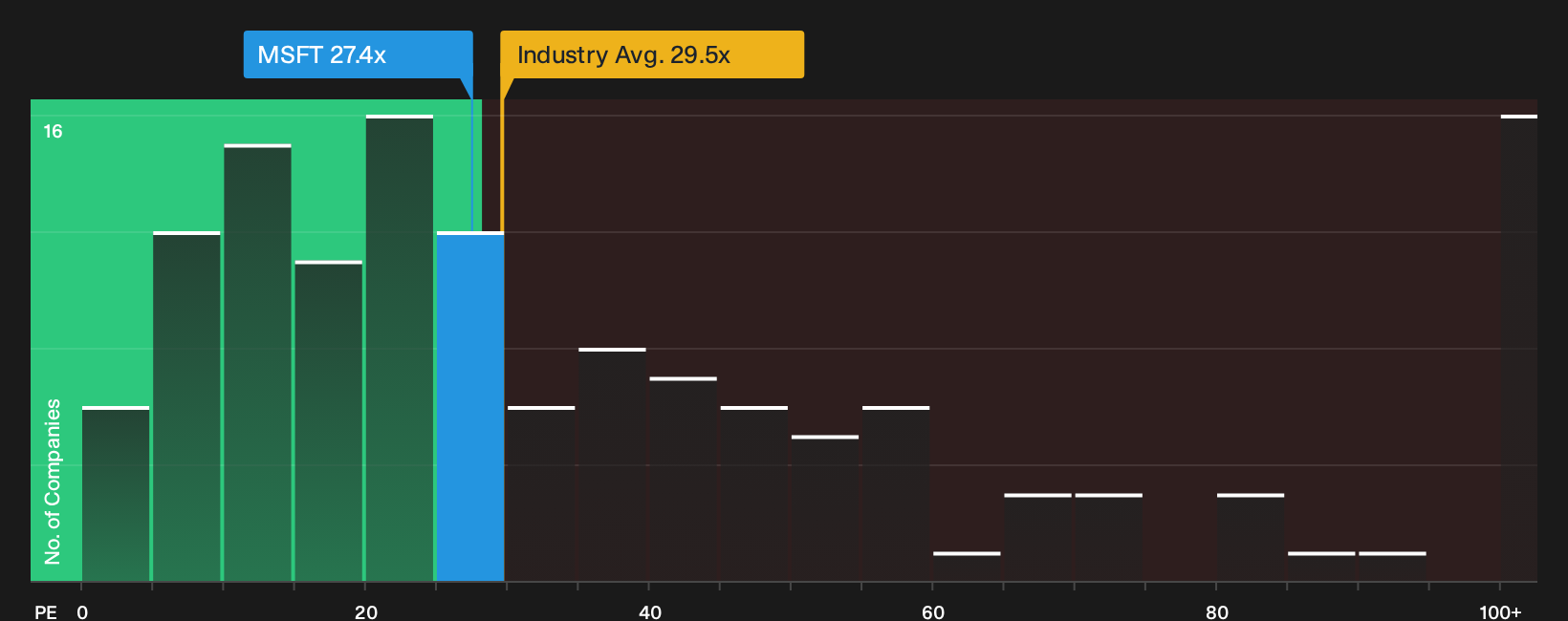
There is a different read on Microsoft when looking at the P/E ratio. The current 27.4x multiple sits below the US Software industry average of 29.5x and well under the estimated fair ratio of 51.2x, which points to less valuation froth than the $419.91 fair value narrative suggests. If the market moves closer to that fair ratio, today’s AI driven anxiety may be viewed as either risk or opportunity.
See what the numbers say about this price — find out in our valuation breakdown.
Next Steps
Opinions are mixed about where Microsoft goes next after this AI surge and ongoing valuation debate. Consider acting promptly, reviewing both sides of the story, and carefully weighing the 3 key rewards and 1 important warning sign.
Looking for more investment ideas beyond Microsoft?
Do not stop your research with Microsoft. Fresh opportunities often sit just outside the obvious choices, and missing them can quietly drag on long term returns.
- Spot potential bargains early by scanning a 16 high quality undiscovered gems that focuses on quality businesses many investors may not be watching yet.
- Build a sturdier core to your holdings by reviewing a list of solid balance sheet and fundamentals (23 results) that highlights companies with stronger financial foundations.
- Focus on offense and defense together by checking a 30 resilient stocks with low risk scores that filters for resilience while you search for upside.
This article by Simply Wall St is general in nature. We provide commentary based on historical data and analyst forecasts only using an unbiased methodology and our articles are not intended to be financial advice. It does not constitute a recommendation to buy or sell any stock, and does not take account of your objectives, or your financial situation. We aim to bring you long-term focused analysis driven by fundamental data. Note that our analysis may not factor in the latest price-sensitive company announcements or qualitative material. Simply Wall St has no position in any stocks mentioned.
Have feedback on this article? Concerned about the content? Get in touch with us directly. Alternatively, email editorial-team@simplywallst.com