


Lam Research (LRCX) Posts Record Results, Is The AI Upside Already Priced In?
Lam Research (LRCX) is back in the spotlight after record fiscal 2026 results, higher margin targets, and richer dividends crystallized around the same time that semiconductor stocks rallied with the Philadelphia semiconductor index.
Lam Research has ridden a strong semiconductor upswing, with a 1-day share price return of 6.98% lifting the stock to US$288.11, even though the 90-day share price return is down 25.94% after a softer 30-day patch. That pullback sits against a powerful longer run, with a 1-year total shareholder return of 128.26% and a 3-year total shareholder return of roughly 3.8x. This suggests earlier optimism has been intense and that recent volatility likely reflects investors reassessing growth expectations and risk after record results and richer capital returns rather than any single headline.
Scan how Lam Research compares with other chip stocks riding the same AI-driven demand cycle by reviewing the hand-picked 89 AI infrastructure stocks.After that surge, Lam Research now trades well below the average analyst target yet screens as expensive on some intrinsic models. Is the truth closer to the bullish price targets or to the more cautious fair value range?
Most Popular Narrative: 32% Undervalued
On the most followed valuation view, Lam Research screens well below an estimated fair value of $423.85 compared with the latest $288.11 close. That gap rests on a detailed cycle thesis that treats the AI memory bottleneck as a multi-year order book rather than a short-term trading story.
Lam Research is the position I hold to be right about the AI memory bottleneck without having to be right about how long it lasts.
Every direct memory holding, Micron, SanDisk, Seagate, makes money while supply stays short and loses the argument the moment capacity catches up. Lam makes money on the shortage and makes money on the response to it, because the capacity that eventually relieves the shortage has to be bought from somewhere, and a very large share of it gets bought from Lam.
See why 23 investors see Lam Research as 32% undervalued.
According to isidrohg, who authored this widely followed thesis, the key is not just Lam Research’s exposure to AI memory spending but the idea that the firm participates in both phases of the cycle. On that view, Lam sells equipment while supply is constrained and continues to supply tools when memory producers eventually add or convert capacity to address the shortage.
The same narrative pegs fair value at $423.85 using a discount rate of 11.25%, implying a sizeable buffer to the current share price. That estimate also embeds a net profit margin assumption of about 31.27%, close to Lam Research’s recent profitability profile rather than a step-change improvement.
Forecasts underlying the story point to annual earnings growth of about 21.3% and revenue growth of 16.6%, which are both above current US market expectations based on the supplied data. The thesis treats those growth rates as consistent with a period of elevated wafer fab equipment spending tied to AI and memory, not as permanently repeatable numbers.
The same framework explicitly flags risks. It highlights that Lam Research trades on a rich P/E of 49.6x compared with both peers and an estimated fair P/E of 44.3x, and that the stock has already delivered a very strong 1-year total return of 128.26%. It also calls out high non cash earnings and the possibility that investors are pricing peak cycle margins as if they were normal.
For readers weighing this against other tools, the narrative’s fair value contrasts with an SWS DCF model output that places Lam Research’s future cash flow value at $169.56 per share, below the current price. The gap between those two approaches shows how much the story hinges on the durability of the AI driven spending cycle and the margin profile attached to it.
Result: Fair Value of $423.85 (UNDERVALUED)
Still, the thesis can crack if memory makers pull back capex faster than expected or if tighter China export rules adversely affect Lam Research’s order pipeline.
Find out about the key risks to this Lam Research narrative.
Another View: Lam Research on Earnings Multiples
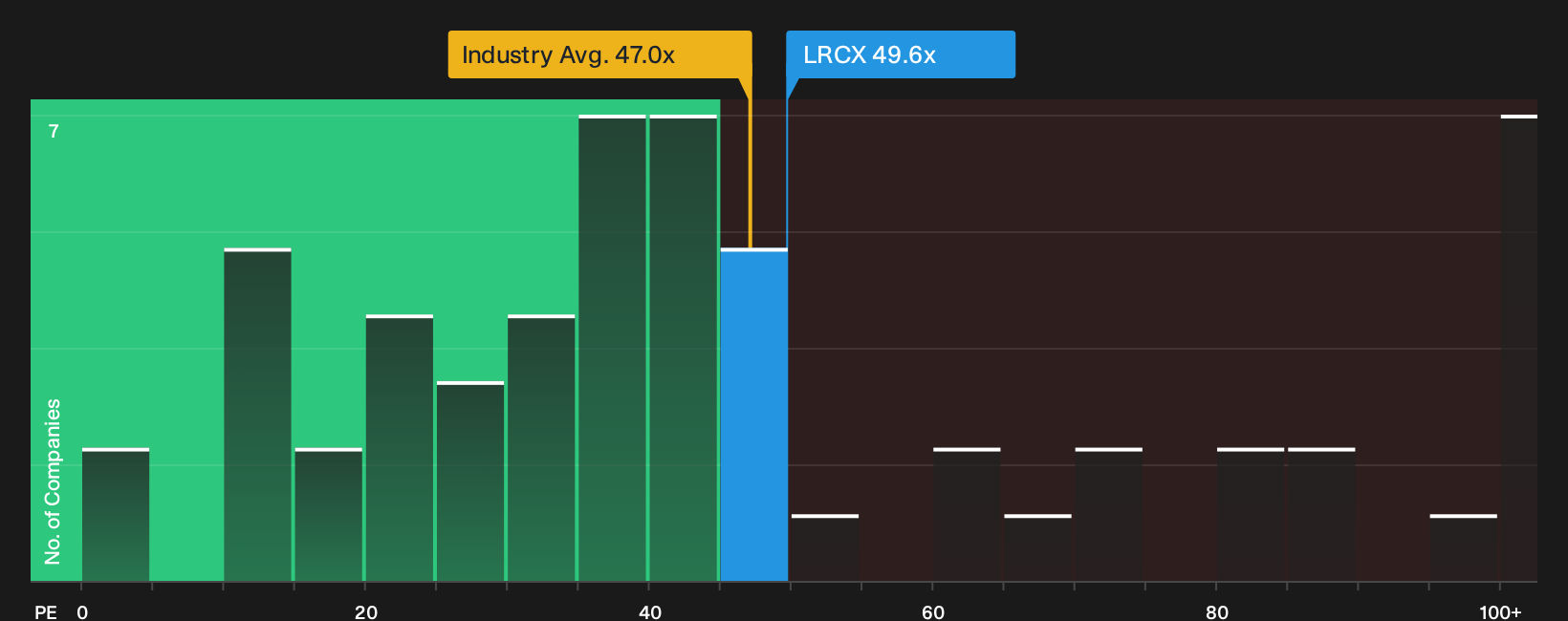
There is a very different read on Lam Research when you swap that narrative fair value for simple earnings ratios. The stock trades on a P/E of 49.6x, above the US Semiconductor industry at 47x and above a fair ratio estimate of 44.3x based on regression analysis.
That means investors are already paying a premium both to peers and to where the P/E could migrate if sentiment cools. The risk is that strong growth expectations are priced in more fully than the 32% undervalued thesis suggests.
See what the numbers say about this price — find out in our valuation breakdown.
Next Steps
If this mix of optimism and concern around Lam Research feels familiar, use it as a prompt to move quickly, study the detail yourself, and then weigh the 3 key rewards and 2 important warning signs.
Looking for more Lam Research sized ideas?
If Lam Research has sharpened your thinking, do not stop here. Broader context across other opportunities can help your portfolio work harder for you.
- Target companies with strong cash generation and sensible valuations by scanning the 33 high quality undervalued stocks that match those criteria.
- Strengthen your income stream by reviewing the 6 dividend fortresses that offer higher yields with focused fundamental checks.
- Prioritize resilience by filtering for the 30 resilient stocks with low risk scores that score well on balance sheet strength and risk metrics.
This article by Simply Wall St is general in nature. We provide commentary based on historical data and analyst forecasts only using an unbiased methodology and our articles are not intended to be financial advice. It does not constitute a recommendation to buy or sell any stock, and does not take account of your objectives, or your financial situation. We aim to bring you long-term focused analysis driven by fundamental data. Note that our analysis may not factor in the latest price-sensitive company announcements or qualitative material. Simply Wall St has no position in any stocks mentioned.
Have feedback on this article? Concerned about the content? Get in touch with us directly. Alternatively, email editorial-team@simplywallst.com