


Will Sandisk Split Change Western Digital Stock Narrative
- Western Digital has completed the separation of SanDisk into an independent flash-focused business, leaving Western Digital concentrated on high-capacity HDDs and data center storage while SanDisk targets NAND and SSD demand across datacenter, edge, and consumer markets.
- The split creates two focused storage platforms, with Western Digital leaning into high-capacity HDD technologies and long-term hyperscale demand, and SanDisk using multi-year supply agreements to smooth the memory cycle and improve revenue visibility.
- We will look at how Western Digital's sharper focus on high-capacity data center storage reshapes the company's broader investment narrative.
Scan how Western Digital's move reshapes storage, then size up other potential beneficiaries in AI and data infrastructure across our hand-picked 89 AI infrastructure stocks.
Western Digital Investment Narrative Recap
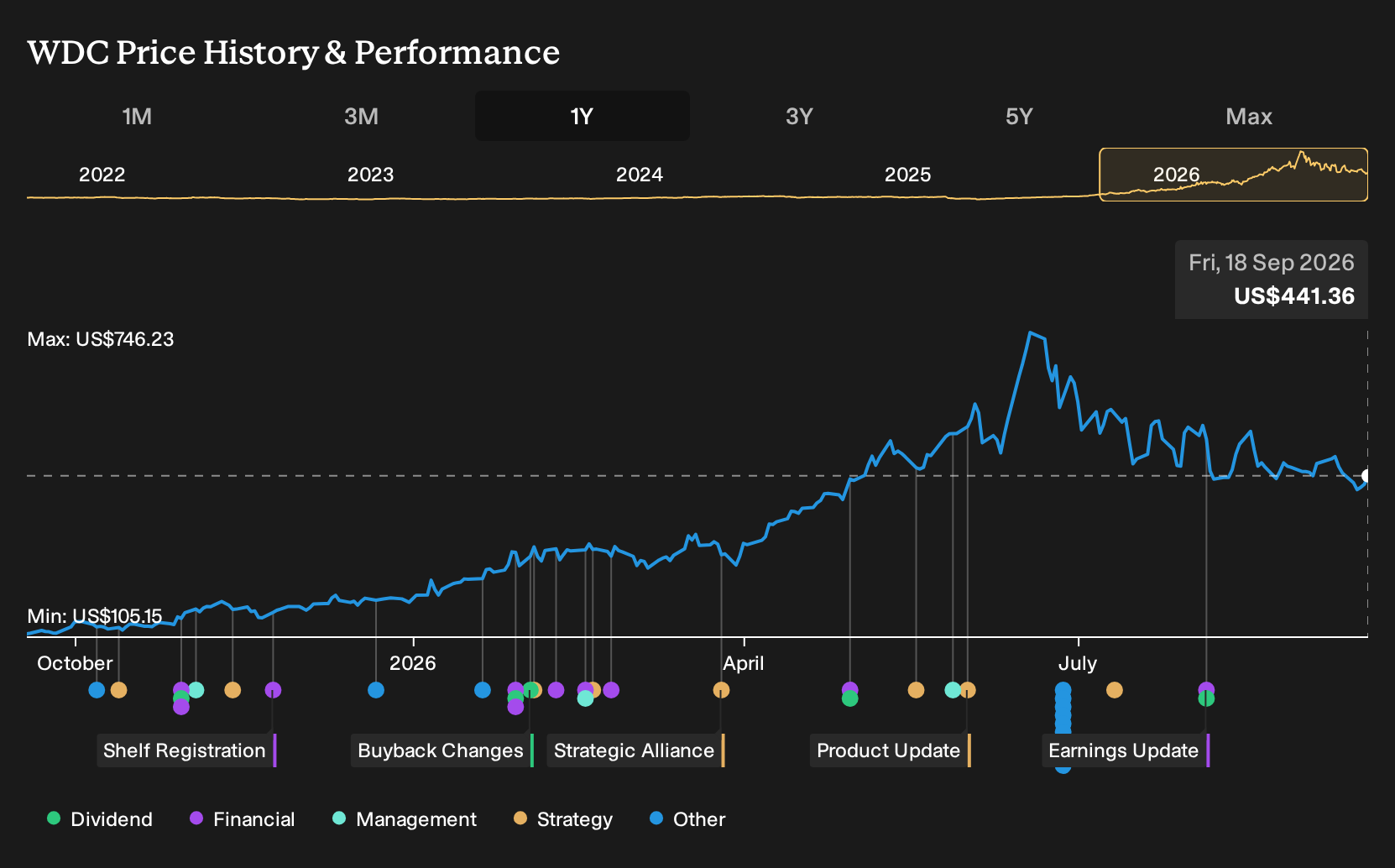
For Western Digital, the core belief is that long term demand for high capacity HDDs tied to cloud and AI infrastructure remains intact, even if pricing and orders move in cycles. The recent selloff on profit taking and demand worries mostly affects sentiment, not the underlying need for large scale storage. The near term swing factor is how consistently hyperscale customers order capacity against existing purchase commitments.
The biggest risk right now is how concentrated that customer base is. Any pause, redesign, or shift toward alternative storage technologies could hit volumes hard. On the flip side, the separation of SanDisk allows Western Digital to focus operationally on executing its HDD roadmap and on maintaining manufacturing yields on UltraSMR and future HAMR products.
The most relevant update tied into this breakup is Western Digital leaning into very high capacity HDD technologies such as 44TB class HAMR and UltraSMR drives for cloud data centers. These products sit directly in the path of AI and unstructured data growth, where hyperscalers are trying to pack more terabytes into every rack while keeping cost per bit in check.
Execution on that roadmap is what connects the story post split. Faster qualification and strong reliability data could support a richer mix toward high value drives, which matters for margins when pricing pressure shows up. Any stumble in yields, or if large cloud buyers experiment more aggressively with custom storage architectures, would work against that thesis even with analyst sentiment currently positive.
Western Digital's current analyst narrative points to revenues of $32.1b and earnings of $15.2b by 2029. This assumes revenue growth of 35.4% per year and an earnings increase of $5.9b from $9.3b today.
Discover how Western Digital's fair value indicates a 50% potential upside to its current price that may not last much longer.
Exploring Other Perspectives
One alternate view focuses less on hyperscaler demand and more on Western Digital's exposure to HDDs losing share to solid state storage. The most cautious analysts were penciling in about $27.6b of revenue and $11.5b of earnings by 2029, well below consensus. That gap shows how sharply opinions can split, so it may be useful to explore several angles before deciding how this separation might reshape expectations.
Explore 6 other Western Digital fair value estimates, including one that suggests as much as 25% downside from the current price.
Reach Your Own Conclusion
Disagree with existing narratives? Extraordinary investment returns rarely come from following the herd, so consider conducting your own research.
- A great starting point for your Western Digital research is our analysis highlighting 4 key rewards and 3 important warning signs that could impact your investment decision.
- See our latest analysis for Western Digital. The report includes a comprehensive fundamental analysis summarized in a single visual, the Snowflake, making it easy to evaluate Western Digital's overall financial health at a glance.
Looking for more Western Digital style investment ideas?
If the Western Digital story has sharpened your thinking on storage and AI infrastructure, it may be a good time to widen the lens and see how other businesses stack up. The Simply Wall St Screener can help you quickly surface stocks that align with your return goals and risk comfort, without needing to sift through every ticker yourself.
- If capital preservation comes first for you, consider starting with a basket of companies that score well on resilience and financial risk using our 30 resilient stocks with low risk scores.
- If you want income on top of potential price moves, scan for companies offering robust yields and more durable payouts through the 6 dividend fortresses.
- If you are hunting for underfollowed opportunities with solid fundamentals, cast a wider net using the 16 high quality undiscovered gems.
This article by Simply Wall St is general in nature. We provide commentary based on historical data and analyst forecasts only using an unbiased methodology and our articles are not intended to be financial advice. It does not constitute a recommendation to buy or sell any stock, and does not take account of your objectives, or your financial situation. We aim to bring you long-term focused analysis driven by fundamental data. Note that our analysis may not factor in the latest price-sensitive company announcements or qualitative material. Simply Wall St has no position in any stocks mentioned.
Have feedback on this article? Concerned about the content? Get in touch with us directly. Alternatively, email editorial-team@simplywallst.com