


RHB Bank stamps its mark
WE are in a waiting room at RHB Centre on Jalan Tun Razak when Datuk Mohd Rashid Mohamad walks in.
The RHB Banking Group managing director and chief executive officer sits down with the StarBiz 7 team for a while, making small talk and recalling details from a conversation he had with us a year ago.
It is a small but telling sign of the rapport built over these meetings.
In banking too, that human connection remains important, with trust still a key part of the relationship even as more of the daily experience moves into the digital space.
That is something the banking group is trying to preserve as it pushes further into digital banking.
“Everyday banking is becoming increasingly invisible, with activities such as making payments, transferring money and doing business happening seamlessly through digital platforms.
“Already, 95.4% of RHB’s customer transactions are done digitally,” Mohd Rashid tells StarBiz 7 as we begin the interview in his office.
RHB is now taking that digital push a step further with RHB Pay, its own unified online payment gateway.
RHB Pay, which was launched in August this year, allows merchants to manage payments through a single platform, with automatic reconciliation and faster settlement directly into their RHB accounts.
The early take-up is already showing promise, with 30 major clients signed up and at various stages of integration. The bank sees a potential pool of about 800 merchants that could eventually use the platform.
“We see this as an opportunity to set ourselves apart from our banking peers. This is an area traditionally served by third-party payment providers,” Mohd Rashid says.
As Malaysia’s fourth-largest bank by assets, RHB is using the platform to move closer to merchants and capture more of the payment flows generated by their businesses.
This will help the bank retain the current account and savings account (Casa) balances linked to their businesses.
Mohd Rashid says RHB expects the payment gateway to add about RM500mil to the group’s Casa balance by end-2026.
The idea to launch its own online payment gateway came from listening to customers, who told the bank that managing payments through third-party providers could be a headache, particularly when it came to reconciliation and cash flow.
“Reconciliation is a nightmare,” Mohd Rashid says, explaining that merchants often have to deal with multiple accounts and payment platforms.
He gives the example of a merchant that currently manages about 500 accounts but could consolidate them into just 10 through RHB Pay.
The RHB Pay launch is part of the group’s broader technology push under its PROGRESS27 strategy, which runs through 2027.
According to Mohd Rashid, the group is investing RM800mil to RM1bil in technology over a period of three years, from 2025 to 2027, as part of this push.
Customer experience is another focus. The banking group tracks this through its Net Promoter Score (NPS), which measures how likely customers are to recommend the bank to others. Its NPS ranks No. 2 in the industry.
“Our ambition is to take the top spot by 2027,” he shares.
This focus on customer experience is also reflected in its service performance.
RHB says 95% of customers were satisfied based on the feedback of 80,000 customers in the first half of financial year 2026 (FY26), while 91.4% of complaints were resolved within the agreed service level.
Growing with customers
For RHB, growth is not simply about selling more products to existing customers. It is about capturing a larger share of their overall banking needs and becoming their primary bank.
That means understanding how their needs change as they grow and serving them accordingly, particularly for small and medium enterprises (SMEs) which can become larger and more complex as their businesses expand.
To support this, it created the Group Community Banking and Business Banking (GCBB) segment in April last year.
“As SMEs move up the scale, they need more than basic banking services, from larger financing facilities to cash management and other solutions. This allows us to deepen our relationship with them.”
Under PROGRESS27, the group is targeting more than 10% annual growth in mid-sized companies, where it sees better returns, compared with the overall loan growth of more than 6% a year in Malaysia.
The bank also aims to capture customers early through its MySiswa programme, which allows students at public universities to use an RHB debit card that also serves as their student matriculation card.
Mohd Rashid says the programme has onboarded about 600,000 students over the past three years, while the latest graduate cohort recorded a customer retention rate of approximately 60%.
Putting AI to work
Mohd Rashid says artificial intelligence (AI) is already being used in mortgage processing, cutting the time taken to process and disburse a mortgage from about 15 to 20 days to as little as three days.
“The AI can process about 20 documents and 120 data points, instead of people having to go through all these documents manually. It can identify what is missing and reduce the risk of human error.”
The bank is also using AI in fraud detection, anti-money laundering checks and collections. It recently established a dedicated Financial Crime Compliance unit, bringing its anti-money laundering and fraud functions together.
However, Mohd Rashid says technology still has its limits, particularly when it comes to credit decisions.
AI is mainly being used for smaller financing, while bigger loans still require human judgement to assess the borrower’s track record and ability to repay, he adds.
As technology takes over more repetitive tasks, RHB does not plan to cut jobs. Instead, the bank is looking to reskill and redeploy employees to other roles.
For instance, Mohd Rashid says staff whose roles are affected by automation could be trained as testers to help assess new systems before they are rolled out.
As for bank branches, he says they will remain open but their role is changing.
They will focus more on services such as wealth management, where customers may still prefer to speak to someone when making bigger or more complex financial decisions.
“In Singapore, our branch operations are focused on wealth management, with relationship managers advising customers on investments and other financial needs.
“The bigger the investment, the more human interaction you need,” he adds.
Notably, RHB’s wealth management business has been seeing strong growth, with assets under management (AUM) growing 26% year-on-year (y-o-y). Meanwhile, AUM in its Affluent Premier segment, which caters to affluent customers, grew 29% y-o-y.
The bank is also planning to expand its wealth management offering with a private banking proposition for its wealthiest customers, which will be launched in the near future.
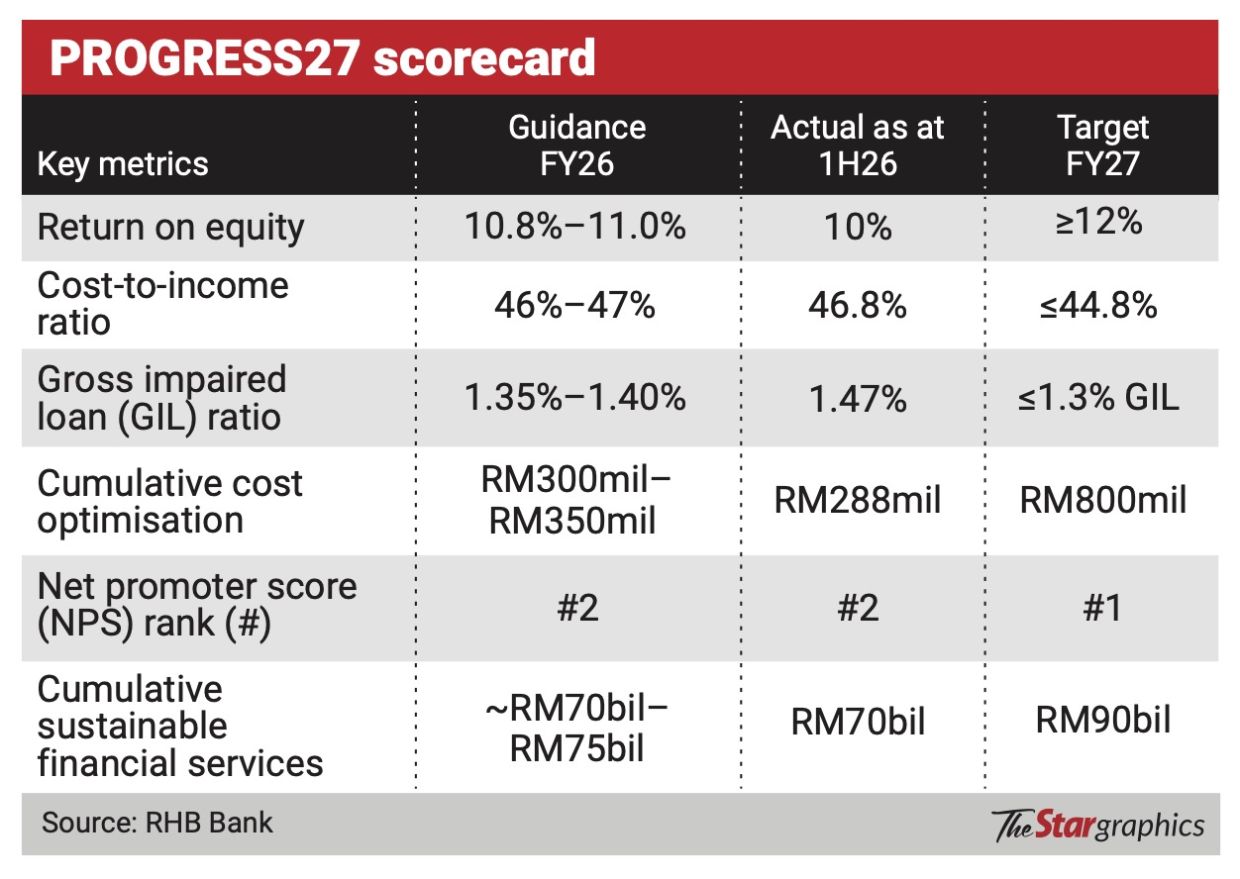
RHB is now in the second year of its three-year transformation strategy.
Mohd Rashid says the three-year timeframe is long enough to set a clear direction while giving the bank room to respond to changes in the economy and banking landscape.
According to him, the group remains focused on its key goals, although some are still work in progress.
RHB delivered a return on equity (RoE) of 10.5% in FY25 and is targeting 10.8% to 11% for FY26. In the first half of FY26, RoE stood at 10%, excluding the yet-to-be-proposed second interim dividend.
Mohd Rashid, 58, who has been at the helm since April 2022, acknowledged the challenging environment.
“I know this year’s market has been really tough. There are a lot of uncertainties, but we remain committed to delivering that.”
For FY27, RHB is targeting an RoE of at least 12%.
To get there, the bank will focus on growing higher-yielding businesses, particularly among Malaysian mid-sized companies, while improving efficiency and boosting fee income. It will also continue to manage costs closely.
RHB achieved RM288mil in cumulative cost savings from January 2025 to June 2026, bringing the group close to its cumulative cost savings target of RM300mil to RM350mil by December 2026.
Its cost-to-income ratio stood at 46.8%, within its 46% to 47% guidance for FY26. The group is targeting 44.8% or lower by 2027.
On sustainability, it is targeting RM90bil in sustainable finance by 2027 and had reached about RM70bil by the first half of FY26.
In the first half of FY26, the group’s net profit rose 7.1% y-o-y to RM1.66bil. The results were supported by steady total income, disciplined cost management, and improvement in credit quality.
The stock, whose largest shareholder is the Employees Provident Fund, has also seen increased investor interest.
Its share price has risen 7.7% as at Sept 2 – making it the second-best performer among major Malaysian banks, behind Public Bank Bhd’s 8.6% gain.
Foreign shareholding has also risen to 23.96% as at end-August 2026 from 19.27% a year earlier.
Mohd Rashid says the group remains committed to shareholder returns, with its dividend payout guidance now at 50% to 60%.
By 2027, Mohd Rashid wants RHB to be seen as more than a bank that has simply become more digital.
“We want to be known as a bank that is progressive, eventually predictive, not just reactive.”
Its upcoming conversational banking service, potentially launching later this year, is another step in that direction, allowing customers to carry out banking transactions in a more intuitive manner rather than having to navigate the usual app menus.
Even as RHB pushes further into digital banking, Mohd Rashid says the human touch remains important.
Recalling advice he received early in his career, he says: “The best part about being in sales is building trust that stands the test of time.”
He says that lasting customer relationships are built on trust and loyalty, creating the confidence needed to sustain those relationships over time.