


How Investors May Respond To Phillips 66 (PSX) Bayway Contract Rally
- Workers at Phillips 66's Bayway Refinery in New Jersey, represented by Teamsters Local 877, held a rally on September 15, 2026, ahead of contract expiry on October 1 to push for higher wages, stronger benefits, and the removal of an Absence Control Policy that allows discipline for being sick.
- The dispute brings Phillips 66's labor practices and potential changes to operating costs into sharper focus, especially at a major Northeast refining hub that plays a material role in the business.
- This article examines how Phillips 66's investment narrative intersects with Bayway labor demands for higher pay and changes to attendance rules.
Scan beyond Phillips 66 and stress test your thesis on union risk and operating costs against other refiners and energy operators screened as 30 resilient stocks with low risk scores.
Phillips 66 Investment Narrative Recap
For someone holding Phillips 66, the core belief is that a complex, multi segment energy operator can keep turning volatile refining cycles, heavy capital needs, and high debt into solid cash generation, buybacks, and dividends. The Bayway rally highlights labor as one more moving part. At this point the event is local and does not on its own reset the broader operating thesis.
The near term swing factor still looks tied to refining utilization and Midstream execution, especially as analysts expect revenue and earnings to decline over the next three years. The biggest risk remains pressure on refining margins and Renewable Fuels economics, which could matter more to earnings than incremental wage or attendance policy changes at a single facility.
The upcoming third quarter 2026 results and webcast on October 28 sit closer to the center of the Phillips 66 catalyst map than the Bayway rally. Management will have to show whether recent very strong earnings growth and a high 22% return on equity remain intact as macro conditions stay challenging for Refining, Renewables, and Chemicals.
That call also gives you a checkpoint on how leadership is balancing Midstream growth projects, the Los Angeles refinery exit costs, and a reliable 1.85% dividend against a high debt load and forecast earnings declines. Any fresh color on turnarounds, Renewable Fuels margins, and capital returns could matter more for the medium term story than this specific labor standoff.
How Bayway Labor Risk Sits Against Phillips 66 Consensus Assumptions
Phillips 66's narrative projects US$136.2b revenue and US$7.3b earnings by 2029, based on analyst forecasts that imply fairly flat top line performance and an earnings increase of about US$3.2b from US$4.1b today.
Uncover why Phillips 66's fair value indicates a 24% potential downside to its current price, which leaves little room for error.
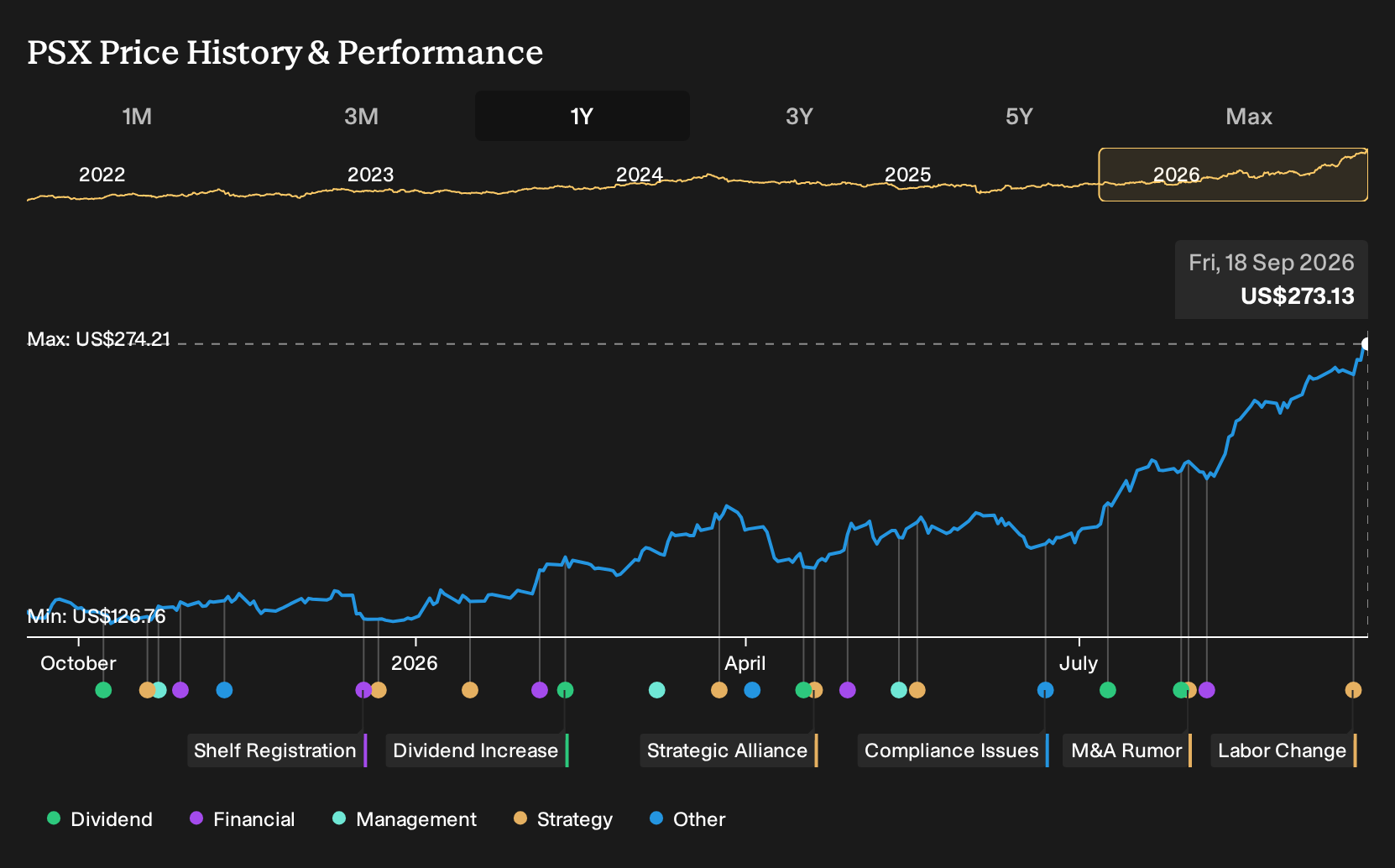
Exploring Other Perspectives
One alternate view flags cost control as the swing factor. The most pessimistic analysts already modeled revenue at about US$122.9b and earnings near US$7.0b by 2029 before this Phillips 66 Bayway dispute. You can treat that as a warning that if labor and other costs climb, their already cautious story may get even tougher.
Explore 2 other Phillips 66 fair value estimates, including one that suggests as much as 24% downside from the current price.
Reach Your Own Conclusion
Don't just follow the ticker. Dig into the data and build a conviction that's truly your own.
- A great starting point for your Phillips 66 research is our analysis highlighting 3 key rewards and 2 important warning signs that could impact your investment decision.
- See our latest analysis for Phillips 66. The report includes a comprehensive fundamental analysis summarized in a single visual, the Snowflake, making it easy to evaluate Phillips 66's overall financial health at a glance.
Looking For More Ideas Beyond Phillips 66?
If the Bayway story has you thinking harder about labor risk, balance sheets, and cash generation, it can help to widen the lens beyond Phillips 66 and compare it with other businesses that share some of the same pressures.
- For investors who want income that feels more resilient, review companies screened as 6 dividend fortresses and see which ones combine higher yields with robust fundamentals.
- If capital preservation is your priority, start with stocks filtered for 30 resilient stocks with low risk scores and compare their risk profiles with Phillips 66.
- To hunt for quality that is not yet widely followed, scan through 16 high quality undiscovered gems and see which stories might deserve a spot on your watchlist.
This article by Simply Wall St is general in nature. We provide commentary based on historical data and analyst forecasts only using an unbiased methodology and our articles are not intended to be financial advice. It does not constitute a recommendation to buy or sell any stock, and does not take account of your objectives, or your financial situation. We aim to bring you long-term focused analysis driven by fundamental data. Note that our analysis may not factor in the latest price-sensitive company announcements or qualitative material. Simply Wall St has no position in any stocks mentioned.
Have feedback on this article? Concerned about the content? Get in touch with us directly. Alternatively, email editorial-team@simplywallst.com