


Texas Instruments (TXN) Plans Dividend Hike, Is The Stock 41% Undervalued?
Texas Instruments (TXN) just put its dividend policy back in the spotlight with a planned 7% hike in the quarterly payout to $1.52 per share, subject to board approval.
Texas Instruments shares have eased off their recent highs, with the 30-day share price return down 5.18% and the 90-day move down 20.05%. The stock still carries longer-term momentum, with a 45.81% 1-year total shareholder return and 75.36% over three years, as investors weigh the dividend increase, capacity buildout and data center opportunity against near-term volatility.
Scan beyond Texas Instruments and see how other chipmakers with solid cash generation and income potential stack up in our curated list of 6 dividend fortresses
Texas Instruments now trades well below the average analyst target after a sharp pullback. Is that discount a safety margin, or a warning that the market’s caution on the spending and data center story is justified?
Most Popular Narrative: 41% Undervalued
On the most followed valuation view, Texas Instruments screens well below an implied fair value of $435.69 compared with the last close at $258.14. This puts the current pullback in a very different light for investors weighing the bigger capital investment story.
Texas Instruments is in the midst of a multiyear capacity-expansion cycle that is temporarily suppressing free cash flow but materially enhancing the company’s long-term competitive position. The buildout of U.S.-based 300mm analog manufacturing is expected to structurally improve cost efficiency, support higher gross margins, and increase supply-chain resilience. As these assets ramp and utilization normalizes, TXN should regain its historical free-cash-flow profile, supported by diversified end-market exposure across industrial, automotive, aerospace/defense, and energy infrastructure.
See why 19 investors see Texas Instruments as 41% undervalued.
Result: Fair Value of $435.69 (UNDERVALUED)
Still, the Texas Instruments story can crack if the heavy capacity build fails to translate into stronger demand or if AI spending tilts toward competing architectures.
Find out about the key risks to this Texas Instruments narrative.
Another View: What Multiples Say About Texas Instruments
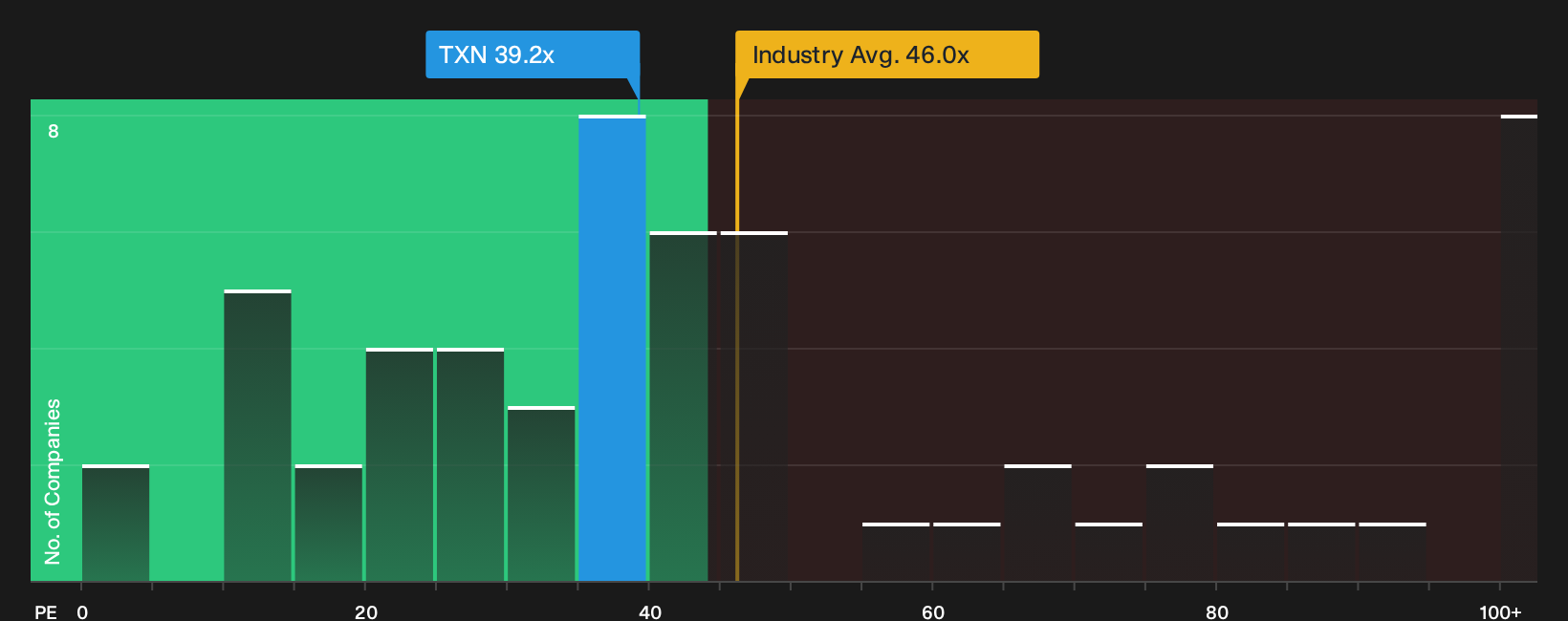
The rich fair value narrative around Texas Instruments meets a more cautious message when you look at the P/E numbers. The stock trades on 39.2x earnings, which is above a fair ratio of 33.7x. That suggests investors are already paying a higher price relative to this reference point, even before any re rating actually happens.
Peers in the US Semiconductor group trade around 46x. TXN therefore sits at a discount to these rivals, but at a premium to where the fair ratio suggests the multiple could drift. Is that gap a reasonable charge for quality, or a signal that expectations are already stretched?
See what the numbers say about this price — find out in our valuation breakdown.
Next Steps
Mixed signals around Texas Instruments can make the story feel messy, which is exactly why you should pull up the numbers yourself and decide where you stand. If you want a shortcut to the main pressure points and bright spots investors are focused on, start with the 3 key rewards and 2 important warning signs.
Looking for more investment ideas beyond Texas Instruments?
If Texas Instruments has sharpened your thinking, do not stop there. Broader context from other opportunities can help you spot patterns and avoid blind spots.
- Target potential high-upside movers by scanning 7 elite penny stocks with strong financials with stronger financial underpinnings than typical speculative trades.
- Focus on price versus quality by checking companies in the 29 high quality undervalued stocks that combine robust fundamentals with discounted valuations.
- Prioritize resilience and capital preservation by reviewing the 30 resilient stocks with low risk scores that score well on balance sheet strength and risk controls.
This article by Simply Wall St is general in nature. We provide commentary based on historical data and analyst forecasts only using an unbiased methodology and our articles are not intended to be financial advice. It does not constitute a recommendation to buy or sell any stock, and does not take account of your objectives, or your financial situation. We aim to bring you long-term focused analysis driven by fundamental data. Note that our analysis may not factor in the latest price-sensitive company announcements or qualitative material. Simply Wall St has no position in any stocks mentioned.
Have feedback on this article? Concerned about the content? Get in touch with us directly. Alternatively, email editorial-team@simplywallst.com