


Russell 2000 at the Crossroads: Rate Shock, Red Sea Risk, and a Fight for New Highs
Rate Shock Meets Red Sea Risk: What Is Driving RTY
Sentiment across RTY and broader small cap markets has turned choppy this week as two forces collide. On September 16, the Federal Reserve raised its target range by 25 basis points to 3.75% to 4.00%, its first hike since 2023, after Fed Chair Kevin Warsh flagged that underlying inflation was not slowing during recent public remarks. The decision followed a run of firmer inflation prints and came alongside a 10-year Treasury yield that broke above 5% for the first time since 2007, a move that weighs disproportionately on small caps given their heavier reliance on variable rate and shorter-term financing. Equities initially wobbled on the news, with the Dow shedding 1.21% and the S&P 500 slipping 0.45% on decision day, before markets rebounded on September 17 as the S&P 500 rose roughly 1% and chipmaker shares climbed about 3%. Money markets are currently pricing close to a 50% probability of another hike at the October meeting, keeping the rate path a live source of volatility.
Layered on top of the rate story is an escalating energy risk. Houthi forces launched a major wave of missile and drone strikes against southern Saudi Arabia on September 8, hitting areas including Jazan, Abha, Najran, and Khamis Mushait and injuring more than 70 people. Days later, on September 10, a drone attack originating from Iraq's Maysan governorate struck a pumping station along Saudi Arabia's East-West pipeline, prompting Riyadh to shut the entire pipeline as a precaution on September 11. Because this pipeline is Saudi Arabia's primary alternative route for moving crude to the Red Sea while Strait of Hormuz traffic remains constrained, the outage has pushed Brent crude toward $108.68 and WTI above $103, marking one of the sharpest weekly gains for oil in months. Higher energy costs feed directly into inflation expectations, complicating the Fed's path and adding another layer of uncertainty for rate sensitive small caps. Separately, growing calls from some AI industry leaders to slow the pace of frontier AI development, from what they characterized as extremely fast to only somewhat fast, have added a secondary layer of caution across risk assets this week.
What the Market Has Done
- The market has been trending up since the end of March, establishing a broader recovery structure.
- From June through the start of September, price action shifted into a sideways range bounded by the 3062 area (ATHs) on the top and 2910 (Jan Swing low) on the bottom.
- More recently, sellers stepped down offers within that range and compressed prices against the 2908 area (Daily level 1).
- In the past week, sellers were able to hold down offers at the 2892 area, establishing it as the market's current pivot point.
What to Expect in the Coming Weeks
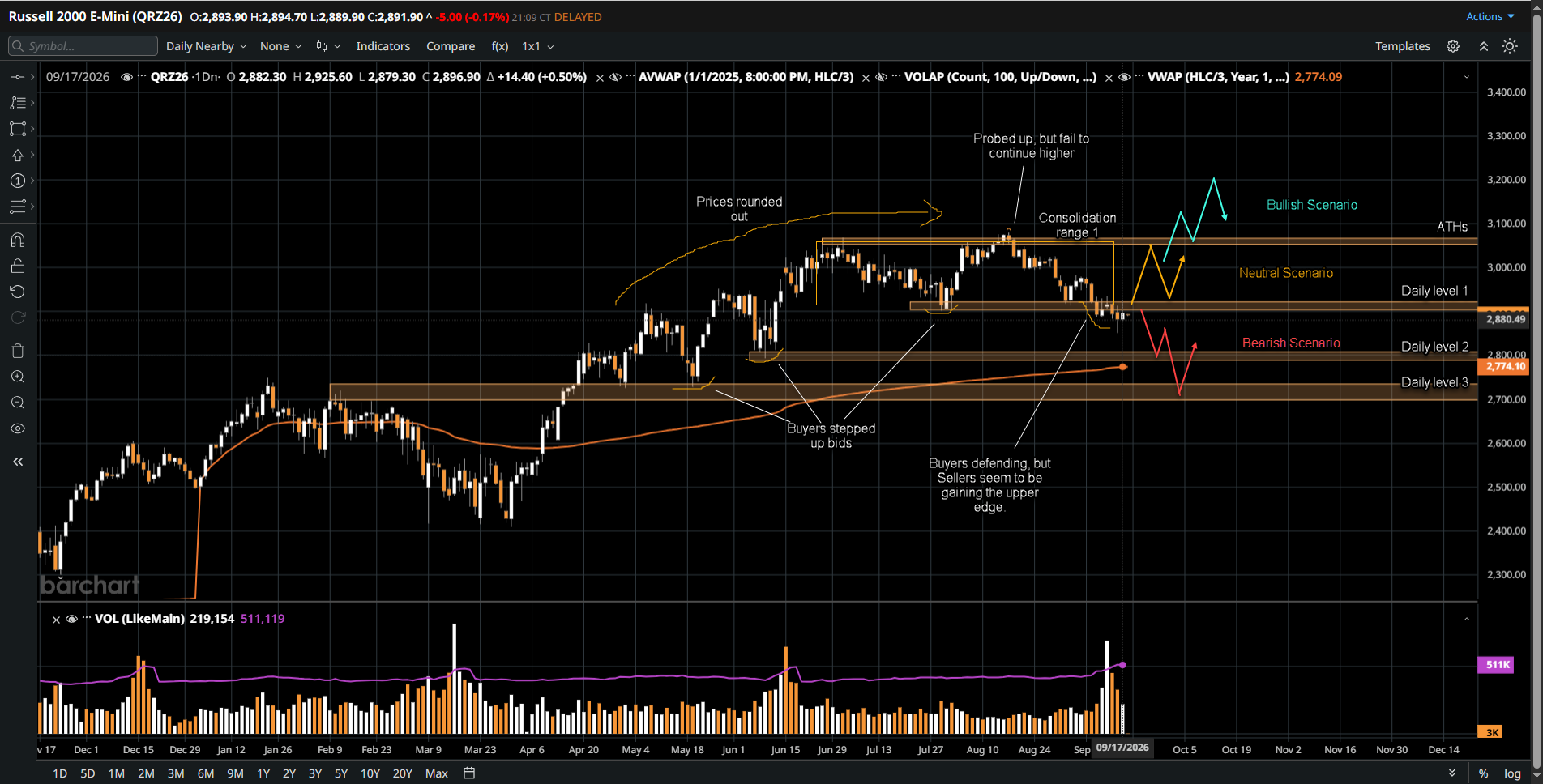
The key level to watch is 2892 (Daily level 1).
Neutral Scenario
- If buyers are able to reclaim back above 2892, expect rotation back up through consolidation range 1, toward the 3062 area (ATHs), where sellers are likely to respond and produce a two-way auction.
- A possible supporting condition for this scenario is a moderation in oil prices alongside incoming Fed commentary that leans more data dependent rather than committing to a follow up hike in October.
Bearish Scenario
- If buyers are not able to reclaim prices back above 2892 quickly, expect a further move down to the 2800 area (Daily level 2), and possibly toward 2735 (Daily level 3).
- A possible trigger for this scenario is renewed escalation in Houthi or Iran linked attacks on Saudi energy infrastructure, sending oil sharply higher and reinforcing a hawkish Fed path alongside a 10 year yield that extends further above 5%.
Bullish Scenario
- If buyers are able to accept above the 3062 area (ATHs), expect a move to make new all-time highs, extending toward 3200.
- A possible trigger for this scenario is Saudi Aramco completing repairs to the East-West pipeline faster than the current timeline suggests, easing oil driven inflation pressure and giving the Fed more room to pause rate hikes in October.
Conclusion
Technically, RTY sits at a genuine inflection point, with the 2892 pivot separating a return toward the range highs from a deeper slide toward the 2800 and 2735 support levels. Fundamentally, that technical battle is being shaped by a Fed that just resumed hiking for the first time in three years and an energy market on edge as conflict in the Gulf threatens Saudi Arabia's export capacity. With both the October Fed decision and the pace of Middle East developments still unresolved, watch how price behaves around 2892 in the sessions ahead, since the reaction there may say as much about market expectations for rates and oil as it does about small caps themselves.
We provide the infrastructure you need to quantify your discipline and ensure every decision is backed by the confidence of seeing exactly what drives your performance. Start trading with the clarity you deserve. Open an Account today.
Disclaimer:
This article is provided for informational and educational purposes only and does not constitute financial, investment, or trading advice. The analysis presented reflects the author’s market observations and opinions at the time of writing and is not a recommendation to buy or sell any futures contract, security, or financial instrument. Futures trading involves significant risk and is not suitable for all market participants. Losses may exceed initial margin deposits, and market conditions can change rapidly.
Any scenarios, levels, or market expectations discussed are hypothetical in nature and are intended solely to illustrate potential market behavior. They do not represent actual trading results and should not be interpreted as guarantees of future performance. Past performance, market behavior, or historical price action are not indicative of future outcomes.
Readers are solely responsible for their own trading decisions and risk management. Always conduct independent research, consider your financial situation and risk tolerance, and consult with a qualified financial professional, if necessary, before engaging in futures or derivatives trading.