


Will Funding Pressure Change PPL's (PPL) Narrative
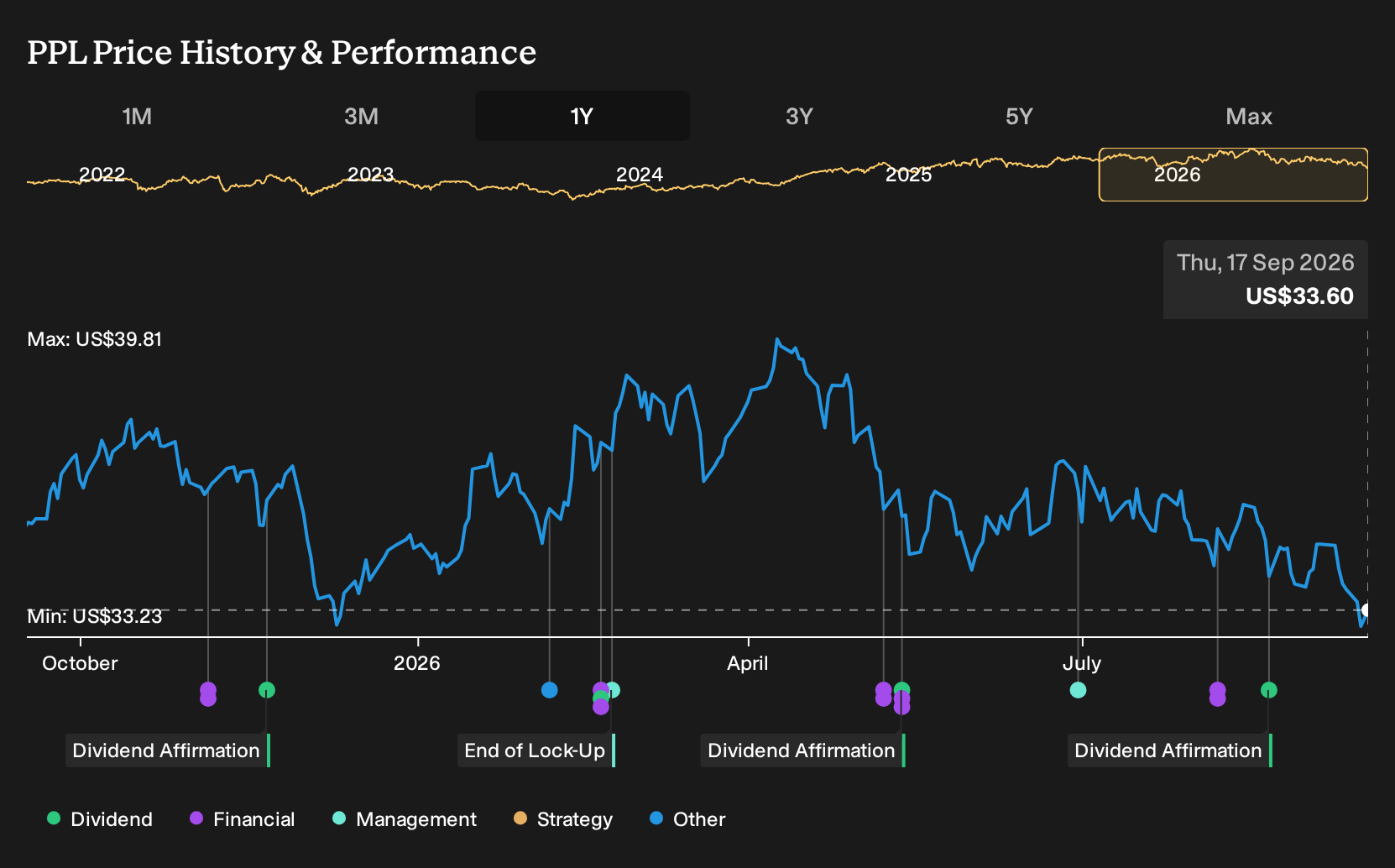
- PPL has faced company specific financial pressures, with higher operating costs and large capital investment needs weighing on its recent performance.
- The combination of these cost and funding demands, along with higher Treasury yields, has sharpened investor focus on PPL's balance between growth spending and financing risk.
- We will now look at how PPL's investment narrative is shaped by these rising costs and the capital intensive conditions in the utility sector.
Compare how PPL's funding pressures stack up against peers by scanning a curated group of utilities and infrastructure players in our 37 power grid technology and infrastructure stocks.
PPL Investment Narrative Recap
To own PPL, you need to believe the heavy US$20b grid and generation build program through 2028 can translate into steady, regulated earnings from rising demand in Pennsylvania, Kentucky and Rhode Island. The recent share price weakness tied to higher Treasury yields does not change the core near term swing factor, which is timely cost recovery through rate cases.
The biggest operational risk right now is that higher operating expenses and interest costs outpace what regulators allow into customer bills, especially with interest payments already not well covered by earnings. If that pressure persists, the strain would sit more on free cash flow and on the sustainability of the current 3.39% dividend.
There have been no fresh company announcements tied directly to the latest share move. The most relevant context remains PPL's existing capital plan and regulatory framework. The utility is targeting roughly US$20b of investment through 2028 across transmission, distribution and new generation to serve growing loads, including data centers and economic development projects.
For you, the key question is whether that build out can stay on schedule and on budget while regulators in Pennsylvania and Kentucky allow reasonable returns and limit lag on cost recovery. Execution on grid upgrades, fuel mix decisions such as the Mill Creek 2 coal life extension, and any further deferral of storage or renewables will all influence future earnings quality and stranded asset risk.
PPL's current analyst scenario points to US$11.0b in revenue and US$1.9b in earnings by 2029. This outlook is built on an assumed 5.6% yearly revenue growth rate and an earnings increase of about US$700m from earnings today of roughly US$1.2b.
Uncover why PPL's fair value indicates a 23% potential upside to its current price, which may not last much longer.
Exploring Other Perspectives
Two fair value views from the Simply Wall St Community span roughly US$19.87 to US$41.20 per share, which shows how far apart private investors can land on PPL. Those forecasts pre date the latest utility sector pressures, so be sure to consider regulatory risk, cost inflation and data center demand uncertainty when you compare these alternative perspectives.
Explore another PPL fair value estimate, including one that suggests as much as 23% upside from the current price.
Reach Your Own Conclusion
Don't just follow the ticker. Dig into the data and build a conviction that's truly your own.
- A great starting point for your PPL research is our analysis highlighting 3 key rewards and 2 important warning signs that could impact your investment decision.
- See our latest analysis for PPL. The report includes a comprehensive fundamental analysis summarized in a single visual, the Snowflake, making it easy to evaluate PPL's overall financial health at a glance.
Looking for more ideas beyond PPL?
If you want to stress test your PPL thesis against what else is out there, broaden your watchlist with a few focused stock shortlists built from the Simply Wall St Screener.
- For investors who want quality at a discount, start with 29 high quality undervalued stocks that combine stronger fundamentals with prices that sit below many fair value estimates.
- If capital preservation matters most to you, prioritise 30 resilient stocks with low risk scores that pair resilient balance sheets with calmer risk profiles.
- When you are hunting for under the radar potential, scan 16 high quality undiscovered gems that show robust financial traits but limited current attention from the wider market.
This article by Simply Wall St is general in nature. We provide commentary based on historical data and analyst forecasts only using an unbiased methodology and our articles are not intended to be financial advice. It does not constitute a recommendation to buy or sell any stock, and does not take account of your objectives, or your financial situation. We aim to bring you long-term focused analysis driven by fundamental data. Note that our analysis may not factor in the latest price-sensitive company announcements or qualitative material. Simply Wall St has no position in any stocks mentioned.
Have feedback on this article? Concerned about the content? Get in touch with us directly. Alternatively, email editorial-team@simplywallst.com