


How Investors Are Reacting To Kadant Stock CEO Transition
- Kadant announced a detailed leadership succession plan, with Michael C. Colwell set to become president, CEO and director, while current CEO Jeffrey L. Powell moves to executive chairman and remains involved in strategy, acquisitions and governance through his expected transition to a non executive board role in 2028.
- The board paired this management overhaul with a reaffirmed quarterly cash dividend of $0.36 per share, indicating that the company plans to continue returning cash to shareholders while preserving continuity in long term decision making through Powell’s extended advisory role.
- The focus now turns to how Kadant’s investment narrative could be reshaped by this CEO transition and extended executive chairman involvement.
Scan how Kadant’s planned CEO handover and dividend decision compare with peers by jumping across to a curated list of list of solid balance sheet and fundamentals (23 results) that investors are watching around leadership shifts.
What Is Kadant's Investment Narrative?
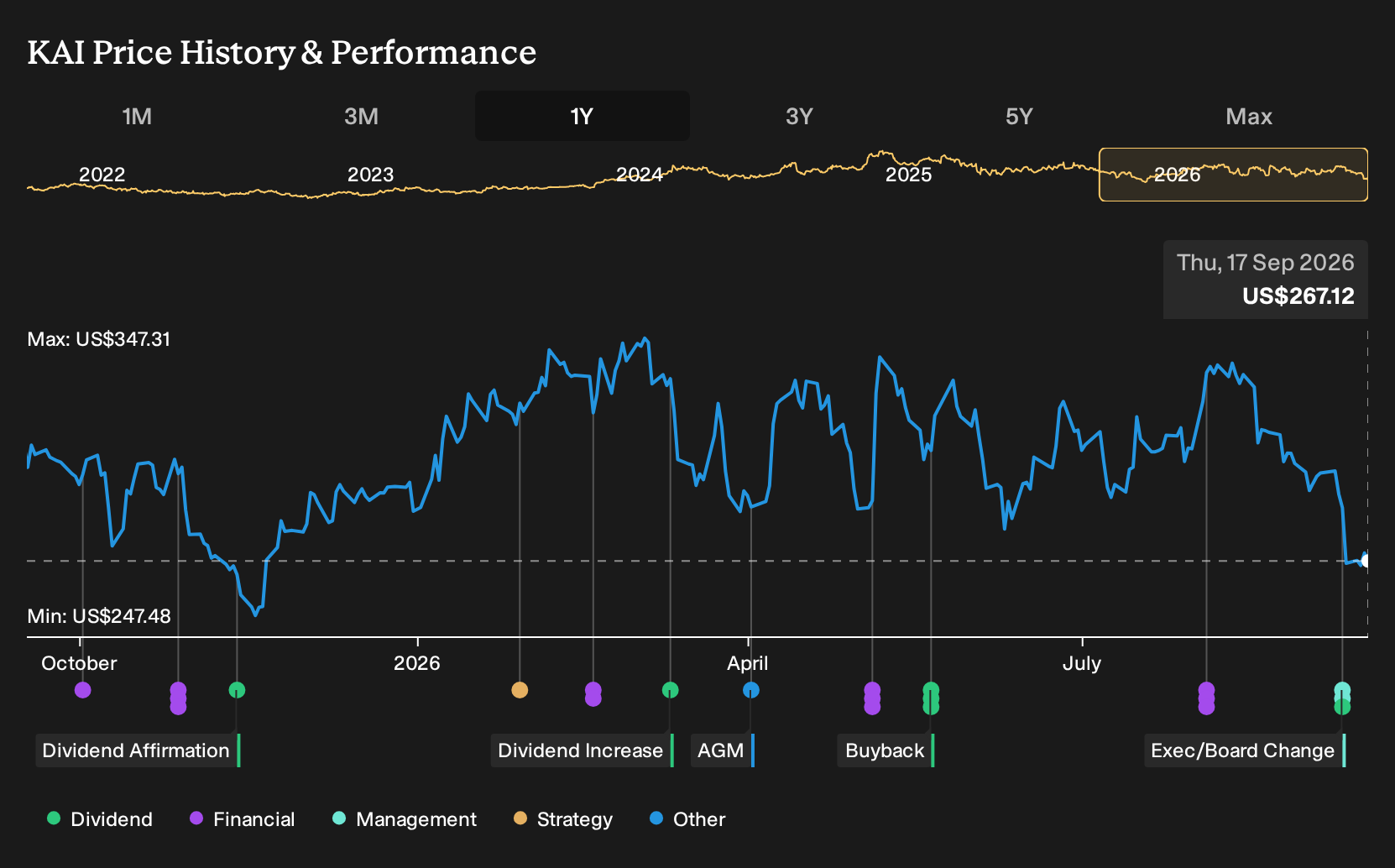
Kadant’s story is about steady industrial plumbing. You have an engineered equipment supplier spread across flow control, industrial processing and material handling, serving pulp, wood products and recycling customers that care a lot about uptime and efficiency. That puts the focus on execution, backlog quality, pricing discipline and how capital hungry these projects are. Recent share performance has been weak over 1, 3 and 12 months, even as analysts still see upside and earnings forecasts point higher, which already suggests that expectations and reality have been rubbing against each other.
The CEO succession and dividend decision sit right in the middle of that tension. Colwell is not an outsider; he has been running the Industrial Processing segment and previously led the Carmanah business, so operational continuity looks intact. Powell staying on as executive chairman through 2027, and as non executive chair to 2028, softens succession risk and helps keep acquisition decisions anchored in existing playbooks. The reaffirmed US$0.36 dividend suggests the board is comfortable balancing cash returns with reinvestment needs. The near term catalysts still hinge on how Kadant converts that experienced bench into cleaner execution and more consistent margins on a roughly US$1.2b revenue base, alongside a share price that currently trades on a premium P/E multiple.
Yet under that relatively tidy succession story, there is a more awkward pressure point that could still unsettle the Kadant thesis if ...
There's only one way to know the right time to buy, sell or hold Kadant. Head to Simply Wall St's company report for the latest analysis of Kadant's Fair Value.
Exploring Other Perspectives
One alternate view on Kadant leans hard into pulp and paper risk. The most pessimistic analysts were still penciling in revenue of about US$1.4b and earnings near US$183.6m by 2029, yet they saw that as only just good enough. You could read the new CEO plan and dividend as catalysts that may reshape those expectations.
The Verdict Is Yours
Don't just follow the ticker. Dig into the data and build a conviction that's truly your own.
- A great starting point for your Kadant research is our analysis highlighting 4 key rewards that could impact your investment decision.
- See our latest analysis for Kadant. The report includes a comprehensive fundamental analysis summarized in a single visual, the Snowflake, making it easy to evaluate Kadant's overall financial health at a glance.
Looking For More Investment Ideas Beyond Kadant?
If you want to stress test your thesis on Kadant, it helps to compare it with a broader bench of businesses filtered by quality, value and income characteristics. The Simply Wall St Screener can surface very different profiles in a few clicks so you can see where Kadant fits in your wider watchlist.
- For investors hunting for mispriced quality, start by sizing Kadant up against a wider field using a curated set of 29 high quality undervalued stocks that combine strong fundamentals with more modest expectations baked into prices.
- If capital preservation and balance sheet resilience matter most to you, set Kadant alongside a 30 resilient stocks with low risk scores to see how its risk profile compares with companies that screen well on financial strength.
- Those seeking earlier stage opportunities can contrast Kadant’s profile with a 7 elite penny stocks with strong financials that pair smaller market values with more speculative growth stories.
This article by Simply Wall St is general in nature. We provide commentary based on historical data and analyst forecasts only using an unbiased methodology and our articles are not intended to be financial advice. It does not constitute a recommendation to buy or sell any stock, and does not take account of your objectives, or your financial situation. We aim to bring you long-term focused analysis driven by fundamental data. Note that our analysis may not factor in the latest price-sensitive company announcements or qualitative material. Simply Wall St has no position in any stocks mentioned.
Have feedback on this article? Concerned about the content? Get in touch with us directly. Alternatively, email editorial-team@simplywallst.com