


Bearish to 159! Wall Street strategists collectively bet on the weakening of the yen before the Bank of Japan's decision on Friday
The Zhitong Finance App learned that strategists, including Wells Fargo and Citigroup, expect the yen to weaken. They expect the Bank of Japan to disappoint investors with a hawkish attitude that falls short of market expectations after Friday's meeting.
The strategists are bearish on the yen. Among them, Citi believes that the yen may fall to 159 against the US dollar in the next few weeks. As of press release, the trend of the yen was basically flat against the US dollar, which was reported at 156.02.
Swap traders have almost completely absorbed expectations that the Bank of Japan will raise interest rates by 25 basis points on Friday. Currently, the market's focus is more on Bank of Japan Governor Ueda Kazuo's statement after the resolution, with a view to finding clues about the central bank's follow-up policy path. The market is expected to raise interest rates even more before the end of the year.
Wells Fargo strategist Kidu Narayanan wrote in a report on Thursday, “The Bank of Japan has a very high threshold for meeting these market expectations, and it is even more difficult to exceed expectations.” “Risk is biased towards results that are more dovish than market pricing.”
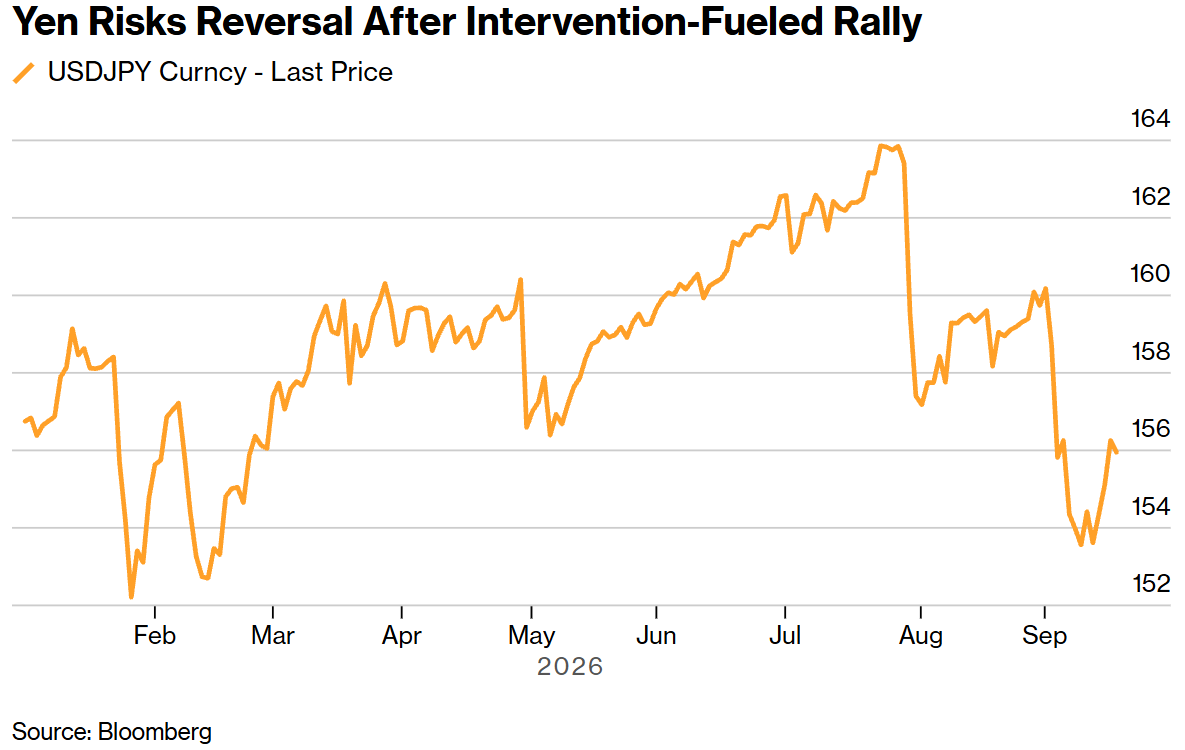
The yen faces the risk of a reversal after rebounding fueled by intervention
Earlier, the yen had weakened after the Federal Reserve raised interest rates for the first time in three years on Wednesday, and Chairman Walsh hinted that the central bank would continue to raise interest rates in the process of fighting inflation.
This reversal of the yen came after a sharp rise at the beginning of this month. At that time, the yen rose to its strongest level since mid-February, and broke through the high point set in late July after a rare joint intervention between the US and Japan to buy yen. The yen has continued to be under pressure in recent years, mainly due to huge interest spreads with other major economies.
Citibank strategist Daniel Torben said in Thursday's report that although if the Bank of Japan fails to meet market expectations and the yen faces downside risks in the short term, he believes that recent policy trends are part of a broader “paradigm shift” that may drive the yen stronger in the long run.
“Our real major concerns about the yen are slowly shifting in the right direction,” Torben said.
Chris Turner, head of foreign exchange strategy at Dutch International Group G10, predicts that if the Bank of Japan fails to release more interest rate hikes, the yen will fall to the level of 157 or 158.
On the other hand, Georgette Boehler, a senior foreign exchange strategist at ABN AMRO, expects the yen to strengthen in the second half of 2027, when she expects the Federal Reserve and the European Central Bank to cut interest rates. However, looking at it now, she expects the yen to hover around 154 against the US dollar until the first quarter of 2027.
She said, “We expect higher energy prices to temporarily interrupt the recovery of the yen.”