


Oracle Stock What Changed After AI Cloud Wins
- Oracle is reshaping its business around AI infrastructure, signing more than $30b in new AI cloud contracts while expanding its 2026 restructuring plan to about $2.8b and cutting roughly 21,000 roles to fund heavy data center buildout.
- The stock is now closely tied to OpenAI, as positive funding news for this key customer supports investor interest in Oracle's large AI backlog and multiyear cloud commitments.
- Next, the focus shifts to how Oracle's AI heavy restructuring and contract wins could alter the longer term investment narrative.
Scan how Oracle's AI buildout compares with other infrastructure heavy plays by running your eye over 60 AI infrastructure stocks while this spending cycle is still reshaping the sector.
Oracle Investment Narrative Recap
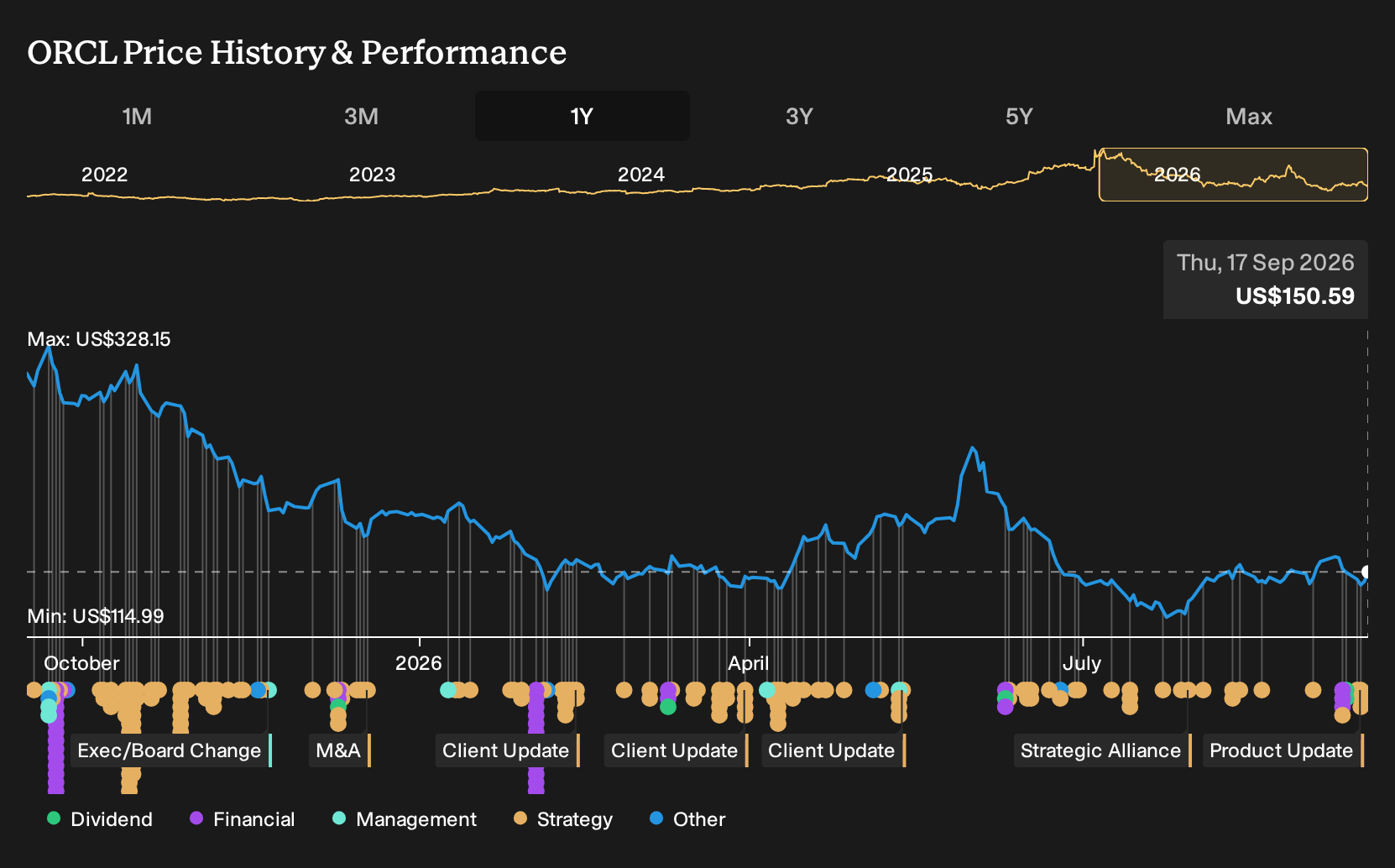
To own Oracle today, you need to believe its huge AI cloud backlog, including the $664b in remaining performance obligations, will convert into healthy, usable revenue without overwhelming the balance sheet. In the short term, the key swing factor is execution on the AI data center buildout and contracts, not the daily share price moves that have left the stock down year to date.
The biggest current risk is overbuilding capacity or leaning too hard on a small set of AI customers while carrying high debt and heavy CapEx. Recent clarifications around Project Jupiter and the separate microgrid indicate that the data center construction path in New Mexico still looks intact. As a result, the headline noise here does not appear to materially change that core risk reward debate.
The most relevant new data point is Oracle’s clarification that Project Jupiter can keep moving ahead under county permits while the adjacent microgrid goes through a stayed air quality review. For anyone watching the AI infrastructure story, the key question is whether regulatory friction could slow the rollout of facilities needed to service that AI backlog.
On the numbers side, Oracle is guiding to at least $90b in revenue for fiscal 2027 and reported first quarter sales of $19.3b with net income of $4.8b. Those figures sit alongside planned fiscal 2027 CapEx of roughly $90b to $95b. Your assessment as an investor is whether moves like Project Jupiter allow Oracle to turn that spend into dependable cloud and AI earnings without stretching its balance sheet too far.
Oracle Earnings And Revenue Assumptions
Oracle's narrative projects US$182.2b revenue and US$42.3b earnings by 2029. That outlook assumes 39.3% yearly revenue growth and an earnings increase of about 2.5x from US$17.0b today.
Uncover why Oracle's fair value indicates a 61% potential upside to its current price, a gap that could narrow quickly once AI contracts mature.
Exploring Other Perspectives
Some of the most optimistic Oracle analysts focus on AI inferencing as a potential upside swing factor, arguing that secure vectorized data and multi cloud access could justify revenue of about US$196.6b and earnings near US$46.5b by 2029. That is far above consensus, and Project Jupiter’s progress may push those narratives to evolve.
Explore 20 other Oracle fair value estimates, including one that suggests as much as 159% upside from the current price.
Decide For Yourself
Disagree with existing narratives? Extraordinary investment returns rarely come from following the herd, so consider trusting your own analysis.
- A great starting point for your Oracle research is our analysis highlighting 4 key rewards and 2 important warning signs that could impact your investment decision.
- See our latest analysis for Oracle. The report includes a comprehensive fundamental analysis summarized in a single visual, the Snowflake, making it easy to evaluate Oracle's overall financial health at a glance.
Looking For More Ideas Beyond Oracle?
If Oracle's AI heavy story has you thinking about portfolio balance, it can help to line it up against other businesses with different risk and income profiles. The Simply Wall St Screener gives you a quick way to scan for stocks that match the kind of financial traits you want to own next.
- For investors who want potential mispricings backed by solid fundamentals, consider reviewing 29 high quality undervalued stocks that may merit a closer look.
- If reliable income matters to you, focus on companies built around steady cash returns by checking out 6 dividend fortresses that offer higher yields.
- Readers who care most about capital preservation and steadier ride profiles can start with 11 resilient stocks with low risk scores that screen well on Simply Wall St's risk metrics.
This article by Simply Wall St is general in nature. We provide commentary based on historical data and analyst forecasts only using an unbiased methodology and our articles are not intended to be financial advice. It does not constitute a recommendation to buy or sell any stock, and does not take account of your objectives, or your financial situation. We aim to bring you long-term focused analysis driven by fundamental data. Note that our analysis may not factor in the latest price-sensitive company announcements or qualitative material. Simply Wall St has no position in any stocks mentioned.
Have feedback on this article? Concerned about the content? Get in touch with us directly. Alternatively, email editorial-team@simplywallst.com